

Ikigai (生き甲斐 or 生きがい, いきがい) is a Japanese word for what gives your life value and makes you want to keep living. It can have to do with work, but also with relationships, hobbies, family, helping your community, or a simple activity that gives your days a shape.
It is usually translated as "reason for living" or "life purpose". Neither expression explains the concept completely. In Japan, ikigai does not have to be big or profitable, and it is rarely found all at once. It can change with your age, your responsibilities and the people in your life.
The well-known four-circle diagram is a tool for thinking about the subject, not the actual definition. This article covers what ikigai means, where the word comes from, what research says about it, and how you can move closer to your own sense of purpose step by step.
Contents 14
The meaning of ikigai
The word is written with the characters 生き甲斐. Iki (生き) means "life", and gai (甲斐) means "worth", "value" or "something that pays off". The spelling 生きがい in hiragana is common in everyday writing. Ikigai, then, is what makes life worth living.
Understanding ikigai as a career question alone makes the word too small. Some people find it in their profession, others in teaching, cooking for their family, gardening, sport, a craft or a long friendship. What matters is the relationship a person builds with the activity.
Ikigai includes the feeling that life has value and that there is something worth getting up for. The word does not promise permanent happiness or a solution to every problem. Purpose and exhaustion can exist side by side, and periods of readjustment are part of the process.
If you are interested in Japanese words for feelings and behavior, you will find more examples in the article on Japanese words that describe Japan and its culture.
Origin and history of ikigai
Japanese literature mentions the word as early as the 14th century, in the war chronicle Taiheiki. For a long time ikigai was tied to social roles and obligations. In the decades after the Second World War, with the economic miracle and rising life expectancy, ikigai returned to public debate, and from the 1960s on the boom in books and magazines about the subject began.
The psychiatrist Mieko Kamiya helped popularize the term with her 1966 book On the Meaning of Life (生きがいについて). She worked with leprosy patients at the Nagashima Aiseien sanatorium and wrote about how a sense of purpose helps people endure difficult conditions.
The character 甲 originally meant a shell or carapace, and 斐 meant a beautiful pattern. Together they form 甲斐, with the meaning "worth" or "value". Related words are yarigai (やり甲斐), the value of doing something, and hatarakigai (働き甲斐), the value of work.
The four-circle diagram
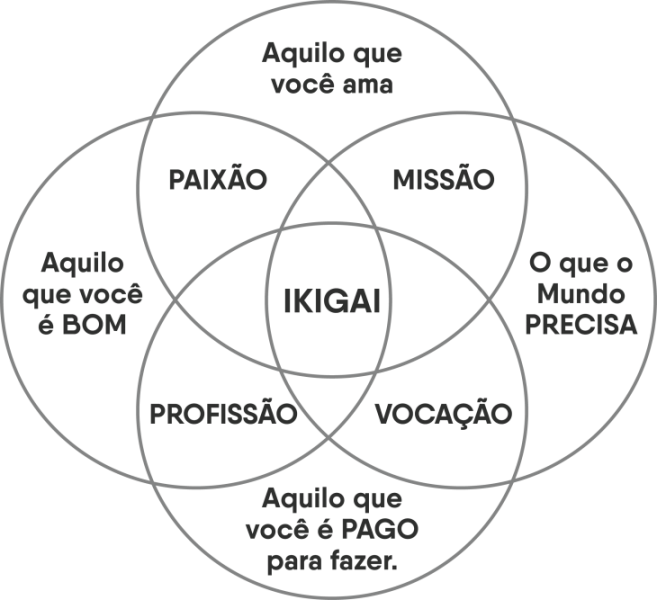
The most widely shared image of ikigai outside Japan is a diagram of four overlapping circles, with four questions: What do you love? What are you good at? What does the world need? What can you be paid for? The intersections are labeled passion, profession, vocation and mission. Ikigai sits in the middle.
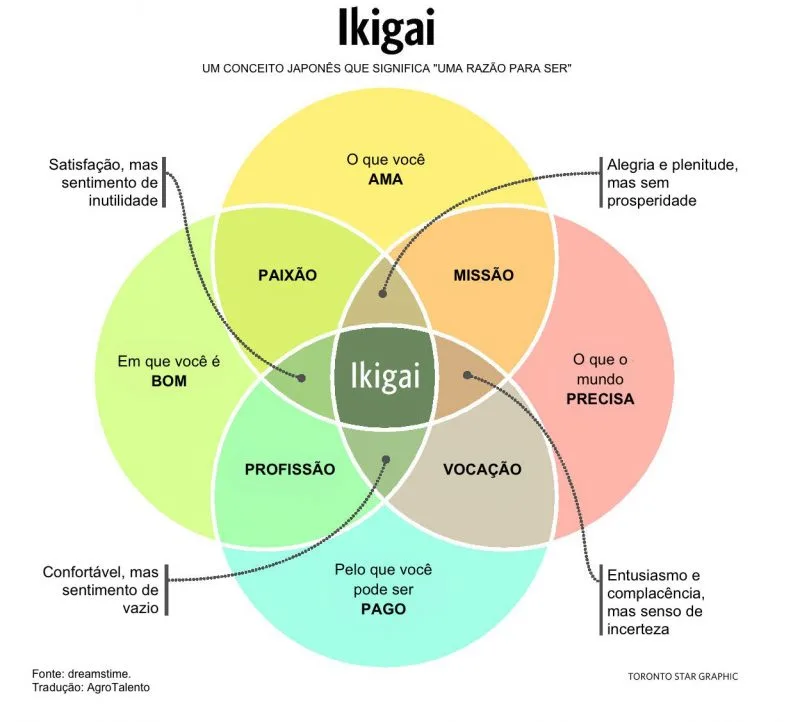
As convincing as the diagram looks, it does not come from Japan. It was created by the American entrepreneur Marc Winn, inspired by an earlier "purpose" diagram by Andrés Zuzunaga, and it spread around the world through the book by Héctor García and Francesc Miralles. Some critics call it an unrealistic ideal, catchy but misleading.
During the research for this article I did not understand the diagram right away, and in Japan ikigai is also seen as a slow, personal process. The model is a worksheet for career and life planning, not the original definition of the word.
An answer does not need to hit all four circles at once to say something about you. If an activity brings in no money or has no obvious benefit for others, it can still be valuable. The diagram is a thinking aid, not a measure of the worth of a life.
Ikigai in psychology and coaching
For some people, ikigai sounds like esotericism or a fashion from the self-help shelf. The comparison with other Japanese ideas helps: as with the kaizen method, the point is small, repeated steps rather than one big move. In the West, the term appears mainly in coaching and psychology, when the subject is values, goals and orientation.
I have been to a psychologist and a psychoanalyst several times myself, and I still do not fully understand how those sessions work, even though I recognize their results. Many coaches use the ikigai idea because it helps people think more openly about work and personal life.
The important boundary: ikigai can offer orientation, but it does not replace medical or psychotherapeutic treatment. Mental and physical complaints belong in professional hands. Thinking about values and goals complements treatment and should not be asked to do more than that.
Before working on this article, I did not even know the word existed. While writing, I engaged with ikigai, and the basic idea stayed with me: that every person needs a reason for their days.
How to find your ikigai
No test provides a final answer. Instead of waiting for a decisive flash of insight, it helps to observe the activities that give your routine a foothold and to start with small experiments. Five suggestions from the study of ikigai:
- Break the routine. Getting out of autopilot and the same repetitive days is a beginning. Ask yourself whether this is really what you want to do every day, and take at least the first step toward your idea.
- Do not compare yourself with others. Focus on your own pace and on what matters to you, instead of the happiness that others supposedly have. I never stopped liking something because other people hated it, nor did I start liking something because everyone else did.
- Loving it is not enough. Liking an activity does not automatically make you good at it. Accept your limits, develop your abilities on purpose and keep trying.
- Passion and profession can meet. Many people believe it is impossible to earn money with something they love. Had I listened to the people around me and taken a normal job instead of building this website about things I enjoy, I would probably be unemployed today.
- Work is more than income. People who recognize their own value in what they do tend to be more motivated and satisfied. That applies to a profession and to anything else we do in life.
A simple exercise
Divide a sheet of paper into four fields: What do I love? What am I good at? What do I want to learn? What is useful to others? Mark the answers that appear in more than one field. Then choose two or three of them and turn them into a small experiment: a course, a conversation, a short project or a fixed hour every week.
After a few weeks, observe what has changed. Did the activity bring energy, contact, curiosity or a sense of progress? Write down what did not work as well. The insight that something does not fit is a result, not a failure.
Ikigai books worth reading
If you want to go deeper, two books stand out. The Little Book of Ikigai (2017) is by Ken Mogi, a Japanese scientist born in 1962 who works at Sony Computer Science Laboratories and teaches as a visiting professor at the University of Tokyo. He explains the concept from a Japanese perspective, with attention to small daily habits.
The other is Ikigai: The Japanese Secret to a Long and Happy Life by Héctor García and Francesc Miralles (2016), the international bestseller that brought the four-circle diagram to a wide audience. The two books complement each other: one approaches the subject through Japanese culture, the other through the practical, Western view that popularized the diagram.
Ikigai and Okinawa
Okinawa often appears in texts about ikigai because part of the population lives to a great age and the island is known for its village communities. That does not mean ikigai alone causes a long life. Diet, healthcare, social conditions, movement and genes also play a role.
Some habits of the people of Okinawa are mentioned again and again: hara hachibu (腹八分), the rule of finishing a meal with the stomach about 80 percent full; plenty of vegetables in great variety; sanpincha, a tea made of green tea and jasmine; the juice of the shikuwasa, a small citrus fruit; and goya, the bitter melon that appears on the table. Add regular, moderate movement and moai, fixed groups in which neighbors support one another.
Research offers clues, not a simple recipe. The Ohsaki Study followed 43,391 Japanese adults for seven years. Participants who reported no ikigai had a 1.5 times higher risk of dying from any cause during the period, with the strongest associations for cardiovascular disease and external causes. A 2025 study with 832 older adults in Kashiwa found that women with ikigai had a much lower risk of becoming frail over five years. Such numbers show connections and do not prove a causal effect.
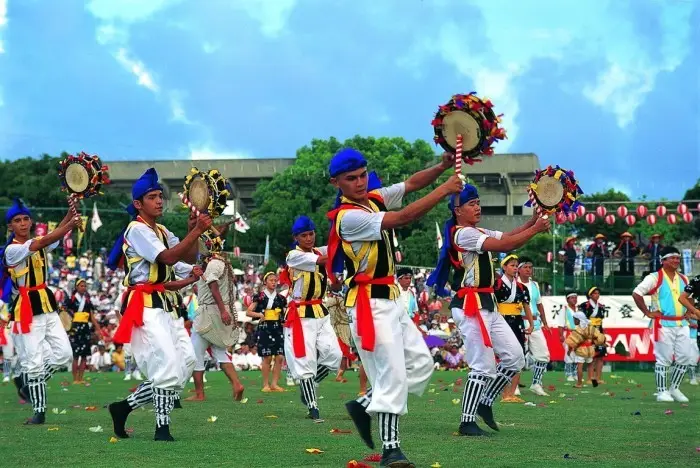
You can read more about the region and its history in the article on Okinawa, the multi-culture archipelago.
Quick questions and answers about ikigai
Some common questions about ikigai, answered briefly.
How do I find my ikigai?
Look inward: What do you do with such pleasure that you lose track of time? Which values do you carry with you? Which activity gives you the feeling that the day has meaning? Start with something simple and work your way toward bigger goals. A conversation or a small experiment often helps more than long brooding.
How do I build my ikigai?
To work out your own reason for living, answer the questions below and actually do what they ask:
- Why do you want to find your purpose?
- Have you made a list of what you like to do?
- Have you asked yourself what you are good at?
- What is most important to you?
- Are you making use of all your gifts?
- Have you stepped out of your comfort zone?
Is ikigai the same as a life purpose?
The two expressions are close, but not identical. "Life purpose" sounds like a large mission. Ikigai can also be a small, concrete reason that gives value to everyday life.
Can I have more than one ikigai?
Yes. A person can have several sources of meaning, and they may change over time. What matters more than a final answer is knowing what sustains you at this stage of life.
Ikigai as a daily practice
Whoever looks for their ikigai is looking for a direction that fits their own life. It becomes concrete in everyday examples: a relationship, a craft, a new skill, a contribution to others or an activity that gives the day a rhythm.
Take the four-circle diagram as an inspiration, try small things and check your answers from time to time. With each attempt it becomes clearer what stays and what gives you something on ordinary days as well.




Community
Comments
0 comments
There are no published comments in this language yet.
Send comment