
Everyone who studies Japanese knows the gap: the vocabulary is there, but in conversation the sentence that keeps things going is missing. This guide collects phrases that actually appear in daily talk, grouped by situation and with romanisation.
The forms are polite, which is the neutral choice with strangers and acquaintances. Once they are secure, the casual versions are easy to derive.
Contents 11
Starting and greeting
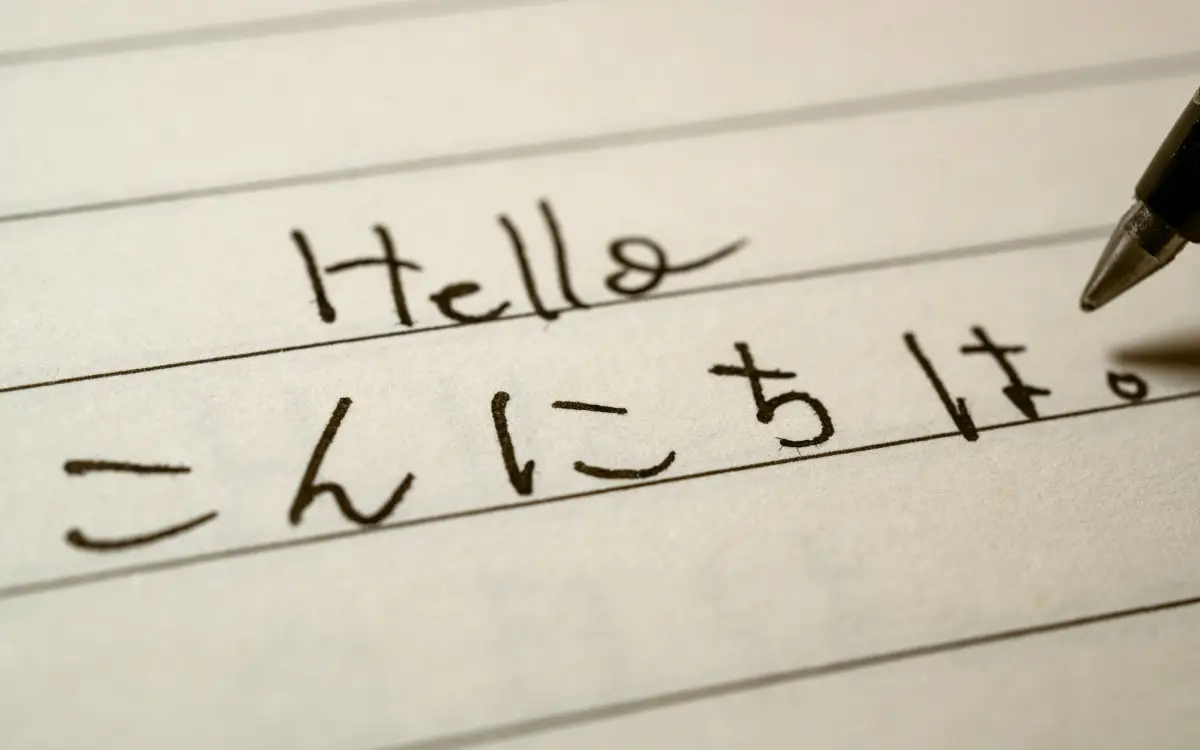
- こんにちは (konnichiwa) = Hello, good afternoon
- おはようございます (ohayou gozaimasu) = Good morning
- こんばんは (konbanwa) = Good evening
- はじめまして (hajimemashite) = Nice to meet you
- よろしくお願いします (yoroshiku onegaishimasu) = Please treat me well
The last one is formula and promise at once. It opens a contact, closes a request and appears at farewells, so it pays to learn it first.
Introducing yourself
- 私は[Name]です (watashi wa [Name] desu) = I am [Name]
- [Country]から来ました ([Country] kara kimashita) = I come from [Country]
- 日本語を勉強しています (nihongo wo benkyou shite imasu) = I am studying Japanese
- 学生です (gakusei desu) = I am a student
- お名前は何ですか (onamae wa nan desu ka) = What is your name
Replace the brackets with your own name or country. One sentence is enough to start; three look like a small introduction.
Asking when something is unclear
- もう一度お願いします (mou ichido onegaishimasu) = Once more, please
- ゆっくり話してください (yukkuri hanashite kudasai) = Please speak more slowly
- どういう意味ですか (dou iu imi desu ka) = What does that mean
- 日本語が少し分かります (nihongo ga sukoshi wakarimasu) = I understand a little Japanese
- 英語を話せますか (eigo wo hanasemasu ka) = Do you speak English
These five save more conversations than a hundred vocabulary words. Whoever can say them clearly ends up in silence less often.

Keeping the conversation going
- そうですね (sou desu ne) = That is so, isn't it
- なるほど (naruhodo) = I see
- 本当ですか (hontou desu ka) = Really
- そうなんですか (sou nan desu ka) = Oh, is that so
- 楽しそうですね (tanoshisou desu ne) = That sounds nice
- それで (sore de) = And then
Japanese conversation runs on short signals that you are listening. These words carry no content, yet they keep the talk open, like a nod.
Asking for directions
- [Place]はどこですか ([Place] wa doko desu ka) = Where is [Place]
- 駅までどう行きますか (eki made dou ikimasu ka) = How do I get to the station
- まっすぐ行ってください (massugu itte kudasai) = Please go straight
- ここで止めてください (koko de tomete kudasai) = Please stop here
In a restaurant and a shop
- これをお願いします (kore wo onegaishimasu) = This one, please
- おすすめは何ですか (osusume wa nan desu ka) = What do you recommend
- お会計をお願いします (okaikei wo onegaishimasu) = The bill, please
- カードは使えますか (kaado wa tsukaemasu ka) = Can I pay by card
- とてもおいしいです (totemo oishii desu) = It is very tasty
Asking for help
- すみません (sumimasen) = Excuse me, sorry
- 手伝っていただけますか (tetsudatte itadakemasu ka) = Could you help me
- 大丈夫です (daijoubu desu) = It is fine
- 気をつけてください (ki wo tsukete kudasai) = Please take care
すみません is the all rounder: it opens a conversation, apologises, calls a waiter and introduces a request. Few words are used so often.
Turning these sentences into your own
All the forms follow one pattern: the verb comes last. Once the structure is clear, swap one word and you have a new sentence: subject, place, object, then the verb with its ending.
The polite ending in -masu is the safest choice at the start. Friends use shorter forms, but the polite one is never misunderstood.
Three mistakes everyone makes
First, translating word by word. Japanese sentences run backwards, with the important part last. Second, speaking too loudly and too directly: tone and context carry more than volume.
Third, waiting for a perfect answer. In conversation a short そうですね helps more than a long flawless sentence.
Practising without a partner
One sentence a day, spoken aloud and in full, with a situation in mind. A sentence a day gives a small set of tools after three weeks, and those tools carry in daily life.
After that, repeat sentences from listening material, because melody and stress are part of politeness.
Where to go next
To work on pronunciation, the articles on romaji, on particles and on the difficulties of Japanese give the next steps.



Community
Comments
0 comments
There are no published comments in this language yet.
Send comment