
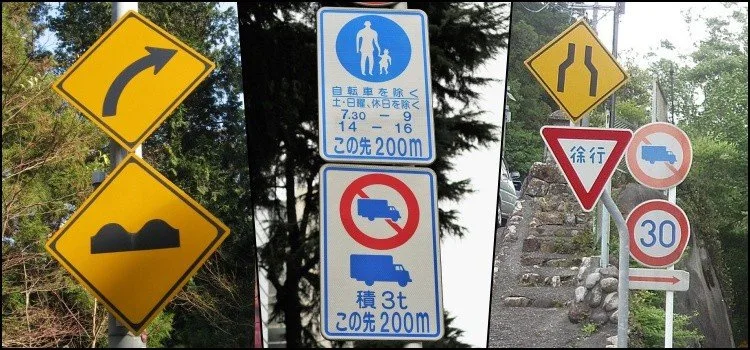
The Japanese stop sign is not an octagon. It is a red triangle pointing down, with 止まれ (tomare) painted across it — and, on plates installed since 2017, the English word STOP as well. If you are studying for the written test, renting a car, or already commuting, lock that shape first: the next inverted triangle you meet is not “yield.”
That next one is 徐行 (jokō). It looks close enough to a give-way sign that people treat it like one. You have to drop to a speed that lets you stop immediately if something appears — and that mismatch is the cleanest preview of how Japanese plates refuse to match the muscle memory you brought from home.
Contents 5
Japanese regulatory signs
The regulatory signs (規制標識 - kisei-hyōshiki) tell drivers and riders what is forbidden, required, or restricted on that stretch of road. Japan also paints a lot of the same information on the asphalt: speed limits, stop lines, and even 止まれ under your wheels. Cyclists and pedestrians have to obey the traffic laws too. The fine is not a tourist exception, and punishments stay strict enough that people actually stay in line.
I will walk the photo sheets and highlight the plates that actually trick people. The rest of the pictograms are obvious once you know the color code. Prohibition signs are round with white backgrounds, red borders, and blue pictograms. Mandatory instruction signs are round with blue backgrounds and white pictograms.
通行止め (301) — Road closed to all means nobody passes, not even on foot. A second plate closes the road to vehicles while pedestrians may still walk. The red disc with a white horizontal bar is no entry for vehicles coming the other way. Those three look related and are not the same rule: closed to everyone, closed to vehicles, and no entry from this direction.
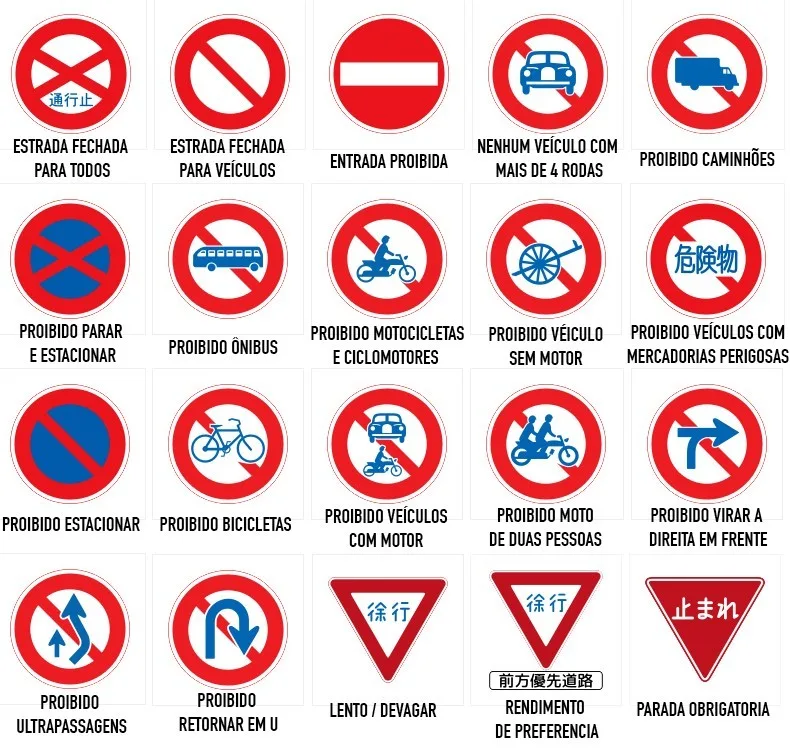
No-stopping and no-parking plates may carry numbers for the hours when the ban applies. On a no-parking stretch you may still stop briefly — about five minutes — if you stay in the car and are loading or unloading. A no-stopping plate with two red bars means you do not wait there at all.
Notice the two signs that say jokō (徐行), “slow.” The first tells you to drive at a speed that lets you stop at once if you need to. It is not yield. Give way, or priority, is a different plate, often stacked under or next to the main sign. The last triangle in that row is the famous tomare: a full stop, then go only when the way is clear.
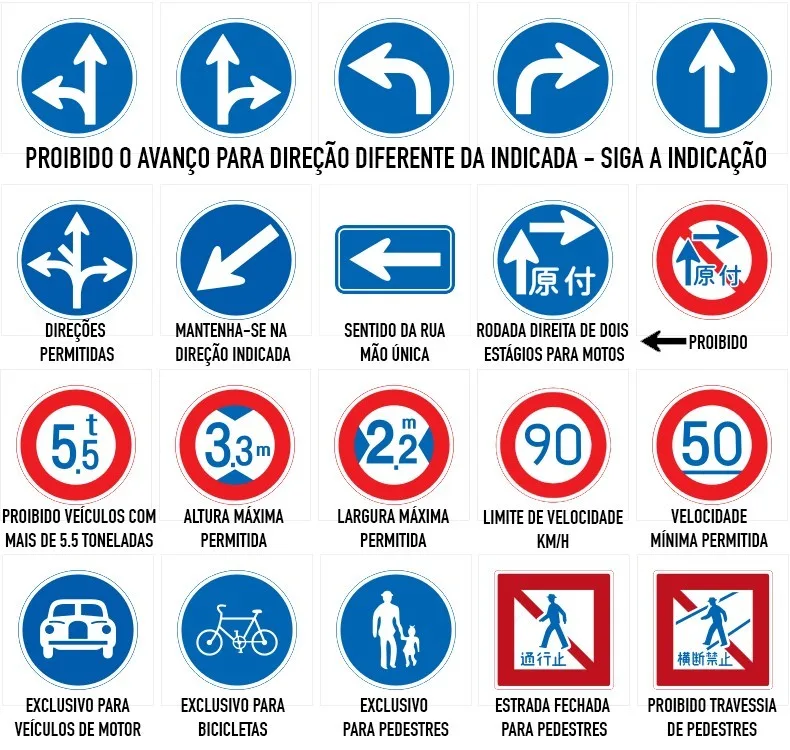
The blue discs with arrows usually show mandatory or permitted directions. Other blue rounds that look rare still mean something you should follow, not a suggestion.
Warning signs
Warning signs do not need much explanation. They alert you to something that is coming or that may happen on the road: odd curves, animals, falling rocks, wind. They mark dangerous conditions, obstacles, or restrictions on or beside the road, whether those conditions are permanent or temporary. You usually meet them 30 to 200 meters before the hazard, which is just enough time if you are already looking.
Japanese warning signs, or caution signs (警戒標識 - keikai-hyōshiki), share the same format: yellow and diamond-shaped. A few still deserve a second look. On several plates the animals or people face the opposite way from what you expect, because traffic here runs on the left side.
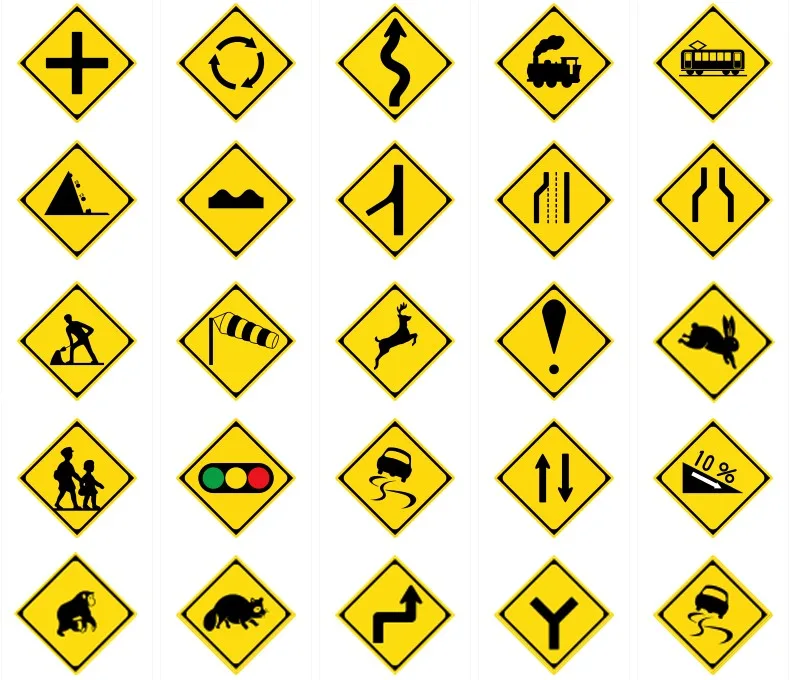
The exclamation mark covers other unspecified dangers. The extra plate underneath usually names the problem. Animal diamonds are specific: rabbits, monkeys, deer, and tanuki — raccoon dogs, not raccoons. The third sign in the second column flags dangerous wind gusts. The second sign in the first column is falling rocks. The last one marks a slippery surface.
The yellow diamond with a train is not decoration. At a railroad crossing you come to a full stop even if the barriers are up and no train is in sight, then you look both ways before crossing. That habit is part of the written test and of everyday driving outside the big cities.
Guide, instruction, and extra markings
Indication and instruction signs in Japanese are called shiji-hyōshiki (指示標識). They come in several shapes and are usually blue. Separate from those, guide signs (案内標識 - an'nai-hyōshiki) carry destinations and distances: dark blue on ordinary roads and national highways, dark green on expressways, often in Japanese and English together.
Different shields name the route. Ordinary routes usually wear a blue shield. Expressways wear a green one. Some pedestrian crossings also let cyclists ride across with walkers — look for the combined pedestrian-and-bicycle plate rather than guessing.
Other signs mark intersections, cities, neighborhoods, train stations, and even escalators.
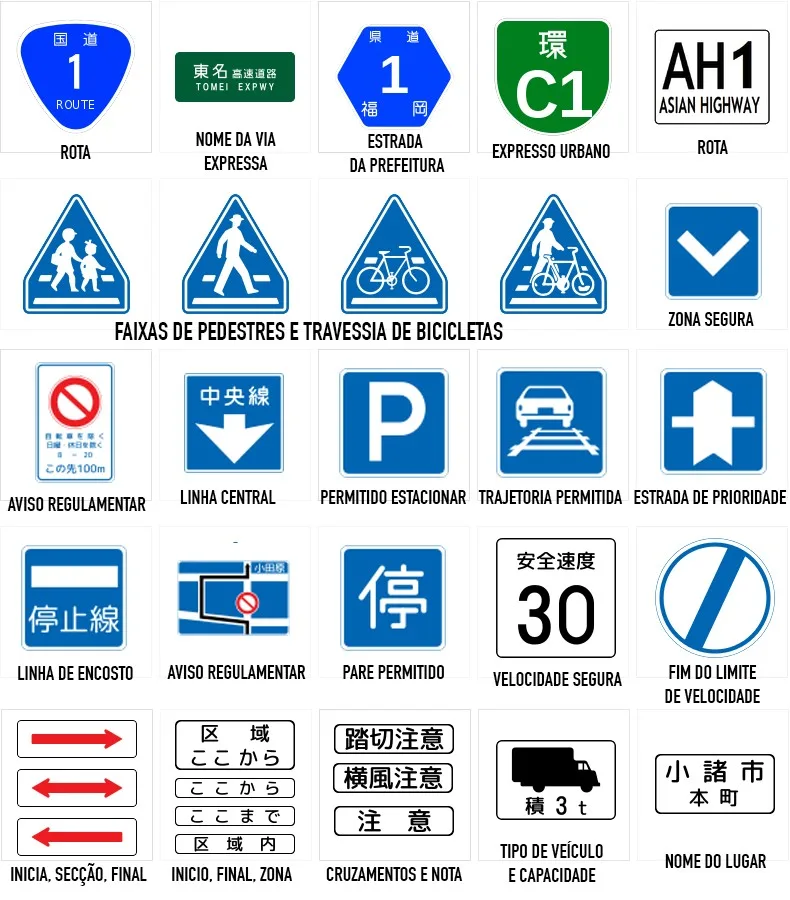
Auxiliary plates
Auxiliary plates (補助標識 - hojo-hyōshiki) hang under the main sign. They are rectangular and white, and they narrow the rule: hours, vehicle type, distance, start, end.
Pay attention to some words found on these plates:
- ここから — koko kara — from here
- ここまで — koko made — up to here
- 停 — the character for a stop (not the verb)
- 終点 — shūten — end point
- 始点 — shiten — starting point
- 注意 — chūi — caution, attention
- 入口 — iriguchi — entrance
- 出口 — deguchi — exit.
Remember to always drive on the left side of the road, whether you are on a bicycle or in a car. Pedestrians keep to the right, so watch that split when a sidewalk disappears. Japanese streets hide plates behind poles, utility boxes, and night glare — the sign that matters is often the one you almost missed.
Switching a foreign license in Japan
If you live in Japan, a short tourist permit is not enough. The usual path is gaimen kirikae: you apply at the Driver's License Center of your prefectural police, not at a private school desk. Your foreign license must still be valid, and you have to prove you stayed at least three months in the country that issued it after you got the card.
The Japan Automobile Federation (JAF) issues the official Japanese translation of a foreign license, which the center asks for with the rest of the paperwork. Some countries and regions skip the written and practical tests. Others, including many English-speaking ones, still take both. The written test leans hard on signs, so the plates above are not trivia — they are the exam.
If you only need to drive as a visitor, the rules change again: an International Driving Permit under the 1949 Geneva Convention, or, for a short list of countries, the national license plus a JAF translation. Vienna Convention permits are not accepted. After about a year from entry, residents are expected to switch. Check the local license center before you assume your home card still works.

Community
Comments
0 comments
There are no published comments in this language yet.
Send comment