
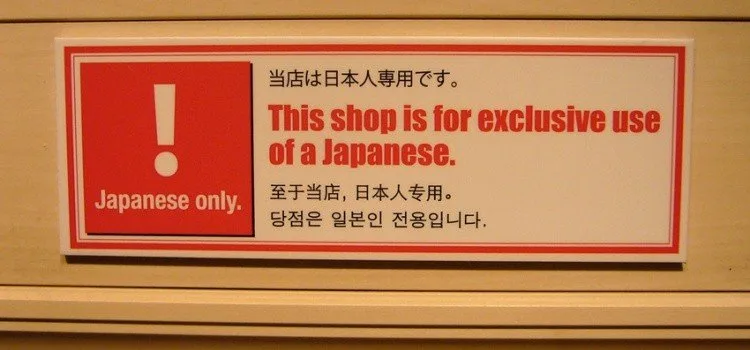
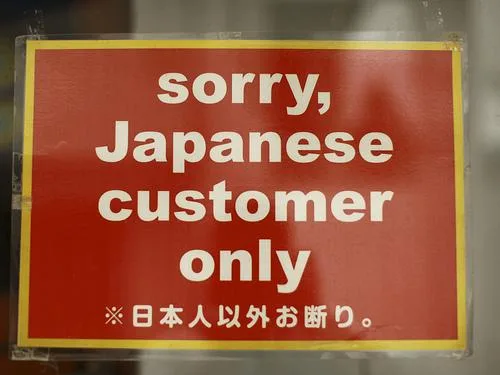
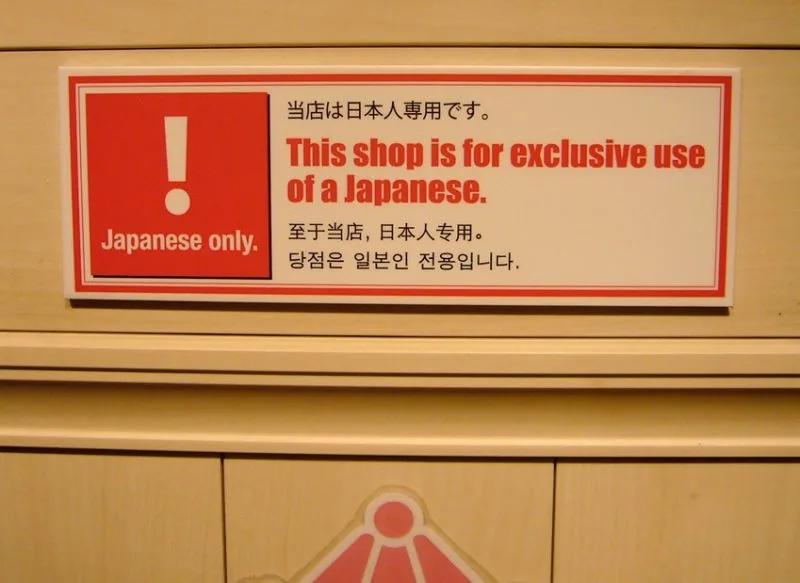
There are establishments in Japan where you will probably come across a sign that says: "Japanese Only" or something like that. Don't worry, it's something very, very rare, but if someone has seen it, it has already made its way onto the internet.
The sign is trying to keep foreigners out, or at least to make them hesitate. You hear all kinds of pretexts: language, trouble, "atmosphere." Some of that is real. Some of it is just prejudice. The mistake is treating every door as the same story.
It is worth clarifying that Japan is not the only place in the world with these signs. There is at least one such establishment in most countries. I have encountered establishments with truly racist signs allowing entry only for whites in countries like the USA.
Don't go judging Japan or the Japanese because of 1 establishment among millions. Calling the Japanese prejudiced because of a sign from a random place only makes you prejudiced.
Contents 5
Why do some places put up "Japanese Only"?
There are several factors. The staff may not be ready to serve customers in another language. The place may be tiny and already stretched. The service may be the kind that wants a closed circle. It could even be a shady business that prefers to stay off the radar.
The few places that tend to have these signs are often accompanied by a +18 sticker, which hints at a sex-industry shop. Many hostess bars and similar businesses simply do not accept foreigners. That is a house rule in a specific trade, not a map of Japan.
I think it is unlikely that the owner of a normal shop puts up this sign for a reason like "aah I don't like gaijin", because that would ruin their own profit and sales. We have entered very Japanese places like some pubs where the owners had never encountered a foreigner, did not speak any other language, and were very happy to meet us.
There are also places that prohibit people with tattoos. Those rules are common, especially in onsen and pools, because of the old link with the yakuza. That is not a Japanese Only sign, but it is another door that surprises visitors.
"Japanese Only" is not the same as Japanese language only
This is the part a photo usually erases. A notice that the staff can only speak Japanese is asking you to order in Japanese, or to try the next shop if you cannot. A Japanese speaker who is not Japanese can still sit down. A tourist with a translation app might still be waved in, or waved off, depending on how busy the kitchen is.
A sign that says Japanese Only, 日本人専用, or "we don't allow customers from overseas" is doing something else. It is sorting people by nationality, or by face. In 2023 an izakaya in Naha put both ideas on the same piece of paper: we only speak Japanese, therefore Japanese Only, no overseas customers. That is not a language note. That is a ban.
If you speak Japanese and the door still stays shut, you already have your answer. If the English is only about language, the honest test is whether a non-Japanese person who can order in Japanese gets a seat.
Are these signs legal?
Article 14 of Japan's Constitution says all of the people are equal under the law, and that there shall be no discrimination in political, economic or social relations because of race, creed, sex, social status or family origin. Japan also joined the UN convention against racial discrimination in 1995. What the country still does not have is a single civil or criminal statute that clearly bans a private shop from refusing a customer because of race or nationality.
The Constitution names equality. A shop door is not automatically a courtroom. That gap is why a Japanese Only sign can stay up for years, and why the rare case that does go to court still matters.
The case people still point to is Yunohana Onsen in Otaru, Hokkaido. The bathhouse put up a Japanese Only sign, first against Russian sailors, then against anyone who did not look Japanese. A naturalized Japanese citizen was still refused. On 11 November 2002 the Sapporo District Court ordered the bathhouse to pay ¥1 million to each of three plaintiffs. The court called the blanket refusal racial discrimination that went beyond socially acceptable limits. The city of Otaru was not held responsible. A higher court later kept the damages against the bathhouse.
So the short version is uncomfortable: the signs sit in a gray zone. Courts have said a race-based refusal can be illegal as a civil wrong. There is still no simple nationwide fine that takes the sticker down the next morning.
Is there prejudice in these signs?
There is no denying that there is an anti-foreign mentality in parts of Japan, but this is not without a story. Foreigners do not always maintain a good reputation. Although it is something done by a handful of fools, we all know that the collective pays for what some individuals do. That is the logic of meiwaku gaikokujin, the "troublesome foreigner" who becomes a template.
Since foreigners stand out so much in Japan, a poorly behaved visitor can make all foreigners look bad. From time to time, a story like this appears in the Japanese media. There is still a certain tension, too, among some of the older generation who lived through the war and anyone who is not Japanese.
However, times have changed, and honestly, no one deserves to go through scorn or repression just because you, coincidentally, belong to the same group as those who harm others. If you are a good person, why suffer discrimination for being a foreigner? Why pay the price for what other people have done?
What to do in these cases?
Although it is difficult to find these types of establishments that prohibit the entry of non-Japanese, it is something that can be dealt with in a simple way. Go to another place. After all, you are not the one losing anything. In this case, they are the ones losing customers.
And generally, these places that have these signs do not have a very good reputation. They are places that even the Japanese themselves tend to avoid. Most of the time, the service of these types of businesses is not of good quality.
So, if you go to a restaurant, bar, or something like that and come across a sign prohibiting the entry of foreigners, simply head to another place. You will not be losing anything.
If you think that this business has offended you in some way, think carefully before trying to waste time reporting or lamenting about it on the internet. Such places are not exclusive to Japan; there are establishments like this in countries like Russia and South Korea. If the English on the door is only "we speak Japanese," that is a different conversation: try ordering in Japanese if you can, and if you cannot, the next shop will feed you.





Community
Comments
0 comments
There are no published comments in this language yet.
Send comment