
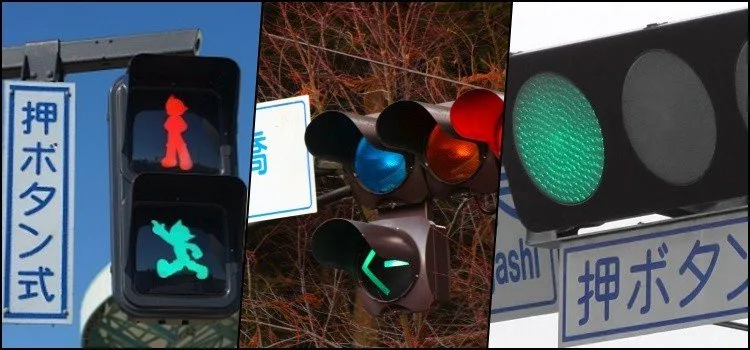
Stand at a Japanese intersection and the go light looks green. The person next to you still calls it aoi (青い) — blue. Green is midori (緑). Some of those lamps even lean turquoise, which is why aoi still sounds right on the street.
I've heard this argument for years: is Japanese green actually blue? The short version is that ao used to cover a much wider cool range than English “blue,” and the street kept the older name. The rest of the story sits in the old color adjectives, leftover 青 compounds, and a traffic law that followed what people already said.
Contents 3
Four color adjectives, then midori
English speakers grow up with red, yellow, and blue as a tidy set of primary colors. Older Japanese color talk was simpler than a crayon box. Four everyday i-adjectives covered a huge range of shades:
- Black — kuroi — 黒い — dark colors in general;
- White — shiroi — 白い — light colors in general;
- Red — akai — 赤い — bright, warm colors in general;
- Blue — aoi — 青い — cool, pale, living colors in general;
Those four are still the only common color words that behave as い-adjectives. Later colors, including yellow, are nouns:
- 黄色 — kiiro — yellow;
- 緑 — midori — green;
- ピンク — pinku — pink;
For a long stretch of Japanese, green lived inside ao. Seawater can look green up close and blue from farther away. A green car still gets called blue when the paint leans that way. The language did not need the clean split that English takes for granted.
Midori as a distinct color word becomes much more visible in the Heian period (794–1185).
The traffic light is not the only blue
The character 青 does not lock onto English “blue.” It still names cool, fresh, unripe, or leafy things, which is why so many everyday words look wrong if you translate them one-for-one:
- 青葉 — aoba — fresh leaves (a blue leaf?);
- 青芝 — aoshiba — lawn grass (rarely used);
- 青りんご — aoringo — green apple (a blue apple?);
- 青山 — Aoyama — a Tokyo district (blue mountain?);
- 青二才 — aonisai — novice (wouldn't an unripe one be green?);
- 青春 — seishun — youth;
- 青年 — seinen — youth;
Many of the words and ideas we just listed sit on the green side of a Western palette. After midori entered ordinary speech, these leftover compounds stayed as relics that did not die. Every language keeps words that no longer match the physics; Japanese just left more of them in plain sight.
How the go light became 青信号
Traffic lights arrived in Japan after midori already existed as a color word. The first electric signal went up at Hibiya Crossing in Tokyo in 1930, imported from the United States with the usual three lamps. The early rulebook called the go color 緑信号 — a green signal. Newspapers and drivers still said 青信号, because ao was the natural word for that cool lamp, and red–yellow–blue makes a neater set of everyday color adjectives than red–yellow–midori.
In 1947 the Road Traffic Control Law wrote the popular name into the statute: the go light is legally ao. Later, when international practice pushed for a clearly green “go,” Japan did not rename the signal. A 1973 cabinet order asked manufacturers to use the bluest shade of green still accepted as green. The lamp stayed inside the international green range, close enough to blue that 青信号 kept making sense. Some intersections now look turquoise. Plenty still look ordinary green. The word on the street did not split in two.
If someone in Japan says the light is blue, they mean you can go. Point at the lamp and say midori and you sound as if you are talking about the trees. The intersection kept an older Japanese way of seeing color, and the law eventually walked over to that side of the street.




Community
Comments
0 comments
There are no published comments in this language yet.
Send comment