
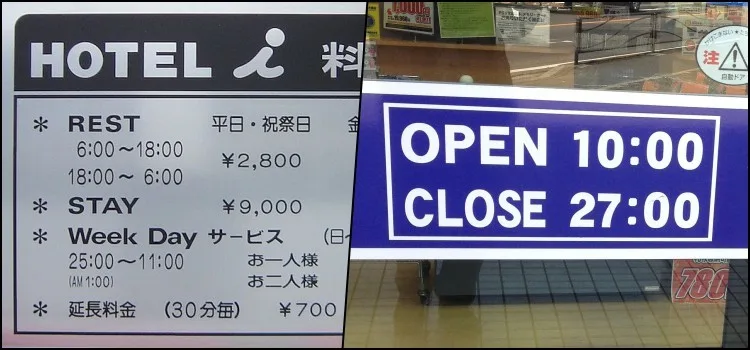
Have you noticed signs in Japan that say 26:00, 27:00, even 28:00? Your phone will never show that, so the first time it happens you stop and look twice.
It is not a different time zone, and it is not a joke about overwork. After midnight the number can keep climbing so the night still belongs to the same date — last train, bar shutter, late anime slot.
Contents 5
What is the 30-hour system?
Unlike the 24-hour clock, which ends the day at midnight (00:00), the 30-hour system stretches the “day” until 6 a.m. the next morning. Midnight is written as 24:00. The hours after that become 25:00, 26:00, and so on, up to 30:00. In practice you will see 25:00 to 29:00 more often than a full 30:00.
The point is practical. A train that leaves at 1 a.m. on the 24-hour clock can be listed as 25:00, so it still belongs to yesterday’s timetable instead of looking like the first train of a new day.
Why the date stays with last night
The 30-hour clock is not a second official time in Japan. Phones, calendars, and most conversation still use 12-hour or 24-hour time. What changes is the date attached to a night that runs past midnight.
If a Thursday night last train leaves after midnight, printing 25:30 keeps it on Thursday’s schedule. Printing 01:30 would make it look like Friday morning’s first departure. Bars and clubs do the same with closing time: open until 30時 means 6 a.m., still treated as the previous business day, and nobody has to wonder whether “6:00” is morning or evening.
That is also why you should not say “let’s meet at 25:00” on the street. People will say 1 a.m. The long clock lives on paper, boards, and late-night listings.
How to read 25:00, 26:00 and 30:00
Only the stretch from midnight to 6 a.m. looks different. Subtract 24 to get the ordinary morning hour:
- 24:00 = 00:00 (midnight)
- 25:00 = 1 a.m.
- 26:00 = 2 a.m.
- 27:00 = 3 a.m.
- 28:00 = 4 a.m.
- 29:00 = 5 a.m.
- 30:00 = 6 a.m. the next calendar morning
Date examples help more than the list:
- January 3, 06:00 = January 2, 30:00
- January 3, 12:00 stays January 3, 12:00
- January 4, 00:00 = January 3, 24:00
- January 4, 01:00 = January 3, 25:00
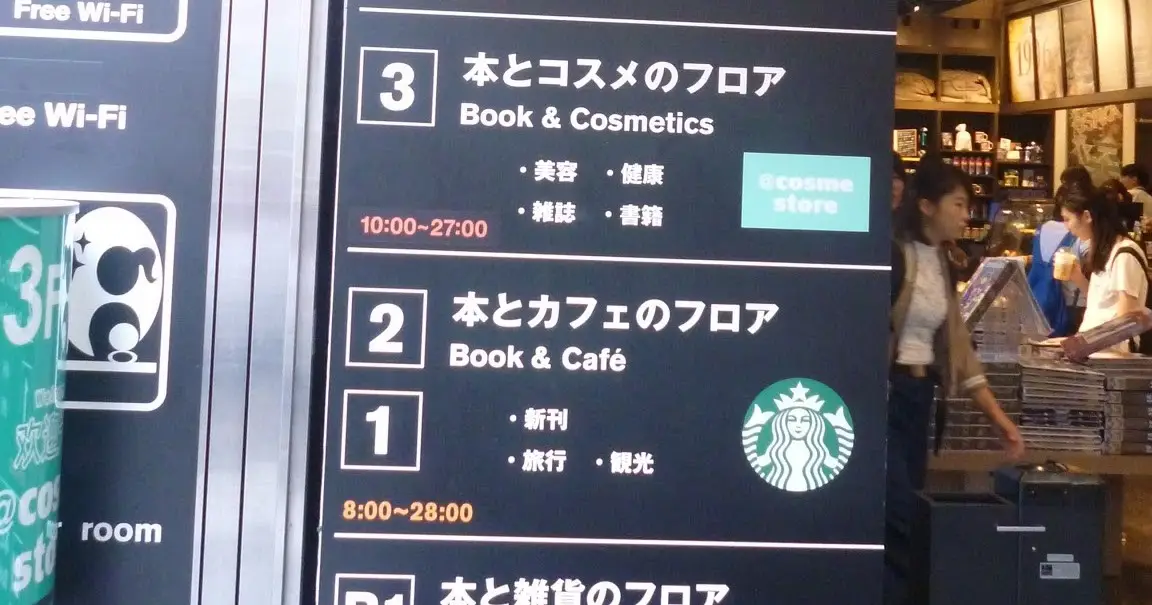
Some businesses stop the count earlier. A shop open until 27:00 is open until 3 a.m. A floor that lists 8:00–28:00 runs until 4 a.m. You do not need the full 30-hour scale every time; you only need the extra hours that night actually uses.
Where you will actually see it
The 30-hour system shows up in a few night-facing corners of daily life, not on every clock in the country.
- Transportation. JR East and other operators print some late departures as 24:xx and 25:xx, sometimes into the 27:00 hour, so last trains stay on the day the service started. If you are figuring out how to take a train in Japan, that extra hour on a board is a last train, not a typing error. Japanese trains already run on a tight 24-hour timetable during the day; the long clock is only for the tail after midnight.
- Nightlife. Bars, clubs, karaoke, and some late restaurants write closing time as 25:00, 26:00, or 30時. A hotel rate board may even list a weekday stay from 25:00, with a small note that this is 1 a.m.
- Television and anime. Late-night TV guides and some commercial radio listings keep the program on the previous broadcast day. An anime slot at 28:00 is 4 a.m., still treated as last night’s schedule. NHK usually stays on the ordinary 12-hour clock, so not every channel does this.
- Observatories. Astronomers at places such as the National Astronomical Observatory of Japan have used the same count for overnight logs, so a session does not change date in the middle of the night — useful when one team is in Japan and another is at a telescope in Hawaii. Amateur meteor watchers sometimes write 25:00 the same way. This is a specialist habit, not something you will hear at a konbini.
Ordinary Japan Standard Time on your phone still resets at midnight. The 30-hour clock is a written convention for nights that refuse to end at 24:00.
If you see 27:00 on a door
Read the extra hours as early morning, keep the date of the night that started the shift, and do not treat it as a second official clock. Japan still uses 12-hour speech with 午前 and 午後, and 24-hour boards for most trains. The long numbers appear when a service, a bar, or a broadcast wants the hours after midnight to stay glued to yesterday.
If you are in Japan after the last regular train, look at the shutter or the station printout before you trust the time on your lock screen. 27:00 is 3 a.m. — and it is still last night.

Community
Comments
0 comments
There are no published comments in this language yet.
Send comment