

Do you know how to make a paper tsuru? Do you know the meaning of the crane in Japanese culture? The fold is one question, and the bird is the other.
Have you heard about the "tsuru" and its numerous legends in Japanese culture? I believe many people know what origami is. Those folds are already part of Japanese culture.
When we think of origami, the figure of various animals and different shapes comes to mind. Tsuru is one of the most popular among them and is often associated with the folklore and legends of the country.
Contents 14
What is the tsuru?
Tsuru (鶴) is the Japanese word for a crane. In the stories, and in the paper fold, the bird meant is the red-crowned crane, tanchō (丹頂, Grus japonensis): a large bird with a long neck and long legs, mostly white, with black on the neck and in the flight feathers, and a patch of bare red skin on the crown. In English it is called the red-crowned crane, or the Japanese crane. The birds prefer wetlands, and a long, coiled windpipe makes the call loud. Stories give the tsuru a life of a thousand years. In the wild the usual life is about 30 years.
Tsuru can also name cranes as a group, and those birds do share the long neck and the long legs. The tales and the origami still point at the red-crowned crane. The paper fold has its own name, orizuru (折り鶴), and it is part of origami, the Japanese art of folding paper.
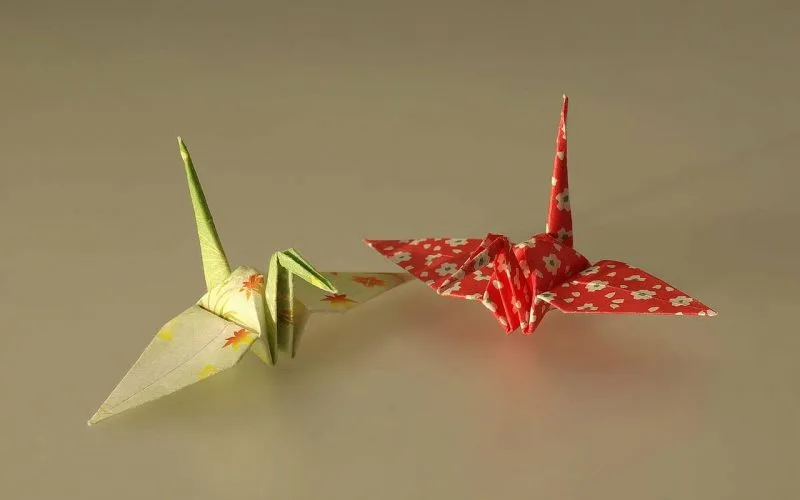
How to Make Origami Tsuru
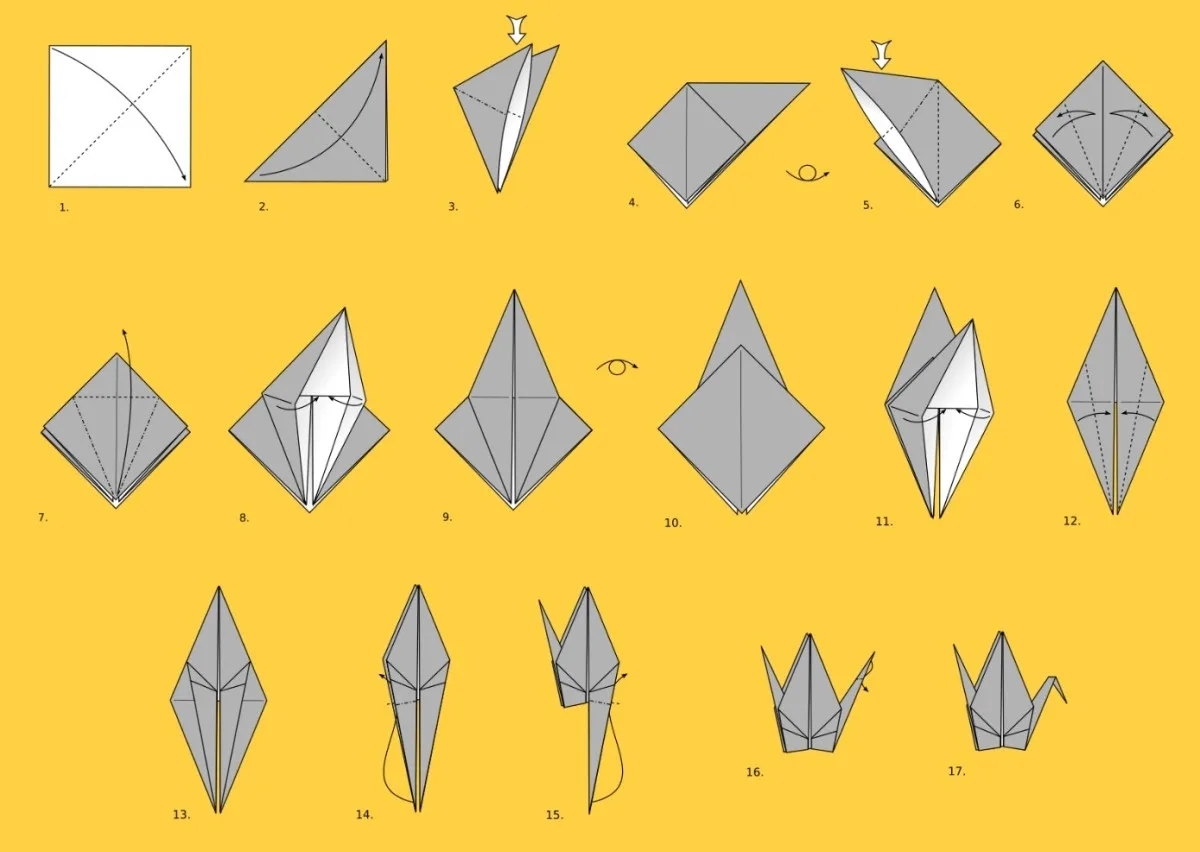
Below is a step by step for one clear way to make a tsuru. There are several ways, some have more steps than others. The drawing has 17 numbered panels and starts from a square. If a line here and a panel disagree, follow the panel.
- Crease a diagonal and fold the square into a triangle (panels 1 and 2).
- Open one flap and flatten it into a smaller triangle (3 and 4). Turn the paper over and do the same on the other side (5). You should now have a square with an open corner.
- Fold the side edges in to the center (6), then lift the bottom point and flatten the flap (7 and 8). Turn over and repeat on the back (10 to 13). The model becomes a long diamond with two thin points at the bottom. That shape is the bird base.
- Inside-reverse one bottom point upward for the neck (14). Inside-reverse the other point, a little lower, for the tail (15).
- Inside-reverse the tip of the neck downward to make the head (16). Spread the wings a little (17).
Culture of the tsuru
The crane shows up far outside Japan. Their beauty and their courtship dances have helped these birds become highly revered symbols for a long time.
A crane gloss in Mecca
Even in Mecca, in pre-Islamic South Arabia, Allat, al-Uzza, and Manat were three important goddesses. A disputed early report says that, during a recitation of the Quran's chapter of the Star, a line was uttered calling them the exalted gharaniq, whose intercession was hoped for. Gharaniq is an obscure word, and "crane" is the common gloss. Many Muslim scholars reject the report.
Don't worry. The episode people argue about is a disputed report, and Salman Rushdie later used it as the seed of the novel The Satanic Verses. For the crane, the gloss is the part that matters.
Tsuru in Greece
Yes, even in one of the largest and most influential cultures in the world, the crane can be found. The Greek word for crane is γέρανος (geranos). Geranium comes from geranion, "little crane," because the seed pod looks like a crane's bill.
In this culture, the crane was a bird of omen, and the stories leave the omen open. In the tale of Ibycus and the cranes, robbers killed the poet near Corinth. As he was dying he called on a flock of cranes that were passing.
The killers later sat in a theater, saw cranes overhead, and one of them, overcome, spoke of the avengers of Ibycus. People nearby heard it, and the crime came out.
Tsuru in China
In China the red-crowned crane is an old emblem of good fortune and long life, used on ornaments and insignia of high officials since ancient times.
Several styles of kung fu are inspired by the movements of these birds in nature. And the movements are well known for their fluidity and grace. The styles built on the crane are:
- Fujian White Crane
- Hung Gar, also called tiger-crane boxing
- the crane inside the Shaolin five animals
Wing Chun is a different southern art. A teacher may liken one of its arms to a wing, and the art keeps its own name.
Tsuru in Japan
Throughout East Asia, the crane is a symbol of happiness and long life. And as expected, the crane appears in popular tales in Japan, where it is one of the auspicious creatures, along with the dragon and the turtle. The life of a thousand years is the legend, and that legend is why good luck got attached to the bird.
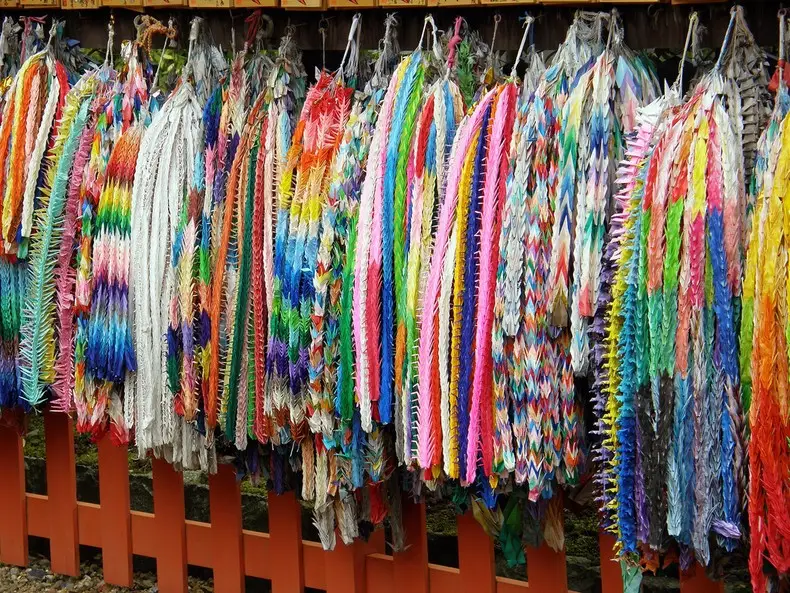
The crane is the favorite of the tradition of folding paper. The fold is the orizuru (折り鶴), and a thousand of them strung together is a senbazuru (千羽鶴). An old Japanese saying holds that anyone who folds a thousand origami cranes will be granted a wish. The oldest known origami instruction book, Hiden Senbazuru Orikata (1797), shows cranes joined from one sheet. It is a folding manual from the Edo period, and the wish people repeat today is a separate saying.
Anyway, I don't know if it works, but it takes patience to fold a thousand sheets; it wouldn't make sense if it didn't work.
This bird, after the Second World War, came to symbolize peace and the civilians killed in the bombing, through the story of the schoolgirl Sadako Sasaki and her origami cranes. That story is the last one here.
History, Fables, and Tales of the tsuru
The legends that have formed over time around this bird come next. The stories may differ, as they are easily modified by popular storytelling.
But I don’t believe there is a great distortion in the stories to the point of taking away all the original meaning of them. Therefore, if you know of any variation of the stories that are here, please comment below. Anyway, let’s go to the stories.
The return of the tsuru
Once upon a time, there was an elderly couple living in a certain place. On a snowy day in winter, the old man was going to the city to sell firewood when he found a Tsuru that had been caught in a hunter's trap.
Feeling pity, he freed the bird from the trap. That night, while the snow was falling violently, a beautiful girl came to the couple's house. According to her explanation, since her parents died, she had been traveling among relatives she had never met before when she got lost and, as a result, would like to stay for one night.
The couple welcomed her enthusiastically into their home. The snow had not stopped the next day, or the day after, and the girl remained at the elderly couple's house. She tirelessly took care of the couple, making them happy.
One day the girl asked the couple, instead of sending her to find relatives she had never met before, to let her stay as their daughter. The elderly couple was delighted to agree.
As she continued to help the elderly couple, one day she asked: "I would like to weave a cloth, so please buy me threads." When she was given the purchased thread, she stated: "Please, never look into the room" to the couple.
Right after that, she hid in the room and wove for three days straight without a break. "Sell this and buy me more threads," she told the couple. The fabric was very beautiful and immediately became the talk of the town, selling for a good price.
With the new thread bought with the money from the sale, the daughter wove another fabric with a finer finish, selling it at a higher price and making the elderly couple rich. However, when she isolated herself in the room to weave a third piece, the couple who continued to keep the promise began to wonder how she wove such beautiful fabric.
Unable to resist her curiosity, the old lady took a peek inside. Where there should have been a girl, there was a Tsuru. The Tsuru was pulling out its own feathers to weave among the threads to produce a shiny cloth.
Large portions of the wing had already been pulled out, leaving the Tsuru in a pitiful state. She finished the weaving, came out to the shocked elderly couple, and confessed that she was the crane that was saved.
And as her true identity was discovered, she had to leave. Thus she transformed into a crane and flew to the sky, leaving behind the regretful elderly couple.
The Tsuru Wife
This story is a kind of alternative to the previous story, but some things are drastically changed.
In "The Crane Wife," a man marries a woman who is, in fact, a Tsuru disguised as a human. And to earn money, she pulls out her own feathers to weave a silk fabric that the man sells, however, she becomes sicker each time she does this.
When the man discovers his wife's true identity and the nature of her illness, she abandons him just like in the previous story.
There are also several Japanese stories about men who married a kitsune, or fox spirits in human form. The fox disguised as a woman stays willingly until the husband discovers the truth, and it is at that moment that she abandons him.

Fables and Tales
In one of Aesop's Fables, the geese and the Tsurus were feeding in the same place when a hunter captured them in his nets. The cranes, having light wings, fled at the approach, while the geese, having slower and heavier bodies, were captured.
Pliny the Elder wrote that the Tsurus selected among them one to keep watch while the others slept. The chosen one held a stone in its claw, in such a way that if it fell asleep, it would drop the stone and wake up.
Thus, a crane holding a stone in its claw is a well-known symbol in heraldry and is called a crane in its vigilance.
Greek and Roman writers often treated the dance of the cranes as a love of joy and a celebration of life.
The story of Sadako Sasaki
Sadako Sasaki was born on January 7, 1943. On August 6, 1945, she was at home in Hiroshima, about 1.6 kilometers from the hypocenter, and she was two years old. The blast threw her, she had no obvious wounds, and she and her mother were caught in the black rain as they fled.
She grew up like other children in her class and ran on the relay team. In late 1954 the swellings started. On February 21, 1955, she was admitted to the Hiroshima Red Cross Hospital with leukemia. In the hospital her father told her the legend of the thousand cranes, and she set out to fold 1,000 of them, wishing to get well again. Paper was scarce, so she used medicine wrappers and gift paper. Her best friend, Chizuko, brought more paper from school.
Many people meet her first in Eleanor Coerr's children's novel Sadako and the Thousand Paper Cranes (1977). In that book she folds 644 cranes, improves enough for a short time at home, and dies before the thousand, with friends finishing the rest. Her family tells it differently. Her older brother, Masahiro Sasaki, says she passed a thousand. A display at the Hiroshima Peace Memorial Museum said that by the end of August 1955 she had reached the thousand and kept folding. She died on the morning of October 25, 1955, at the age of twelve. She thanked the family around her, and her brother has said those were her last words.
The 644 and the short discharge come from the novel. The dates, the leukemia, and the cranes folded in the hospital belong to her life.
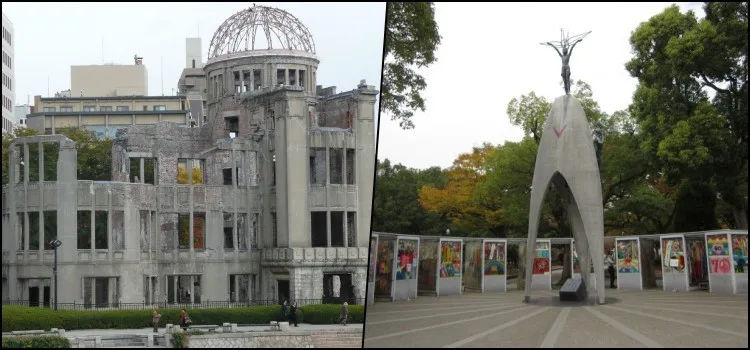
Monument in honor of Sadako Sasaki
After her death, classmates, saddened by the loss, began collecting money for a memorial to her and to the other children killed by the bomb. Students from more than 3,100 schools in Japan, and from nine other countries, sent donations. On May 5, 1958, almost 3 years after Sadako's death, the Children's Peace Monument was unveiled in the Hiroshima Peace Memorial Park, near the place where the atomic bomb fell. Kazuo Kikuchi designed the figure of the girl holding a crane, and Kiyoshi Ikebe designed the stand. The inscription at the base reads: "This is our cry. This is our prayer. For building peace in this world."
The bird, the fold, and the wish
You can finish one crane from the drawing above. A thousand of them is the senbazuru wish. Sadako's count is 644 in Coerr's novel and past a thousand in her brother's account, and her family tells the second story.



Community
Comments
0 comments
There are no published comments in this language yet.
Send comment