
Have you heard of the Japanese word pettanko [ぺったんこ]? In anime and manga it shows up on a flat chest, which is why so many short glossaries stop at that picture. Digital Daijisen records it as the sound of pounding mochi, and as the look of something pressed flat.
Having small breasts is not a problem in Japan, nor should it be in the rest of the world. Daijisen's own examples are a cushion, ぺったんこな座布団, and a folding chair, 折りたたむとぺったんこになる. As an adverb, the word is the sound of the mallet on the mochi, ぺったんこと餅をつく, and manga applied that pressed-flat look to a chest.
Contents 4
The sound, the cushion, and the seesaw
Pixiv's encyclopedia calls ぺったんこ a mimetic word. An object is pushed flat, or it sits flat under its own weight. The same sound covers pressing a hanko and sticking a sticker. Those are ordinary scenes, and they say nothing about how a person feels.
Heibonsha's World Encyclopedia, in the older edition, lists ぺったんこ among Japan's local names for a seesaw, beside ぎっこんばったん and ざいこばったん, from the way the board moves. In 1922, Arishima Takeo's novel Seiza [星座] uses the word for a man who folds his belly flat while he sits. The anime habit came after those uses.
In ordinary speech you can call a cushion pettanko, or describe mochi pounding as pettanko. In a caption, 胸はペッタンコ means the chest is flat.
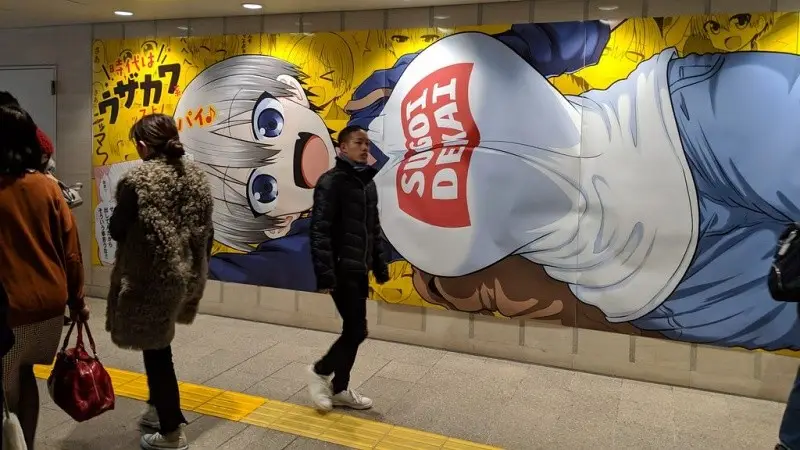
The flat chest in manga
On Pixiv the tag often means a flat chest. The encyclopedia says 胸はペッタンコとは、つまり貧乳である. Call a chest pettanko and you are calling it hinnyuu [貧乳], a small chest, with the same word Daijisen uses for a cushion and a mallet.
Old fan glossaries added a test the dictionaries skip. They counted a character as pettanko only when she was proud of a flat chest or embarrassed by it, and they left out anyone who simply had a small chest and did not mind. Anime News Network's old lexicon said that, and it offered the English nickname Delicious Flat Chest, or DFC. Daijisen and the Pixiv article stay with the shape.
Pechapai, when you mean the chest
When you want the chest and nothing else, the word is ぺちゃぱい [pechapai]. Daijisen reads it as ぺちゃんこのおっぱい: a woman's breasts on the small side, or the woman herself, and it lines the word up with 貧乳. Tsurupeta [つるぺた] is a separate otaku coinage. For a plain size, pechapai is the word I would use.
And what about a large chest?
Some women complain about a large chest, or wish it were smaller. You can see that in some anime, and clearly in real life too. I don't know a single word that simply flips pettanko, because the older senses are a sound and a flat shape. For a large chest, Daijisen gives ぼいん [boin] as a colloquial noun and lists 巨乳 [kyonyuu] beside it. Boinboin [ボインボイン] is the doubled, playful form of that noun. Kyonyuu is the one you will see written when someone means the size.
I hope you enjoyed this short article; it was quite tense to write about this delicate subject. If you liked this article, don't forget to share and leave your comments. The other pieces I wrote on this subject are what oppai means in Japanese, including sizes and the small-chest myth and Oppai Bokin and the free-oppai events.




Community
Comments
0 comments
There are no published comments in this language yet.
Send comment