
Anyone who writes a name in red ink in Japan often gets a friendly warning. To a skeptic it is only a colour; to many Japanese it touches an old taboo. Red ink is just one example. Around graves, chopsticks and numbers, Japanese society keeps a whole set of rules of this kind. This article explains where they come from, what still applies today and how to react if you break one by accident.
Contents 7
Why red ink is taboo for names
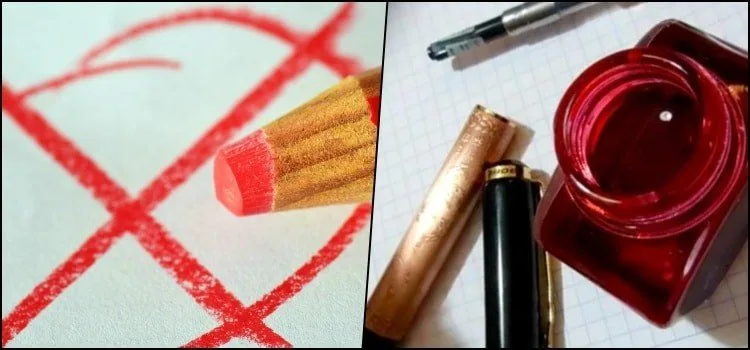
The reason lies in the cemetery. In Japan the names on grave markers are red; only after death is the name completed in black. Because red is tied to the grave and to death, many Japanese avoid writing the name of a living person in red ink. Sending back a card or a form with a red name does not look malicious, but it does look insensitive.
Ironically, the personal seals that Japanese people use instead of signatures are almost always red. The colour itself is not forbidden; the issue is the name and the context. A second reason comes from the language: 赤字 (akaji), literally red writing, means deficit. That is another reason red feels unlucky in business settings.
The numbers four and nine
四 (shi), the Sino-Japanese reading of four, sounds like 死 (shi), death. That is why some hospitals and hotels have no room or floor with the number four, and car rental companies avoid it. Gift sets usually come in three or five pieces; four is considered unlucky. If you buy four glasses, do not present them as a gift.
Nine has a double reading too: 九 (ku) sounds like 苦 (ku), suffering. In everyday life people therefore prefer yon to shi and kyū to ku. Combs (kushi, 櫛) are rarely given as presents, because the word sounds like 94, that is suffering and death. These rules matter most at formal occasions, at weddings and with older people.
Chopsticks and death
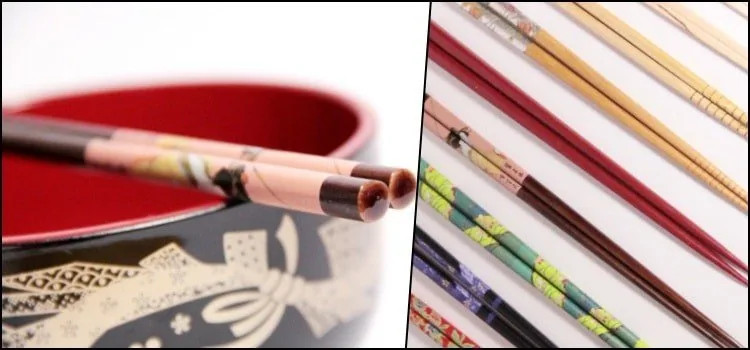
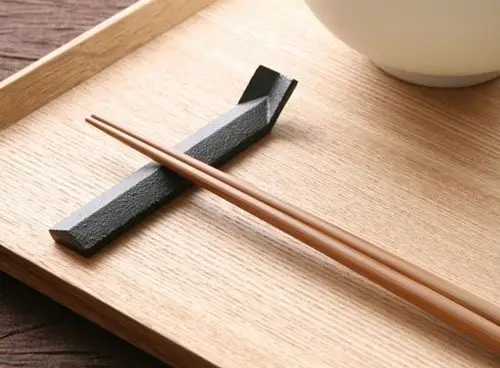
At the table there are two clear prohibitions. Chopsticks are never stuck upright into a bowl of rice, because that is how incense sticks stand on an altar; the position is called hotokebashi and belongs to the veneration of the dead. Nor should you pass chopsticks from one pair to another, because that is exactly how bone fragments are placed in an urn after a Japanese cremation.
Crossing chopsticks after a meal or pointing them at someone is impolite, but not considered bad luck. The two rules above still upset many Japanese today, because they recall a funeral directly.
Sleeping, nails and the north
Sleeping with your head to the north is seen as a bad sign, because the dead are laid out with their head to the north in Japan. Guests in hotels or in a friend's home rarely think about it, but it is a recurring motif in stories. Some Japanese also avoid cutting their fingernails in the evening; the older explanation is that you will not be at your parents' deathbed.
A broken comb or a torn strap on wooden geta sandals is also a bad omen. After a funeral, mourners throw salt over themselves and on the path to the front door to purify themselves. And when a hearse drives past, some people tuck their thumbs inside their fists, because the thumb is called oyayubi, parent finger; this is believed to protect the parents from misfortune.
What brings good luck
Not everything is negative. Unlike in Europe, a black cat crossing your path is good luck in Japan. A spider in the morning brings luck, a spider at night brings bad luck. A dream in the first night of the new year, hatsuyume, is read as a sign for the year ahead. And whistling at night is said to call snakes; the snakes mean thieves, and the rule is mainly a reminder not to disturb the neighbours.
How seriously is it taken today?
The rules vary by region and generation. In big cities young people fill in forms with any pen, and not everyone avoids a room numbered four. At weddings, funerals, gift-giving and in contact with older people, however, attention is still high, and mistakes are noticed.
If you break a taboo by accident, you do not need a long explanation. A short “sorry, I did not know” is usually enough, and a new sheet of paper or a new envelope solves the problem faster than a debate about superstition. What matters is not to treat the warning as a lecture.
Conclusion
Red ink is a small taboo with a clear root: the colour of names on gravestones. Around it stand the numbers four and nine, chopsticks, the position when sleeping and a few everyday rules. You do not have to believe them to respect them. Knowing them avoids awkward moments and shows that you take Japanese politeness seriously.
Read more: taboos with chopsticks, 15 rules for chopsticks, funerals and cemeteries in Japan, the red hanko stamp and Japanese superstitions.


Community
Comments
0 comments
There are no published comments in this language yet.
Send comment