
Contents 4
This list shows the 150 most-used kanji in the Japanese language, ordered by their rank in the standard frequency list. Knowing these 150 characters by sight and reading is enough to decode a large share of everyday writing — signs, news headlines, official forms and casual text.
Each entry below shows the kanji itself, its on'yomi (Sino-Japanese reading) and kun'yomi (native Japanese reading) in romaji, the stroke count, and 1–2 short English meanings. A kanji often shifts nuance with the word it joins, so the meanings listed are the most common ones in modern Japanese.
Related topics
- Japanese female names with kanji and meanings
- How to write your name in kanji
- Kanji that look similar
Ranks 1–50: the most frequent kanji
These first 50 kanji form the backbone of Japanese writing. They appear in almost every text and are the first characters a learner should aim to recognise on sight.
- 日 (nichi, jitsu / hi, -bi, -ka) – day, sun, Japan (4 strokes)
- 一 (ichi, itsu / hito(tsu)) – one (1 strokes)
- 十 (juu, ju, -ji, -ju / too, to) – ten (2 strokes)
- 二 (ni, ji / futa(tsu), futatabi) – two (2 strokes)
- 大 (dai, tai / ō(kii), -ō(ini)) – big, great (3 strokes)
- 三 (san, zou / mi(tsu)) – three (3 strokes)
- 係 (kei / kaka(ru), kakari, kaka(waru)) – person in charge, connection (9 strokes)
- 会 (kai, e / a(u), a(waseru), atsu(maru)) – meeting, gathering (6 strokes)
- 国 (koku / kuni) – country, nation (8 strokes)
- 年 (nen / toshi) – year (6 strokes)
- 中 (chuu / naka, uchi) – in, middle, inside (4 strokes)
- 本 (hon / moto) – book, main, origin (5 strokes)
- 五 (go / itsu(tsu)) – five (4 strokes)
- 四 (shi / yo, yo(tsu), yon) – four (5 strokes)
- 出 (shutsu, sui / de(ru), da(su)) – exit, leave (5 strokes)
- 上 (jou, shou, shan / uwa(ru), kami, a(geru), a(garu), nobo(ru), nobo(seru), nobo(su)) – up, above, rise (3 strokes)
- 時 (ji / toki, -doki) – time, hour (10 strokes)
- 同 (dou / ona(ji)) – same, identical (6 strokes)
- 長 (chou / naga(i), osa) – long, leader (8 strokes)
- 東 (tou / higashi) – east (8 strokes)
- 行 (kou, gyou, an / i(ku), yu(ku), okona(u)) – go, travel (6 strokes)
- 事 (ji, zu / koto) – thing, matter (8 strokes)
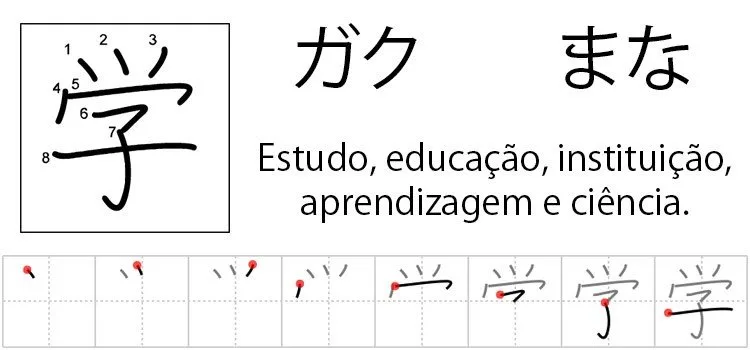
- 学 (gaku / mana(bu)) – study, learning (8 strokes)
- 生 (sei, shou / i(kiru), i(keru), i(kasu), u(mareru), u(mu), na(ru), na(su), ki, nama) – life, birth, raw (5 strokes)
- 月 (getsu, gatsu / tsuki) – month, moon (4 strokes)
- 者 (sha / mono) – person, someone (8 strokes)
- 六 (roku, riku / mu, mu(tsu)) – six (4 strokes)
- 間 (kan, ken / aida, ma, ai) – interval, space (12 strokes)
- 方 (hou / kata, -kata, -gata) – direction, person (4 strokes)
- 分 (bun, fun, bu / wa(keru), wa(karu)) – part, minute (4 strokes)
- 前 (zen / mae, -mae) – before, in front (9 strokes)
- 後 (go, kou / nochi, ushi(ro), ato) – behind, later (9 strokes)
- 地 (chi, ji / —) – earth, ground (6 strokes)
- 場 (jou, chou / ba) – place, spot (12 strokes)
- 手 (shu, zu / te, -te) – hand (4 strokes)
- 政 (sei, shou / matsurigoto) – politics, government (9 strokes)
- 的 (teki / —) – target, -ical (8 strokes)
- 発 (hatsu, hotsu / —) – depart, emit (9 strokes)
- 合 (gou, katsu / a(u), a(waseru)) – fit, unite (6 strokes)
- 八 (hachi / ya, ya(tsu), yō) – eight (2 strokes)
- 議 (gi / —) – deliberation, debate (20 strokes)
- 部 (bu / -be) – section, part (11 strokes)
- 稲 (tou, te / ine, ina-) – rice plant (14 strokes)
- 員 (in / —) – member, employee (10 strokes)
- 見 (ken / mi(ru), mi(eru), mi(seru)) – see, visible (7 strokes)
- 京 (kyou, kei, kin / miyako) – capital (8 strokes)
- 九 (kyuu, ku / kokono(tsu)) – nine (2 strokes)
- 社 (sha / yashiro) – company, shrine (7 strokes)
- 対 (tai, tsui / aite, kota(eru), nara(bu), muka(u)) – versus, opposite (7 strokes)
- 業 (gyou, gou / waza) – business, work (13 strokes)
Ranks 51–100: very frequent kanji
The next 50 kanji build out the rest of the high-frequency core: numbers, basic verbs, family and time vocabulary, and the kanji for the country's political and social institutions.
- 七 (shichi / nana, nana(tsu)) – seven (2 strokes)
- 子 (shi, su, tsu / ko, -ko, ne) – child (3 strokes)
- 新 (shin / atara(shii), ara(ta), nii-) – new (13 strokes)
- 自 (ji, shi / mizuka(ra), ono(zukara)) – oneself (6 strokes)
- 高 (kou / taka(i), taka(meru)) – high, tall, expensive (10 strokes)
- 内 (nai, dai / uchi) – inside, within (4 strokes)
- 立 (ritsu, ryuu, rittoru / ta(tsu), ta(teru), tate-) – stand (5 strokes)
- 相 (sou, shou / ai-) – mutual, minister (9 strokes)
- 度 (do, to, taku / tabi, -tai) – degree, time (9 strokes)
- 回 (kai, e / mawa(ru), mawa(su)) – times, round (6 strokes)
- 問 (mon / to(u), to(i)) – ask, question (11 strokes)
- 定 (tei, jou / sada(meru), sada(maru)) – fix, decide (8 strokes)
- 億 (oku / —) – hundred million (15 strokes)
- 目 (moku, boku / me, -me) – eye, point (5 strokes)
- 小 (shou / chiisa(i), ko-, o-) – small, little (3 strokes)
- 力 (ryoku, riki, rii / chikara) – power, strength (2 strokes)
- 全 (zen / matta(ku), sube(te)) – whole, all (6 strokes)
- 円 (en / maru(i)) – circle, yen, round (4 strokes)
- 気 (ki, ke / iki) – spirit, mood (6 strokes)
- 峠 (— / tōge) – mountain pass, climax (9 strokes)
- 金 (kin, kon, gon / kane, kana-) – gold, money (8 strokes)
- 通 (tsuu, tsu / too(ru), too(su), kayo(u)) – traffic, pass through (10 strokes)
- 開 (kai / hira(ku), a(ku), a(keru)) – open (12 strokes)
- 戦 (sen / ikusa, tataka(u)) – war, battle (13 strokes)
- 市 (shi / ichi) – city, market (5 strokes)
- 米 (bei, mai, meetoru / kome, yone) – rice, USA (6 strokes)
- 民 (min / tami) – people, nation (5 strokes)
- 千 (sen / chi) – thousand (3 strokes)
- 連 (ren / tsura(naru), tsu(reru)) – connect, series (10 strokes)
- 決 (ketsu / ki(meru), ki(maru)) – decide, fix (7 strokes)
- 現 (gen / arawa(reru), arawa(su)) – present, appear (11 strokes)
- 入 (nyuu / i(ru), i(reru), hai(ru)) – enter (2 strokes)
- 午 (go / uma) – noon, horse (4 strokes)
- 代 (dai, tai / kawa(ru), ka(waru), ka(eru), yo, shiro) – substitute, era (5 strokes)
- 第 (dai / —) – ordinal prefix (11 strokes)
- 実 (jitsu, shitsu / mi, makoto) – reality, truth, fruit (8 strokes)
- 主 (shu, su, shuu / nushi, omo, aruji) – lord, main (5 strokes)
- 動 (dou / ugo(ku), ugo(kasu)) – move, motion (11 strokes)
- 明 (mei, myou, min / aka(rui), a(keru), a(kari)) – bright, light (8 strokes)
- 党 (tou / nakama, mura) – party, faction (10 strokes)
- 当 (tou / a(taru), a(teru), masa(ni)) – hit, present (6 strokes)
- 下 (ka, ge / shita, shimo, moto, kudaru, kudasu, o(rosu)) – below, under (3 strokes)
- 関 (kan / seki, kaka(waru), kannuki) – connection, concern (14 strokes)
- 家 (ka, ke / ie, ya, uchi) – house, home (10 strokes)
- 調 (chou / shira(beru), totono(u), totono(eru)) – tune, adjust (15 strokes)
- 題 (dai / —) – topic, subject (18 strokes)
- 教 (kyou / oshi(eru), oso(waru)) – teach, faith (11 strokes)
- 意 (i / —) – idea, meaning (13 strokes)
- 区 (ku / —) – ward, district (4 strokes)
- 北 (hoku / kita) – north (5 strokes)
Ranks 101–150: common kanji for more advanced texts
The final 50 entries round out the 150-kanji set with body, society, nature and daily-life vocabulary. Together with the first 100, they cover most of the words you will meet in newspapers, menus and short articles.
- 機 (ki / hata) – machine, mechanism (16 strokes)
- 要 (you / i(ru)) – need, essential (9 strokes)
- 化 (ka, ke / ba(keru), ba(kasu)) – change, -ization (4 strokes)
- 野 (ya, sho / no, no-) – field, plain (11 strokes)
- 来 (rai, tai / ku(ru), kita(ru), kita(su)) – come, cause (7 strokes)
- 理 (ri / kotowari) – logic, reason, truth (11 strokes)
- 体 (tai, tei / karada, katachi) – body, object (7 strokes)
- 強 (kyou, gou / tsuyo(i), tsuyo(meru), shi(iru)) – strong, force (11 strokes)
- 成 (sei, jou / na(ru), na(su)) – become, complete (6 strokes)
- 外 (gai, ge / soto, hoka) – outside, abroad (5 strokes)
- 都 (to, tsu / miyako) – metropolis, capital (11 strokes)
- 作 (saku, sa / tsuku(ru)) – make, produce (7 strokes)
- 選 (sen / era(bu)) – choose, select (15 strokes)
- 所 (sho / tokoro, -tokoro, dokoro) – place, spot (8 strokes)
- 万 (man, ban / yorozu) – ten thousand (3 strokes)
- 公 (kou, kuu / ooyake) – public, official (4 strokes)
- 表 (hyou / omote, arawa(su), arawa(reru)) – surface, table (8 strokes)
- 最 (sai, shu / motto(mo)) – most, maximum (12 strokes)
- 近 (kin, kon / chika(i)) – near, close (7 strokes)
- 期 (ki, go / —) – period, term (12 strokes)
- 思 (shi / omo(u), obo(su)) – think, believe (9 strokes)
- 正 (sei, shou / tada(shii), tada(su), masa, masa(ni)) – correct, right (5 strokes)
- 物 (butsu, motsu / mono, mono-) – thing, object (8 strokes)
- 道 (dou, tou / michi) – road, way, path (12 strokes)
- 府 (fu / —) – prefecture office (8 strokes)
- 法 (hou, hat-, hot-, huran / nori) – law, method (8 strokes)
- 約 (yaku / —) – approximately, promise (9 strokes)
- 用 (you / mochi(iru)) – use, employ (5 strokes)
- 点 (ten / tsu(keru), tsu(ku), ta(teru)) – point, dot (9 strokes)
- 安 (an / yasu(i), yasu(maru)) – cheap, calm, peaceful (6 strokes)
- 不 (fu, bu / —) – non-, un- (4 strokes)
- 務 (mu / tsuto(meru)) – duty, task (11 strokes)
- 心 (shin / kokoro, -gokoro) – heart, mind, spirit (4 strokes)
- 産 (san / u(mu), u(mareru), ubu-, mu(su)) – birth, product, produce (11 strokes)
- 今 (kon, kin / ima) – now (4 strokes)
- 川 (sen / kawa) – stream, river (3 strokes)
- 経 (kei, kyou / he(ru), ta(tsu)) – pass through, longitude, sutra (11 strokes)
- 委 (i / yuda(neru)) – committee, entrust (8 strokes)
- 以 (i / mot(t)e) – by means of, with (5 strokes)
- 共 (kyou / tomo, tomo(ni), -domo) – together, both (6 strokes)
- 原 (gen / hara) – field, original, plain (10 strokes)
- 重 (juu, chou / omo(i), omo(ri), kasa(neru)) – heavy, pile (9 strokes)
- 結 (ketsu, kechi / musu(bu), yu(u), yu(waeru)) – tie, unite (12 strokes)
- 海 (kai / umi) – ocean, sea (9 strokes)
- 水 (sui / mizu, mizu-) – water (4 strokes)
- 打 (da, daasu / u(tsu), u(chi-)) – hit, strike (5 strokes)
- 名 (mei, myou / na, -na) – name, fame (6 strokes)
- 町 (chou / machi) – town, block, street (7 strokes)
- 予 (yo, sha / arakaji(me)) – in advance, prior (4 strokes)
- 多 (ta / oo(i), masa(ni), masa(ru)) – many, much (6 strokes)
The most effective way to learn these 150 kanji is to study five to ten new ones a day, pairing each one with a couple of vocabulary words and a short example sentence. Reading, writing and meaning then stick together, and the list becomes a working reference you can return to whenever you meet an unfamiliar character.


Community
Comments
0 comments
There are no published comments in this language yet.
Send comment