
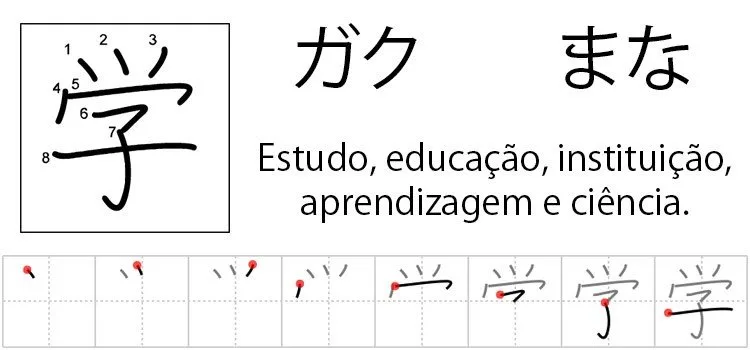
The kanji 学 is one of the first characters you meet when learning Japanese, and it stays useful through every level of study. Its core meaning covers to study, to learn, and science, and it shows up in countless words tied to school, university, and research. Once you can read 学 at a glance, you start spotting gaku and manabu in compounds you have not studied yet.
Contents 6
Readings and structure
Before diving into the vocabulary, it helps to lock in the basic data of the character:
- Kun'yomi: まな(ぶ)
- On'yomi: がく
- Proper names: まこと, まなぶ, さとる
- Radical: 子 (child)
- Strokes: 8
The kun'yomi manabu appears most often as a verb, while the on'yomi gaku shows up in compound nouns such as 学生 or 大学. Both forms become part of your active vocabulary as soon as school or university topics come up.
Words that start with 学
The compounds below all use the on'yomi gaku and refer to people, places, or concepts tied to learning:
- 学生 (gakusei) – student
- 学園 (gakuen) – university, campus, academy
- 学問 (gakumon) – scholarship, learning, academic study
- 学ぶ (manabu) – to learn (verb)
- 学校 (gakkō) – school
- 学会 (gakkai) – academic meeting, learned society
- 学課 (gakka) – lesson, schoolwork
- 学科 (gakka) – study subject, course of study
- 学食 (gakushoku) – school cafeteria
- 学位 (gakui) – academic degree, level of education
- 学外 (gakugai) – outside the university
- 学期 (gakki) – semester, school term
- 学業 (gakugyō) – academic work, studies
- 学芸 (gakugei) – arts and sciences
- 学際 (gakusai) – interdisciplinary
- 学士 (gakushi) – bachelor's degree (holder)
- 学籍 (gakuseki) – school registration, enrollment
- 学内 (gakunai) – on campus
- 学閥 (gakubatsu) – old school ties, academic cliques
- 学名 (gakumei) – scientific name (of a species)
- 学割 (gakuwari) – student discount
Words that end with 学
These compounds place 学 at the end and usually name a field of study or academic discipline. The reading follows the same -gaku pattern:
- 医学 (igaku) – medicine
- 科学 (kagaku) – science
- 化学 (kagaku) – chemistry
- 物理学 (butsurigaku) – physics
- 文学 (bungaku) – literature
- 経済学 (keizaigaku) – economics
- 古学 (kogaku) – classical studies
- 光学 (kōgaku) – optics
- 工学 (kōgaku) – engineering
- 神学 (shingaku) – theology
- 生物学 (seibutsugaku) – biology
- 大学 (daigaku) – university
- 中学 (chūgaku) – middle school
- 停学 (teigaku) – suspension (from school)
- 哲学 (tetsugaku) – philosophy
- 入学 (nyūgaku) – enrollment, school admission
- 博学 (hakugaku) – erudition, broad learning
- 法学 (hōgaku) – law, jurisprudence
That is already more than 40 words sharing the same kanji, which is exactly what makes 学 one of the most rewarding characters to learn early: once you know it, a large slice of everyday and academic vocabulary starts to unlock on its own.
Levels of education in Japan
The Japanese school system is clearly divided into stages, and each stage carries 学 in its name, which makes the logic behind the system easy to see:
- Elementary school – 小学校 (shōgakkō) – the "small school" where children aged 7 to 12 study
- Middle school – 中学校 (chūgakkō) – the "intermediate school" for students aged 13 to 15
- High school – 高等学校 / 高校 (kōtōgakkō / kōkō) – the "advanced school" for students aged 16 to 18
- University – 大学 (daigaku) – the "big school" where students aged 19 to 22 study
The split into elementary, middle, and high school roughly matches the combined elementary and secondary school stages in many English-speaking systems, with a dedicated three-year high school phase before university.
Students and school life
Where someone studies is expressed in Japanese through a clean word family. The suffix 生 (sei, meaning "student of") attaches to each level of school:
- 学生 (gakusei) – a student at a 学校
- 小学生 (shōgakusei) – a student at a 小学校
- 中学生 (chūgakusei) – a student at a 中学校
- 高校生 (kōkōsei) – a student at a 高校 / 高等学校
- 大学生 (daigakusei) – a student at a 大学
You can tell at a glance which stage someone is in. In everyday conversation 学生 is often used almost as a synonym for 大学生, since primary schoolers in Japan are already called shōgakusei.
A character that carries daily life
学 appears on school buildings, student ID cards, station signs like 学園前, and in almost any news item about science and research. Once you can read the character with confidence, you start spotting schools, universities, and educational institutions in every Japanese city, and you can also pick up the field a conversation partner works in the moment words like 経済学, 文学, or 法学 come up. For anyone starting out with Japanese, anchoring 学 early pays off: it is light in stroke count and heavy in usefulness.



Community
Comments
0 comments
There are no published comments in this language yet.
Send comment