
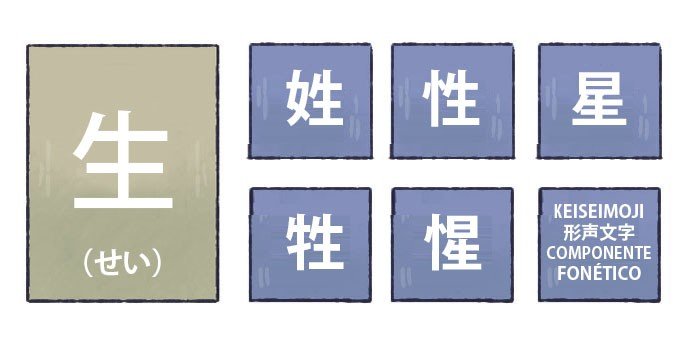
Did you know that in Japanese several kanji can share the same pronunciation because of a small piece sitting inside them? That piece is the phonetic component, onpu (音符). It lives inside keiseimoji (形声文字), the form-and-sound characters that make up around 80% of everyday kanji — and keiseimoji is the character type, not the name of the sound piece itself.
These phonetic components can be radicals that carry a sound, or other kanji acting as sound-bearers. The onpu usually sits on the right side of a character, and sometimes at the bottom. It only hints at the Chinese reading, the on'yomi.
Why does Japanese have so many kanji with the same reading? Japanese is a language with few phonemes that imported Chinese characters from a tonal language. In practice, Japanese inherited those Chinese readings — without the tones that used to keep them apart.
If you already know the reading of one phonetic component, you can start guessing the on'yomi of other kanji that carry the same piece. The meaning side is a different job: that is what the bushu, the radicals, usually mark.
Contents 5
Concept of phonetic components
Japanese kanji are often formed by a combination of elements. In a keiseimoji, one element leans toward meaning and another toward sound. The sound element is the phonetic component (音符, onpu). It is not always accurate, but it offers a useful clue — almost always for on'yomi, not for kun'yomi.
Practical examples
- Kanji: 時 (time)
- Phonetic component: 寺
- Reading: ji
- Note: The kanji 寺 (temple) is read as "ji" in on'yomi. The same piece in 時 is also read as "ji". That is why 時, "time", is read ji in compounds such as 時間 (jikan).
- Kanji: 湖 (lake)
- Phonetic component: 胡
- Reading: ko
- Note: 湖 looks as if it carried 古, but the sound-bearer is 胡. Water plus 胡 gives 湖, lake, with the on'yomi ko. 古 does mark ko in other characters, such as 枯 and 固 — just not in this one.
- Kanji: 保 (protect)
- Phonetic component: 呆
- Reading: ho
- Note: 呆 is uncommon on its own in everyday Japanese, but the ho sound is shared with 保, where that shape acts as the phonetic component.
How to use phonetic components while learning
Identification: start by spotting the phonetic piece in a kanji. It is usually a smaller shape you already know from another character.
Association: tie that piece to a kanji whose on'yomi you already know. If 寺 is ji, 時 is an easy next step.
Practical exercises: write or review kanji that share the same phonetic component together. A list built around 寺, or around 青 (sei), trains the ear faster than isolated flashcards.
Attention to exceptions: the phonetic component is not an infallible guide. Some kanji keep an extra on'yomi, pick up voicing, or simply refuse the expected sound. Balance this technique with vocabulary — the word is the final judge.
What is a kanji with a phonetic component?
The cleanest way to see the idea is in one family. Pay close attention to the image below:
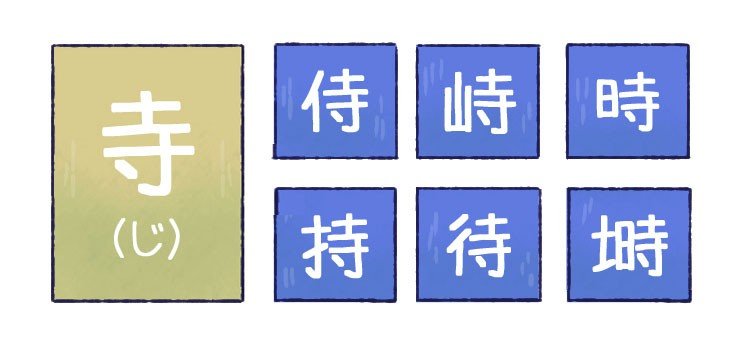
Here we find the kanji 寺, Buddhist temple. Its Japanese reading (kun'yomi) is [tera], while the Chinese reading (on'yomi) is [ji]. The other characters in the image carry 寺 on the right. Most of them share that on'yomi, ji: 侍, 持, 時, 峙, 塒.
Look again at 待. It sits in the same picture, with 寺 on the right — and still the on'yomi is tai, not ji. Same shape family, different sound. That is the whole warning in one character: the component is a hint, not a stamp.
The rule is not absolute in other ways either. Many Japanese kanji have more than one Chinese reading. Some also pick up voicing, the same kind of shift marked by dakuten in kana. An on'yomi in か may appear as が inside a word; rendaku can do similar work across a compound. You cannot decide that from the isolated character alone — you need the word it forms.
Keep in mind that there are thousands of kanji. Some are built from one component, some from several. Others have zero, one, or more than one on'yomi. With that in mind, you can start grouping characters by their sound-bearers and discovering readings. It is not an easy process; you need a fair amount of Japanese already before the guesses become comfortable.
Kanji with the same on'yomi readings
The table below shows examples of characters that share a phonetic component, or a radical/kanji that carries a reading. Treat it as a map, not a spell: when a row looks too tidy, check the word.
| Radical, component | Reading | Kanji |
|---|---|---|
| 几 | ki | 机, 肌, 飢 |
| 亡 | bou | 忙, 忘, 盲, 望, 妄 |
| 干 | kan | 汗, 肝, 奸, 刊, 岸 |
| 五 | go | 伍, 吾, 悟, 語 |
| 己 | ki | 起, 記, 紀, 忌 |
| 工 | kou | 紅, 空, 虹, 江, 攻, 功 |
| 及 | kyuu | 吸, 級, 扱 |
| 士 | shi | 仕, 志, 誌 |
| 方 | hou, bou | 肪, 坊, 紡, 防, 妨, 房, 傍, 芳, 訪, 放 |
| 乍 | saku | 作, 搾, 昨, 酢 |
| 中 | chuu | 忠, 沖, 仲, 狆 |
| 化 | ka | 花, 貨, 靴 |
| 反 | han | 版, 板, 坂, 飯, 販, 叛 |
| 分 | fun | 粉, 紛, 雰 |
| 半 | han | 伴, 絆, 判 |
| 白 | haku | 伯, 拍, 泊, 迫, 舶, 柏 |
| 皮 | hi | 彼, 被, 疲, 披 |
| 付 | fu | 府, 符, 附, 俯 |
| 包 | hou | 抱, 泡, 胞, 砲, 飽 |
| 可 | ka | 河, 何, 荷, 歌 |
| 古 | ko | 固, 故, 枯, 個, 沽, 姑 |
| 生 | sei | 姓, 性, 星, 牲, 惺 |
| 正 | sei | 征, 政, 症, 整 |
| 司 | shi | 伺, 詞, 嗣, 飼 |
| 且 | so | 粗, 祖, 狙, 阻, 組 |
| 旦 | tan | 但, 胆, 担 |
| 令 | rei | 冷, 鈴, 零, 齢 |
| 立 | ryuu | 粒, 笠 |
| 申 | shin | 神, 伸, 紳 |
| 召 | shou | 招, 沼, 昭, 紹, 詔, 照 |
| 安 | an | 案, 按, 鞍 |
| 同 | dou | 洞, 胴, 桐, 銅, 筒 |
| 寺 | ji | 侍, 持, 時, 塒, 峙 |
| 各 | kaku | 格, 閣, 額 |
| 圭 | kei | 桂, 畦, 珪, 罫, 鮭 |
| 交 | kou | 校, 絞, 較, 郊, 効 |
| 共 | kyou | 供, 恭, 洪 |
| 次 | shi | 姿, 諮, 資 |
| 成 | sei | 盛, 誠, 城 |
| 朱 | shu | 株, 珠, 殊 |
| 我 | ga | 峨, 蛾, 餓, 俄 |
| 甫 | ho | 浦, 捕, 補, 蒲, 輔, 舗 |
| 見 | ken | 硯, 現 |
| 辰 | shin | 唇, 振, 賑, 震, 娠 |
| 肖 | shou | 宵, 消, 硝 |
| 弟 | tei | 第, 剃, 涕 |
| 廷 | tei | 庭, 挺, 艇 |
| 良 | ryou | 郎, 浪, 朗, 狼, 廊 |
| 直 | choku, shoku | 植, 殖 |
| 長 | chou | 張, 帳, 脹 |
| 非 | hi | 悲, 緋, 誹, 扉 |
| 朋 | hou | 崩, 棚 |
| 果 | ka | 課, 菓 |
| 官 | kan | 棺, 管, 館 |
| 奇 | ki | 崎, 埼, 椅 |
| 其 | ki | 期, 欺, 棋, 基, 旗 |
| 金 | kin | 欽, 錦 |
| 采 | sai | 彩, 菜, 採 |
| 青 | sei | 清, 精, 晴, 請, 情, 静 |
| 昔 | shaku | 借, 惜, 錯 |
| 尚 | shou | 常, 裳, 掌 |
| 昌 | shou | 娼, 唱, 菖, 晶 |
| 禺 | guu | 遇, 寓, 隅, 偶 |
| 扁 | hen | 編, 偏, 篇 |
| 則 | soku | 側, 測 |
| 相 | sou | 想, 箱, 霜 |
| 莫 | baku | 膜, 漠, 幕 |
| 高 | kou | 縞, 稿 |
| 曽 | sou | 贈, 僧, 憎, 増 |
| 童 | dou | 撞, 憧, 瞳 |
| 義 | gi | 儀, 議, 犠, 蟻 |





Community
Comments
0 comments
There are no published comments in this language yet.
Send comment