
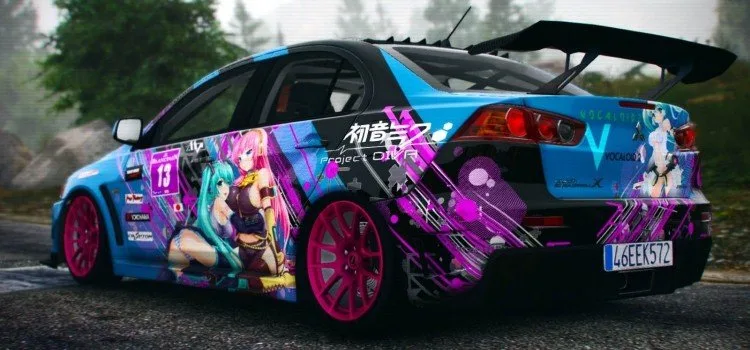
In Japan, the passion for anime and manga goes beyond collectibles and invades the streets. That is the setting for itasha (痛車): cars customized with stickers and paint of characters from anime, manga, games, or idols. The practice mixes otaku culture with automotive customization — not a museum piece, a daily driver that refuses to look ordinary.
The term “itasha” is already a joke. In the 1980s it pointed at imported Italian cars (イタリア車, Itaria-sha), shortened in slang to イタ車. Later the same sound picked up the character 痛 (ita), “pain.” For some people the wrap is painful to the eyes; for others it is a passion worth every yen — and painful for the wallet either way.
Contents 7
How did Itasha culture emerge?
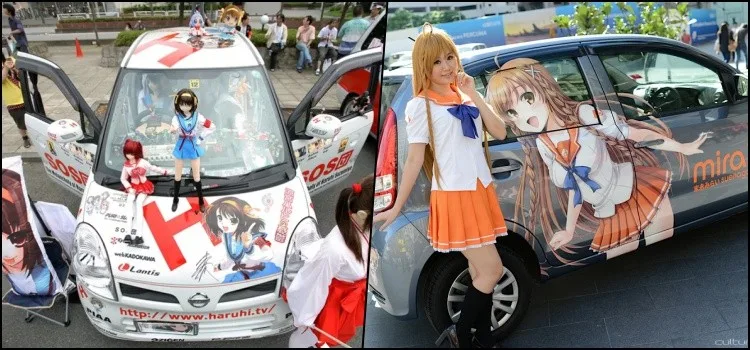
Itasha culture began to gain traction in Japan in the 1990s, when the first decorated cars started to appear on the streets. The look grew next to other loud Japanese vehicle styles, such as bosozoku bike gangs and the extravagant dekotora trucks. At first, itasha were simple stickered daily drivers. The practice later grew into full designs, custom parts, and interiors built around one franchise.
The turning point came in 2005, with a striking presence of itasha at Comiket (Comic Market), the largest dōjinshi event in Japan. Two years later, the first Autosalone (あうとさろーね) — a gathering aimed at itasha, not the Tokyo Auto Salon — was held in Ariake, next to the Comiket grounds. That is when the hobby stopped looking like a private joke and started looking like a scene.
How much does an Itasha wrap cost?
Turning a regular car into an itasha can be a serious investment. Costs vary with the type of customization and how complex the design is, but these yen ranges are a useful map:
- Partial wrapping: Between 50,000 and 150,000 yen (about 300 to 1,000 USD), depending on the area covered and the quality of the vinyl.
- Full wrapping (complete wrap): From 200,000 to 500,000 yen (about 1,300 to 3,300 USD). Detailed work or a design by a known artist can run higher.
- Custom painting: Less common because of the cost, often more than 500,000 yen.
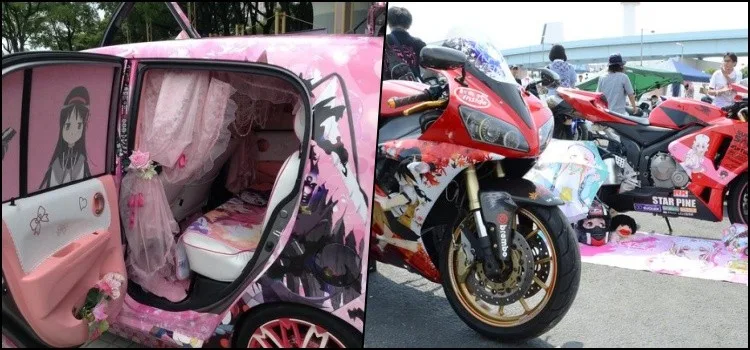
On top of stickers and paint, many owners add custom wheels, LED lights, and even engine work, which can push the bill far past the wrap itself.
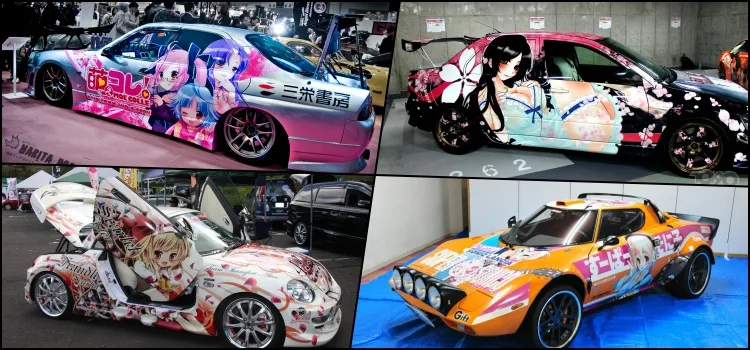
Besides the wrap, the cars used as itasha are often expensive, compact sports models — GR Corolla, Nissan 370Z, Toyota 86, Subaru BRZ, Mazda MX-5, Honda Civic, Nissan Silvia. Of course, minivans, kei cars, and even trucks are not left out. Others build itasha out of motorcycles and bicycles. Anything with wheels can become one, depending on how much you want to spend.
How to create Itasha abroad?
Itasha is still most visible in Japan, but the practice has been growing in other countries. A few practical notes if you want to try it outside Japan:
- Plan the design:
- Pick the characters or franchise and decide how they sit on the panels. Software like Photoshop helps you see the layout before you pay for vinyl.
- Find wrap shops:
- Look for local companies that do automotive wrapping and accept a custom file. Use UV-resistant vinyl so the art does not fade after one summer.
- Check local rules:
- Traffic and customization laws differ. In some places certain wraps are restricted or need approval — especially if they cover lights, plates, or windows.
- Finish the cabin:
- Seat covers, mats, cushions, and small figures complete the theme. The outside is what strangers see; the inside is what you live with.
Where to find Itasha in Japan?
If you want to see itasha in person, a few districts still concentrate the cars more than the rest of the map:
Itasha in Akihabara
Akihabara, in Tokyo, is the usual first stop. On weekends, decorated cars often sit on nearby streets while owners shop or meet. Informal gatherings happen around the district, especially when a new release or a convention weekend pulls people in.
Other popular locations
- Nipponbashi (Osaka): Known as the “Akihabara of Osaka,” another natural meeting point for itasha owners.
- Ōsu (Nagoya): Famous for pop-culture shops and a regular magnet for decorated cars.
- Dedicated events: Autosalone started the dedicated-meet habit. Larger gatherings such as Itasha Tengoku (痛車天国) in Odaiba put registered cars in one place, which is easier than hoping for a lucky parking spot.
The influence of Itasha on global culture
Itasha became a public badge of otaku pride and inspired meets far beyond those three districts. The same idea jumped to other vehicles: motorcycles are itansha (痛単車), bicycles are itachari (痛チャリ), and there are even themed trucks and aircraft when someone has the budget.
Decorating a car with a favorite character is more than a wrap job. It is a way to put identity on a license plate and live with the jokes. If you have stood next to one, you already know the visual punch. The rest is vinyl, yen, and whether you can handle being stared at in traffic.



Community
Comments
0 comments
There are no published comments in this language yet.
Send comment