
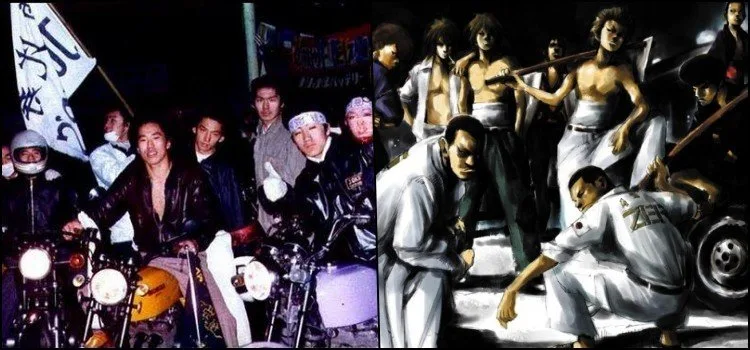
Anime flattened three Japanese street worlds into one costume: bleached hair, a loud shirt, a short fuse. On the actual streets those silhouettes had names — yankii, bosozoku, sukeban — and they were not interchangeable, and they were not the yakuza.
Japan still sells the image of quiet trains and identical uniforms. That is why these tribes stayed famous. They were the visible exception: some kids never joined a crew, some only fought at school, some built motorcycles that looked like festival floats. Pop culture kept recycling the uniforms long after the street versions thinned out.
They share a few habits and still differ from Western “bad kids.” Plenty of them do not even look the part at first glance. You have to watch the posture, the school rules they break, and the name people actually use.
Contents 8
Types of delinquents in Japan
The usual umbrella word is yankii (ヤンキー), borrowed from English “yankee.” It does not mean an American. Japanese speakers used it for a loud, rebellious look that felt foreign next to school hair codes and pressed uniforms.
In 1975 the word still pointed at poor kids from Kansai. Then it covered Japanese youths who copied American street style. It finally settled on students who refuse school norms: dyed hair, a punch perm or pompadour, a uniform worn as a dare. The film Kamikaze Girls (Shimotsuma Monogatari) still gives a clean picture of that yankii world, even while it teases the stereotype.
Yankii is the bucket. The other words are more specific. A short glossary helps, as long as you do not treat every term as a formal gang:
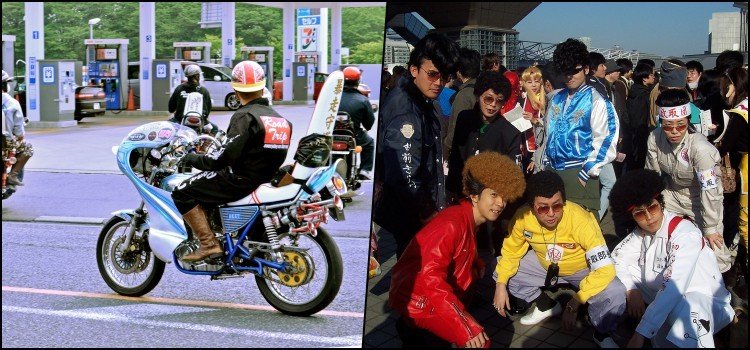
- Bosozoku (暴走族) — “reckless driving tribes,” the motorcycle crews with parade-loud bikes.
- Bancho (番長) — the male boss of a school or street crew. The female counterpart is sukeban, not a “female bancho” in everyday slang.
- Tsuppari (突っ張り) — a 1970s tough-guy style and attitude, often folded into yankii later. It is not “tsubari.”
- Sukeban (スケバン / 女番) — girl boss, or the girl crew around her. Ordinary members were not all called sukeban.
- Yakuza — Japan’s organized crime syndicates. Professional, hierarchical, and usually contemptuous of teenage punks.
- Gyaru — a fashion and girl-culture style that can look aggressive. It is not a gang by itself.
- Hashiriya (走り屋) — street racers. They share asphalt with bosozoku but chase speed more than the costume parade.
- Ijime (いじめ) — bullying. It happens in Japanese schools; it is a behavior, not a crew name.
- Furyou (不良) — “no-good,” a broad label for someone who will not follow the rules.
- Chinpira (チンピラ) — a small-time yakuza errand boy or punk on the edge of that world.
How to spot yankii and gang youth
There is no single uniform that covers every decade. You still catch a lot of them by posture before you catch them by clothes.
Yankii and related crews like to squat in a stance called unko zuwari or yankii zuwari. It looks like a toilet squat: heels down, knees out, backside close to the ground, as if the sidewalk were a throne. Anime repeats it because the pose is already a sentence. It says the person is not standing up for anyone.
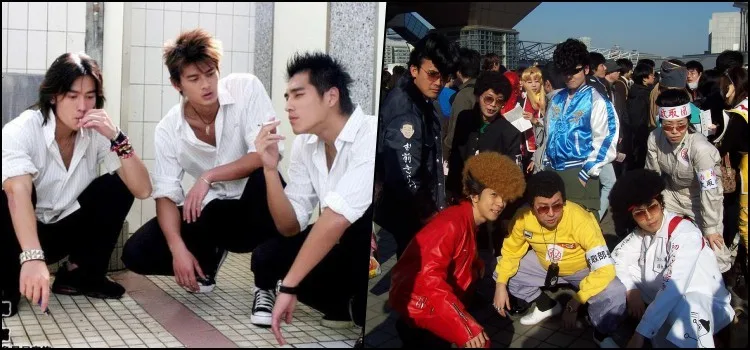
The rest of the costume changes with the tribe. Common pieces are bandanas, surgical masks, extra piercings, cheap gold, pants stuffed into boots or rolled to the knee. Some chase a hard look with scars or tattoos. Girl delinquents often wreck a school uniform on purpose: loosened scarf, loose socks, a skirt worn against the fashion of the year.
Sukeban of the 1970s usually lengthened the skirt, not shortened it. The long hem was a refusal of the miniskirt and of the “cute student” they were supposed to be. If an anime girl hikes the skirt to the thigh, you are looking at a later costume, not the classic sukeban cut.
The behavior matches the reputation more than the hair dye does. They pick fights, make noise, and treat school and neighbors as a stage. Baseball, motorcycles, and martial-arts talk show up a lot. A quiet kid in a perfect uniform can still be furyou if the attitude is there. Clothes help. They are not the crime.
The yakuza rarely treat these youths as colleagues. In that world the syndicate is a job with ranks and obligations. Yankii and bosozoku look like amateurs playing tough. Some later drift toward chinpira work. That pipeline does not make a high-school crew into the Japanese mafia.
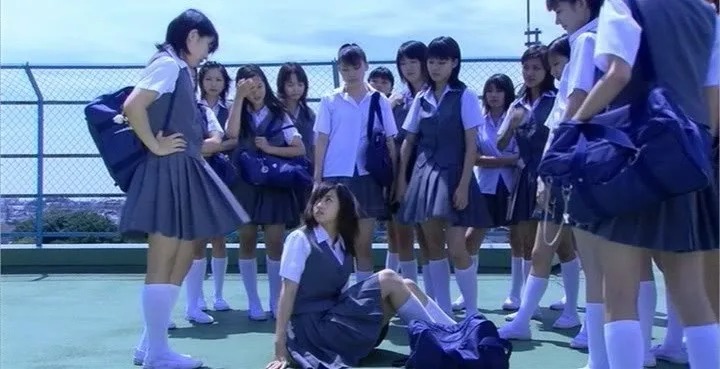
Even outgoing, funny people get called furyou (不良) in Japan. The word covers anyone who will not obey, will not blend in, or simply looks off. It can mean bad, inferior, or delinquent, depending on who is doing the scolding.
Bosozoku — Japan’s reckless riding tribes
Would you expect a country this tidy to raise motorcycle tribes that wake whole neighborhoods? Bosozoku did exactly that. They customized bikes until the machine was a billboard, then rode in packs that ignored lights, helmets, and anyone who asked them to stop.
They are not a single club with one president. Bosozoku is a style of crew: young riders, loud exhausts, and a taste for being seen. Some later crossed into yakuza life. Most were teenagers looking for a pack, not soldiers of a syndicate.
Origin and what they actually did
The word bosozoku (暴走族) took hold in the 1970s and literally means “out-of-control tribe.” The look is older. In the 1950s, while Japan rebuilt and the auto industry grew, lower-class youths formed riding groups first known as kaminari zoku (雷族), the “thunder tribes,” named for the noise.
The early story includes returning veterans who could not sit still, then younger kids who wanted the same adrenaline. Rebellion against a stiff society was the official excuse. A lot of members were simply underage and wanted a family that would have them. Japan’s age of majority is 18 since April 2022. Drinking and smoking still wait until 20. In the classic bosozoku years the crews were mostly teens, and twenty was the line where “youth trouble” was supposed to end.
That youthful need to belong is the boring truth under the legend. They were a boys’ club with engines. The 1980s and 1990s made them infamous: mass rides, smashed cars, fights with wooden swords and metal pipes, New Year runs that treated the expressway as a private track.
They like to claim a just cause. I do not buy it. Noise and vandalism do not become philosophy because someone embroidered a slogan on a jacket. If that sounds harsh, the neighbors who lost sleep for decades would sound harsher.
In 1982 police counted 42,510 bosozoku. They moved in large numbers, raced, broke traffic law, and collected an audience. Some groups copied yakuza talk about family and principle. Copying the speech is not the same as joining the organization.
Bosozoku like to call themselves a family. The resemblance to yakuza talk is part of the costume.
How bosozoku dress
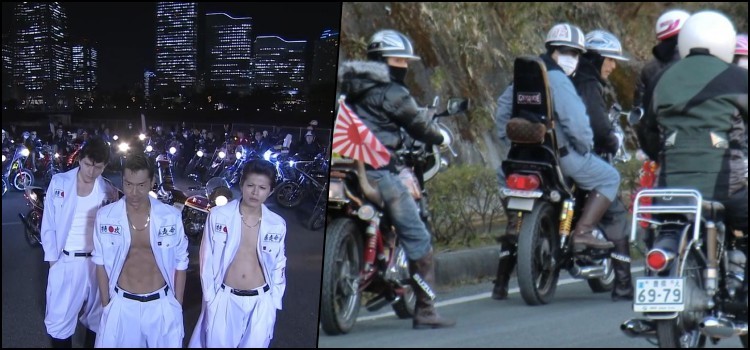
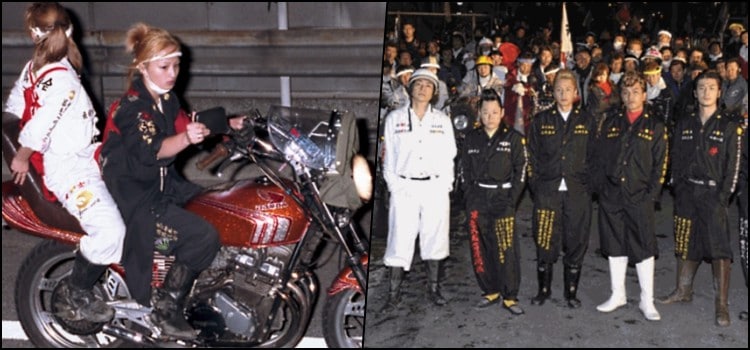
The uniform is a jumpsuit like a factory worker’s, or a tokkou-fuku (特攻服), a “special attack” coat covered in kanji slogans. Baggy pants, combat boots, a hachimaki, a surgical mask, and a punch perm or pompadour finish the silhouette. The coat often hangs open over bandaged ribs, as if the wearer had already survived something.
The bikes are the other half of the outfit. A ordinary Japanese road bike gets squeezed handlebars, a tower of fairings, a huge seat back, painted flames or a rising-sun motif, and mufflers cut to shout. Regional crews added their own excess — Ibaraki bikes are famous for stacking lights and shells until the machine looks like a festival float that escaped the parade.
For people who like quiet streets, the classic bosozoku is almost gone. In 2004 Japan tightened the Road Traffic Law and gave police a cleaner way to arrest group riders on the spot. From more than 40,000 members in 1982, counts fell below 10,000 by the mid-2000s. In 2011 the figure was 9,064. By 2015 it was about 6,771. Remaining packs ride smaller, often on scooters, often without the full costume.
A few neighborhoods still hear them at night. Anime, dorama, and films froze the 1980s version in amber: Akira, Great Teacher Onizuka, later Tokyo Revengers. Games and bedroom screens gave later teens a cheaper rebellion than a confiscated motorcycle. What remains is noisier than a book club and milder than the old speed tribes.
Sukeban — Japan’s girl bosses
Sukeban (スケバン / 女番) names the boss of an all-girl delinquent crew, and by extension the crew itself. The word spread in the late 1960s. Male gangs and the yakuza left almost no room for women with authority, so the girls built their own hierarchy. The street version is mostly gone. The school-uniform-as-armor look never left manga.
Crime writer Jake Adelstein put the oddity plainly: in yakuza life women hold almost no rank. That these girl gangs existed at all cut against a male deviant culture. The 1960s and 1970s were already arguing about feminism and women’s space in Japan. Sukeban did not write theory. They smoked in the bathroom, hid blades under long skirts, and ran their own punishments.
How sukeban lived
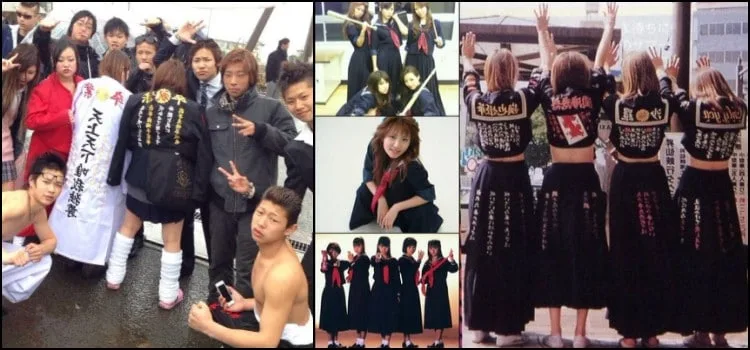
Male crews built reputations on brawls and theft. Sukeban added a written-feeling code. Each group had ranks and its own penalties. Loyalty mattered. Heavy makeup and openly sexual clothes were often treated as a problem, not a flex. The look was dyed or permed hair, thin eyebrows, a sailor uniform modified by hand, and a skirt worn long.
They started as small bathroom cliques with cigarettes. Then the numbers and the crimes grew: shoplifting, thinner-sniffing, fights with rival girls, blades and chains under the hem. Typical crews sat around 50 to 80 members. Tokyo’s United Shoplifters were said to gather about 80. The Kanto Women Delinquent Alliance was rumored — the number is a rumor — to claim around 20,000.
The most repeated 1970s name is K-Ko the Razor, out of Saitama, next to Tokyo. Stories say she hid a razor in cloth between her breasts and led a feared circle of girls. How much is police pamphlet and how much is campfire talk is hard to separate. The name survived as an urban legend because it was easy to retell.
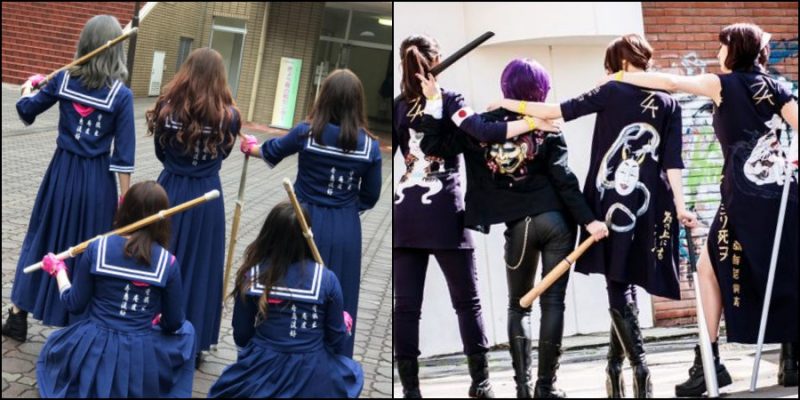
Rules, punishments, and the afterlife on screen
Breaking sukeban rules could mean a lynching, which here meant a graded beating, not a gallows. A “light” penalty was a cigarette burn on bare skin. A “medium” one, in the stories that circulated, put that burn on intimate skin. Disrespecting seniors, talking to enemies, and getting caught with drugs were listed causes. Messing with the opposite sex — cheating on a boyfriend — sat near the top.
The same girls who hid razors were often conservative about dating and sex. They wanted to look older than they were and still police each other’s romances. That mix is what later films could not resist: violence plus a moral code plus a sailor collar.
Toei’s Pinky Violence movies and series such as Sukeban Deka turned the boss-girl into a genre. Manga and games kept the silhouette after the street crews dissolved into ordinary adult life. What you meet now is usually fashion, cosplay, or a character type. The real sukeban left a stricter, smaller, and more local world than the legend on the DVD cover.


Community
Comments
0 comments
There are no published comments in this language yet.
Send comment