
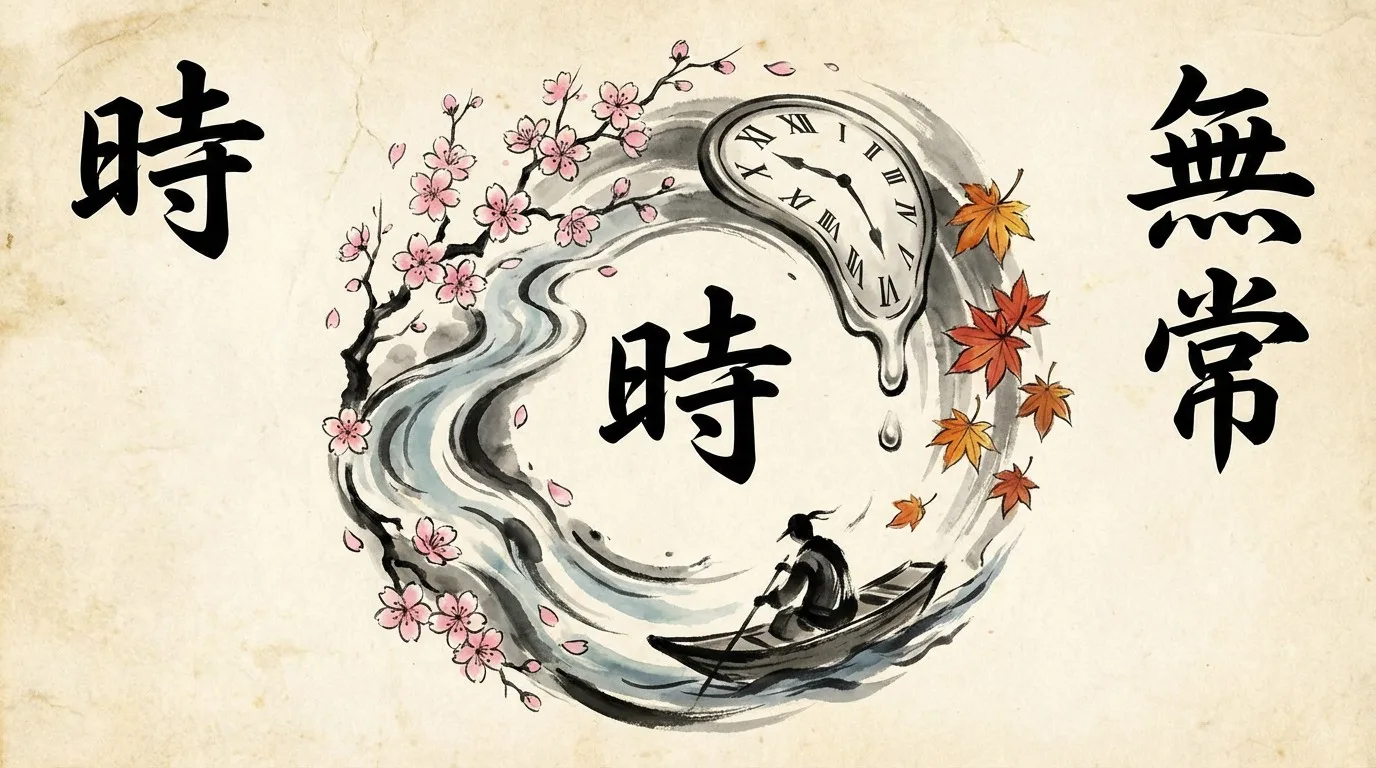
The concept of "time" in Japan is fascinating because it is not limited to a single word. Depending on the context — whether you are talking about the weather, the time that passes on the clock, or a historical era — the term changes completely.
Several languages that originated from Latin unify the concept of climatic time with period time. Although the Japanese language uses words of different origins like English and German, the ideograms always convey some unity in this sense.
If you want to understand the Japanese word for time in depth, this guide explores the essential terms, the philosophy behind them, and how to use them correctly.
Contents 7
Jikan (時間) – Time as Duration or Unit
The word Jikan is the basis for measurable time, composed of the ideograms for "time/hour" (時) and "interval" (間). It is used whenever the focus is on counting hours, scheduling availability, or the duration of an event. When you say you "don't have time" for something, you are referring to this unit that can be spent or saved.
In addition to meaning the abstract concept of chronological time, Jikan functions as the hour counter suffix. For example, when you say san-jikan (3 hours), you are specifying an exact block of time. It is the most pragmatic word in the vocabulary, treating time as a linear and quantifiable resource that governs routine and productivity in Japanese daily life.

Toki (時) – Time as Moment or Occasion
Toki represents time in its most poetic and specific form, focusing on the "when" something happens. While Jikan measures the journey, Toki marks the arrival point. It is often used to describe life stages, special occasions, or the exact moment an action occurs, functioning almost like a temporal conjunction in complex sentences.
In Japanese philosophy, Toki carries a greater emotional weight, being the word chosen to talk about memories or significant events. It is the term that appears in proverbs about the ephemeral nature of life, indicating that time is not just a running clock, but a succession of unique moments that define human experience and the circumstances of destiny.
Kikan (期間): A defined period or deadline
The word Kikan is used to define a time interval with established start and end points, being very common in administrative, legal, and technical contexts. It combines the kanji for "period/expectation" (期) with that of "interval" (間), focusing on the delimitation of a temporal space. It is the correct term to refer to contract deadlines, course durations, or product warranty periods.
Unlike Jikan, which is generic, Kikan implies a structure or purpose. When a company defines a "testing period" or the government establishes a "validity period," the precision of Kikan ensures that there are no ambiguities about when that time window closes. It is an essential word for organization and compliance with formal obligations.
Jidai (時代): An era or historical period
Jidai transports the concept of time to the macro scale, referring to large historical or generational divisions. The term is composed of the kanjis for "substitution/generation" (代) and "time" (時), suggesting the passing of the baton between different periods. It is used for both official eras, such as the Meiji Era or Edo, as well as for significant phases of personal life, such as the "childhood era."
The use of Jidai gives a tone of distance or historical analysis to the sentence. In pop culture and entertainment, the genre Jidaigeki (period films) uses this root to situate the viewer in a specific political and social context of the past. It is the word that connects individual time to the larger flow of human history and society.
Shunkan (瞬間): An instant or ephemeral moment
Shunkan refers to the smallest perceptible fraction of time, translated as "instant" or "moment." The first kanji (瞬) carries the sense of "blink of an eye," emphasizing that it is something that happens and disappears almost simultaneously. It is a powerful word, used to describe epiphanies, accidents, or the exact millisecond in which a decision changes everything.
Unlike Toki, which can be a long occasion, Shunkan is purely about brevity. In Japanese literature and art, this term is vital for expressing the aesthetics of Mono no Aware — the sensitivity to the ephemeral. It is time captured in a photograph or the brief impact of a blow in martial arts, where there is no space for duration, only for absolute presence.
Tenki (天気) – Atmospheric Time (Weather)
Unlike Latin languages, Japanese drastically separates clock time from nature time through the word Tenki. Literally translated as "energy of the sky," it describes the weather conditions of a location. Using chronological terms to talk about rain or sun is a common mistake for beginners, as for the Japanese, the weather is a spiritual and physical manifestation of the environment, not a count of minutes.
The concept of Tenki is central to Japanese culture, where observing climatic changes dictates festivals, harvests, and even social behaviors. Greeting someone by commenting on the "good weather" (ii tenki desu ne) is one of the most fundamental forms of social interaction, demonstrating how harmony with the conditions of the sky is valued in Japanese etiquette.
Other Japanese Words for Time
Aida (間): It is the purely Japanese reading of the kanji for kan. It means "between" or "interval." It is used to say that something happened during a span of time.
Toshi-tsuki (年月): Literally "years and months." It is used to talk about the time that has passed on a larger scale, usually with a nostalgic tone.
Kigai (機会): Translated as opportunity. In Japanese, often "having time" for something means having the "opportunity" (kigai) to do it.
Setsu (節): Used for seasons or seasonal periods. Time here is cyclical, linked to nature.
Gogatsu-byou (五月病) illustrates how time is inseparable from psychological state in Japan, referring to the "May sickness" that affects students and new employees after the end of the Golden Week holidays. The term encapsulates the period of discouragement that arises when the euphoria of the new school year or fiscal year (which starts in April) dissipates, showing how the calendar dictates the emotional rhythm of society.
Mae-uri (前売り) deals with temporal anticipation, specifically referring to sales or reservations made in advance. In a country where planning is taken seriously, this concept of "prior time" is vital to ensure access to events and transport, demonstrating the value placed on organization even before the main event begins.
Chou-jikan (長時間) describes a prolonged period or a "long duration" continuously. It is a word commonly used in the context of work or travel, focusing on the exhausting extent of time spent on a single activity, differentiating itself from a neutral duration by emphasizing the weight of temporal continuity.
Ichiji (一時) refers to temporary time or a momentary suspension. Unlike an ephemeral instant, this term indicates something that is valid only "for now," such as a technical stop or a provisional closure, being essential to signal that the current situation is a brief exception within the normal flow of hours.
Sakuhodo (先程) is a formal expression used for an immediate past, meaning "a little while ago." It is a word of extreme politeness, very common in business environments to revisit a topic mentioned minutes earlier, showing how the Japanese language calibrates time through hierarchy and social respect.
Kongo (今後) projects the gaze to the future from the present moment, meaning "from now on." It is a strategic term that marks the turning point where the past time is left behind and new guidelines or behaviors come into effect, being very common in official announcements and personal resolutions.






Community
Comments
0 comments
There are no published comments in this language yet.
Send comment