
Among the many Japanese legends and folktales, the story of Hanasaka Jiisan has been told for centuries. Its main character is Hanasaka Jiji, the old man who makes flowers bloom. A. B. Mitford included the tale in Tales of Old Japan in 1871, and Yei Theodora Ozaki retold it in The Japanese Fairy Book in 1903. In the best-known versions, the old man has a loyal companion: a white dog named Shiro.
The tale is a lesson in kindness set against greed and cruelty. The story is also remembered in the Japanese expression kareki ni hana o sakaseru, "to make flowers bloom on a withered tree," used when something that seemed finished comes back to life. It is one of Japan's best-known folktales, in the same company as Momotarō. Here is how the story goes.
Contents 3
The old man and his dog Shiro
Once upon a time, long ago, in a mountain village in Japan, there lived an old man and his wife. The couple made a living by working hard on their land. They had a little dog that looked very much like a wolf, with snow-white fur, named Shiro. They had no children, so they gave all their love and affection to the dog.
Shiro accompanied the couple to the fields every day. One day, the dog began barking non-stop. He ran to his owner, tugged at his clothes, and led him to a spot in the field. When they arrived, the dog began to dig rapidly. Seeing this, the old man took his hoe and helped. To their surprise, they found a box of gold coins buried in the ground. Very happy, they returned home. The generous couple gave alms to the poor and shared the gold with their neighbors.

The neighbor's greed
However, there was a neighboring couple who were stingy and greedy and did not like the kind couple. When they heard about the gold, they quickly knocked on the couple's door. They asked if they could take Shiro for just one day, hoping to find more gold. The generous old man and his wife allowed Shiro to go with them.
The wicked old man led Shiro to his own field, tied a rope around the dog's neck, and forced him to search for gold. After much mistreatment, Shiro stopped near a tree and began to sniff the ground. Thinking that the dog had found gold, the old man pushed him aside and began to dig. After much work, he found only a foul-smelling heap of refuse.
In a rage, the old man struck Shiro with his hoe and killed him. He returned home without telling anyone what he had done. The kind couple grew anxious when Shiro did not return. They went to the neighbors to ask what had happened, and the wicked old man admitted what he had done. Devastated, the good old man went to the place where his companion had died, picked him up in his arms, and carried him home to bury him.
The couple wept over the grave every day. They planted a tree beside it, and in a short time it had become a full-grown tree. One night, Shiro appeared to the old man in a dream and told him to cut it down and make a mortar from its wood.
The old man did as the dog asked. He cut the tree down and made a mortar from its wood, the kind used to pound rice for mochi, the rice cakes Shiro had loved. When he filled the mortar with rice and began to pound, the rice turned into gold coins. The more he pounded, the more coins appeared. Once again, he shared the gold with the village.

Kindness is rewarded
Again, the greedy neighbors decided they wanted the mortar. Once again, the kind couple allowed them to use it. But when the neighbors pounded their rice, it turned into a foul-smelling mess. Furious, they smashed the mortar and burned the pieces. When the good old man came to collect it, he found only ashes. He gathered them in a small basket and took them home.
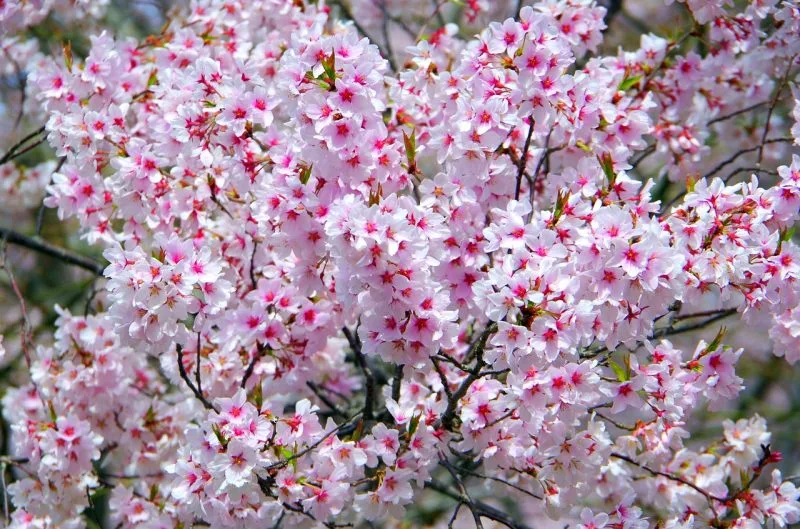
On the way, a gust of wind lifted some of the ashes and carried them to a withered tree. The tree burst into bloom, and cherry blossoms appeared on branches that had been bare. Wherever the ashes landed, more trees flowered.
Word of the blooming trees reached the local daimyo, who summoned the old man to his residence. There, the old man scattered the ashes over a withered cherry tree, and it flowered at once. The daimyo rewarded him with silk, gold, and other gifts, and gave him the name Hanasaka Jiji, "the old man who makes flowers bloom."
The greedy neighbor heard the news and gathered the remaining ashes. He went to the daimyo, claiming to be the real Hanasaka Jiji. He scattered the ashes over a withered tree, but nothing bloomed. A gust of wind blew the ashes into the daimyo's eyes and mouth, blinding and choking him. The daimyo's retainers seized the impostor and dragged him away.
The kind couple shared their wealth with the village and lived out their years in comfort. The ending changes with the telling: in Mitford's version, the kind couple forgives the neighbor and shares their fortune; in Ozaki's, he is sent to prison. In every version, the ashes bloom only for the couple who cared for Shiro, while the neighbor copies the gesture without the bond behind it.





Community
Comments
0 comments
There are no published comments in this language yet.
Send comment