
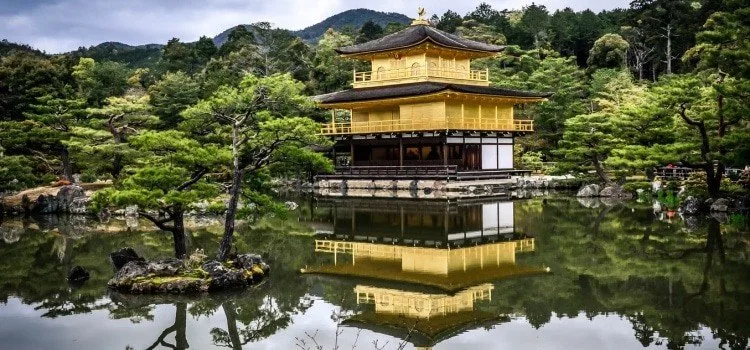
Kinkaku-ji, the Golden Pavilion of Kyoto, is one of Japan's most photographed buildings. Its top two floors are covered in gold leaf, and the structure is reflected in a pond that frames it from almost every angle. The temple is the main attraction of the Rokuon-ji complex in northern Kyoto.
This article explains what Kinkaku-ji is, how the villa of a shogun became a Zen temple, what fires destroyed it, and how to visit it without missing the details.

Contents 12
What is Kinkaku-ji?
Kinkaku-ji (金閣寺) is the popular name of Rokuon-ji (鹿苑寺), a Zen Buddhist temple of the Rinzai sect, Shōkoku-ji school. It stands in Kita-ku, in the north of Kyoto, and is dedicated to Kannon Bosatsu, the bodhisattva of compassion.
The name Kinkaku-ji means "Temple of the Golden Pavilion", but the whole complex is not gold. The phrase refers to the shariden, the reliquary hall at the center of the grounds, whose upper two floors are covered with gold leaf. The temple is part of the Historic Monuments of Ancient Kyoto, a UNESCO World Heritage Site since 1994.
Where does the name come from?
The official temple name is Rokuon-ji, and the golden building is only one part of it. Visitors and guidebooks adopted the nickname Kinkaku-ji because of the gold, and the name became more famous than the official one. The same building is also called the Golden Pavilion in English.
The gold is not decorative only. In the Muromachi period, gold was associated with protection from death and with the purification of negative thoughts. Visual excess was also a way to display power and wealth.
The Kitayama villa before the temple
Before the pavilion existed, the site held the Kitayama-dai villa of Saionji Kintsune, a powerful courtier of the Kamakura and early Muromachi periods. In 1397 the shogun Ashikaga Yoshimitsu bought the property and turned it into his retirement villa.
Yoshimitsu was the third shogun of the Ashikaga shogunate and one of the most influential figures of the Muromachi period. He moved to the villa, then called Kitayama-dai, and built a complex of pavilions, gardens, and halls. The golden pavilion was completed around 1399.
From shogun's retreat to Zen temple
The villa was designed as a place of rest and a statement of power. Yoshimitsu received guests there, held ceremonies, and used the site to show his influence over the court and the warrior class.
When Yoshimitsu died in 1408, the building passed to his son, who converted the villa into a Zen temple according to his father's wishes. The site became Rokuon-ji, and monks used it as a place of meditation. The name Rokuon, "Deer Garden", refers to a legendary deer park in the area.

Fires, war, and reconstruction
During the Ōnin War (1467–1477), most of the buildings of the complex burned down. The pavilion itself survived that war, and for centuries it was the oldest surviving structure on the site.
On 2 July 1950, a 22-year-old novice monk set fire to the pavilion. The building burned to the ground, and the original statue of Ashikaga Yoshimitsu inside was lost. The monk attempted suicide and was later sentenced; he was released in 1955 for reasons of mental health and died in 1956.
The pavilion was rebuilt in 1955 as a close reconstruction of the original. The fire is remembered in Japanese literature, most notably in Yukio Mishima's novel The Temple of the Golden Pavilion, based on the incident.
Three architectural styles in one building
Kinkaku-ji is not a single style. Each floor uses a different architectural language, and together they tell the story of the transition from courtly elegance to warrior rule and Zen practice.
The first floor, Hō-sui-in, follows shinden-zukuri, the style of the aristocratic mansions of the 11th century. It has open verandas, unpainted wood, and white plaster, and it connects the interior to the pond and the garden.
The second floor uses the style of samurai residences, with a more enclosed structure, while the third floor is a Zen hall with Chinese-style elements. The roof is topped by a bronze phoenix.
The gold leaf and the phoenix
The upper two floors are covered with 0.5-micrometer gold leaf, a very thin coating that gives the pavilion its shine. The current layer dates from a restoration between 1986 and 1987, when the old leaf was replaced with about 20 kilograms of gold.
The phoenix on the roof is a bronze ornament, not gold. It represents the mythical bird associated with the emperor and with renewal. From the far bank of the pond, the bird and the two golden floors form the image most visitors remember.

The garden and the Mirror Pond
The pavilion stands beside Kyōko-chi (鏡湖池), the Mirror Pond, which contains ten small islands and rocks arranged to represent famous places from Chinese and Japanese literature. The garden was designed so that the pavilion and the pond are seen together.
The grounds include a moss garden, a tea house, and walking paths. The route takes visitors past the pond first, then up the slope behind the pavilion, where the view changes with every step.
Kinkaku-ji and Ginkaku-ji
Kinkaku-ji was the model for Ginkaku-ji, the Silver Pavilion, built by Ashikaga Yoshimasa, Yoshimitsu's grandson. Ginkaku-ji was never covered in silver as the name suggests, but it follows the idea of a villa that became a Zen temple with a garden.
The two pavilions are often visited as a pair, and together they help explain the taste of the Muromachi period, from the gold of Kinkaku to the quieter palette of Ginkaku.
Visiting Kinkaku-ji
Kinkaku-ji is open from 9:00 to 17:00 and generally has no closing days during the year. Admission costs about 500 yen for adults, with lower prices for children; check the official site before going because prices can change.
From Kyoto Station, bus number 205 reaches the temple in about 40 minutes. Another option is the Karasuma subway line to Kitaoji Station, followed by bus 204 or 205 or a short taxi ride. The temple is usually crowded, so early morning is the calmest time.
The visit takes about 15 to 45 minutes. The path is one direction, and there are several viewpoints where the pavilion is framed by trees. The most famous view is the one from the pond, near the entrance.

Common questions
What does Kinkakuji mean? The name means "Temple of the Golden Pavilion" and refers to the gold-covered shariden of Rokuon-ji.
Is Kinkaku-ji the same as Rokuon-ji? Yes. Rokuon-ji is the official name of the temple; Kinkaku-ji is the popular name of the pavilion and of the site.
Is the pavilion original? No. The current pavilion was rebuilt in 1955 after the 1950 fire, and the gold leaf was renewed in the 1980s.
Can you go inside the pavilion? No. Visitors walk around the outside and see the building from the garden; the interior is closed to the public.
Conclusion
Kinkaku-ji is a building that has burned and been rebuilt of the same gold, and that is part of its story. The pavilion combines aristocratic, samurai, and Zen architecture in three floors, and it is surrounded by a garden designed to be seen together with the pond.
A visit to Kyoto is incomplete without it, and a little context makes the sight more than a pretty photo. The temple shows how power, religion, and taste changed in Japan, and how a single building can survive through reconstruction.
To read more: the Kyoto guide with curiosities and tourism tips, the history and practice of zazen meditation, the imperial palace garden of Kyoto, the classic characteristics of Japanese houses and the Sensō-ji temple in Asakusa.



Community
Comments
0 comments
There are no published comments in this language yet.
Send comment