
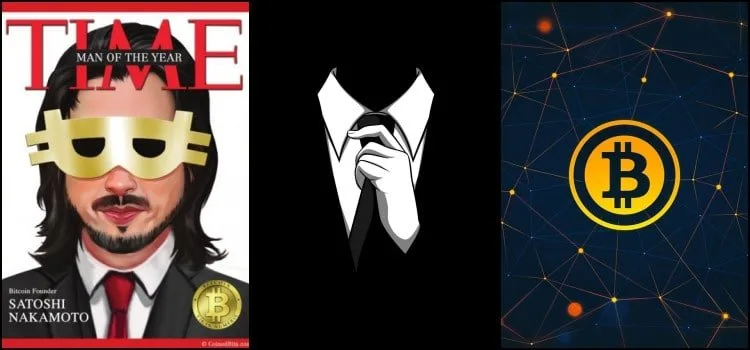
Few inventions of the last twenty years have raised as many questions as Bitcoin. And few have an inventor about whom almost nothing is known. Satoshi Nakamoto designed the system, wrote the first software and mined the first blocks. Then the person or group behind the name disappeared. This text sums up what is documented, what is suspected and why the question of identity still matters.
Contents 9
What is known about Satoshi Nakamoto
Satoshi Nakamoto is a pseudonym. The name is documented as active from 31 October 2008 to 26 April 2011. In that period Nakamoto published the concept, built the first implementation and worked on the software until the lead passed to other developers in December 2010.
The name sounds Japanese, and on his P2P Foundation profile Nakamoto gave Japan as his residence. There he described himself in 2012 as a 37-year-old man born on 5 April 1975. Whether these details are true is open. Nakamoto never shared personal information in technical discussions.
The language raises doubts as well. The published texts contain no trace of Japanese, which would be unusual for a native speaker living in Japan. That feeds the theory that the name hides a group or a person from an English-speaking background. None of these theories is proven.
The beginning: white paper and genesis block
The domain bitcoin.org was registered on 18 August 2008. On 31 October 2008 a link to a text titled “Bitcoin: A Peer-to-Peer Electronic Cash System”, written by Satoshi Nakamoto, appeared on a cryptography mailing list. The document describes a payment system without banks in which participants check each other.
On 3 January 2009 the network began when Nakamoto mined the first block, the genesis block. Embedded in that block is a line from The Times: “The Times 03/Jan/2009 Chancellor on brink of second bailout for banks”. The text gives the date and headline and points to the bank bailouts of the financial crisis.
The first years
Nine days after the genesis block, on 12 January 2009, Hal Finney received the first bitcoin transaction: ten bitcoins from Nakamoto. Finney was a cryptographer and one of the first supporters, alongside Wei Dai and Nick Szabo, whose earlier designs fed into the system.
In daily life bitcoin remained an experiment. On 22 May 2010 the first known commercial transaction took place: the programmer Laszlo Hanyecz bought two Papa John's pizzas for 10,000 bitcoin. The date is now known as Bitcoin Pizza Day, and the amount is often used to show how much the value has changed since.
The fortune in the wallet
The early blocks contain bitcoin that still sits on addresses attributed to Nakamoto. The wallet has been untouched since 2010. Estimates put the holding at around 1.1 million bitcoin. At a price above 123,000 dollars per bitcoin in July 2025, that would have been worth almost 135 billion dollars.
Those coins were never moved. That is part of the puzzle: anyone with such a holding would need the private key to send it. Nobody has done so publicly. It suggests that those involved either no longer have access or deliberately stay silent.
The last contact and the disappearance
With the handover of development Nakamoto gradually left the public stage. The last known message is dated 26 April 2011. In it Nakamoto says, in substance, that the work has been handed to others and that it is time to move on to other things.
There has been no confirmed statement since. For a project built on open software and public discussion, that is unusual. Bitcoin works without a founder because rules and code are maintained by many developers. The system no longer needs Nakamoto, yet the question of identity remains.
The candidates
Among those proposed are Adam Back, Hal Finney, Dorian Nakamoto and Nick Szabo. None of these claims was proven. Finney is mentioned most often, since he received the first transaction and lived near Nakamoto. He denied the theory during his lifetime.
In 2014 a magazine reported on a 64-year-old Japanese man named Dorian Nakamoto and called him the inventor. Dorian denied it several times. Later the P2P Foundation profile also spoke up and rejected the account. The case shows how quickly a name can become a certainty.
The best-known claim came from Craig Wright, who said in 2016 that he was Nakamoto. In 2024 the High Court in London, in the case brought by the Crypto Open Patents Association, ruled that Wright neither wrote the white paper nor operated under the pseudonym between 2008 and 2011. Judge James Mellor stated this explicitly. A 2024 HBO documentary suggested Peter Todd, which developers and observers mostly doubted.
What a satoshi is
The name also lives on as a unit. The smallest unit of bitcoin is called a satoshi: one hundred millionth of a bitcoin, or 0.00000001 BTC. The total supply is capped at 21 million bitcoin, and that limit is expected to be reached around the year 2140.
To get there, the reward for new blocks halves every 210,000 blocks. In 2026 it stands at 3.125 bitcoin per block. After that, miners will earn only from fees. This mechanism is one reason why bitcoin is often described as a scarce digital good.
Why the identity still matters
For the operation of the network the question of Nakamoto is irrelevant. For everything else it is not. Whoever holds the private key to the early addresses could move part of those coins and influence the market. The question also matters legally, for example for copyright in the white paper or for claims to the name.
There is also a symbolic side. Bitcoin was designed as a counterweight to banks and central banks, and the story of the anonymous inventor fits that claim. An identity would demystify the project but also make it vulnerable. Perhaps that is why the question stays open.
Conclusion
What is documented is the white paper of 31 October 2008, the genesis block of 3 January 2009, the first transfer to Hal Finney and the withdrawal by 2011. What is not documented is who stood behind the name. Every candidate so far has been disproven or never proven, and the roughly 1.1 million bitcoin from the early years remain untouched.
Read more: yen coins of Japan, talking about money in Japanese, kinpuu money envelopes, the Japanese economic miracle and the five-yen lucky coin.




Community
Comments
0 comments
There are no published comments in this language yet.
Send comment