
Are foreigners discriminated against in Japan? Articles involving prejudice, racism, and xenophobia keep coming back on this site, and they always generate controversies.
Be very careful when reading this. Many readers take what I write too seriously and generalize, as if all of Japan and every Japanese person were prejudiced. Remember that things are relative: if I mention this or that case, I am talking about a minority, not the majority.
If, after reading this article, you walk away thinking Japanese people are prejudiced, you are the one doing the generalizing. Discrimination against foreigners exists in any country. Sometimes it is prejudice. Sometimes it is language, a landlord's fear, or a rule that was never written for someone without a Japanese guarantor. Read the cases without turning them into a national character.
Contents 4
Don't generalize
We are not going to downplay the cases of discrimination and prejudice in Japan; they show up in the next sections, in plain language. We just do not want you to treat them as the whole country.
You will meet Japanese people who are prejudiced at heart, or who act that way in a group without thinking. You will also meet the rest. Japan's population is about 124 million. Even in a thought experiment where one person in ten were hostile — and that is not a measured rate — you would still have nine people who are not. Don't let the hatred of a dozen people take away the joy of living in Japan.
We are not saying there is one prejudiced person for every ten in Japan. The number is likely lower. Humans just like to generalize.
The same habit shows up in other labels. Japan still carries a reputation as a suicidal country, yet the official rate in 2025 was about 15.4 deaths per 100,000 people — high next to some countries, not a reason to stamp a whole nation.

Fear of foreigners?
Japan now has more than four million foreign residents. Most of that growth is work, study, and family — not a tourist weekend. The country is more used to outsiders than it was a decade ago, and it is still capable of treating someone as a guest who never quite belongs.
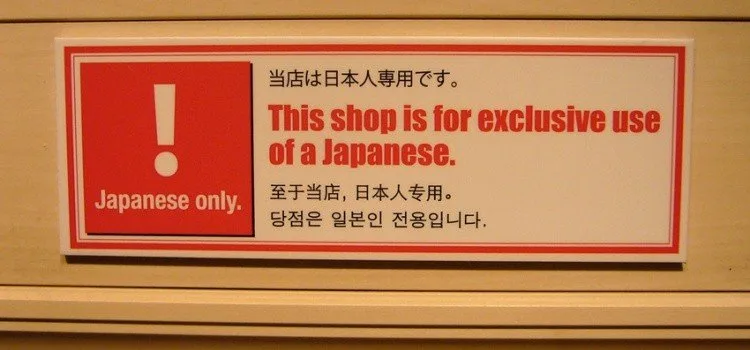
What people call xenophobia here is often not a slogan. It is a landlord who will not take a foreign name, a shop that puts up a Japanese-only sign, a coworker who switches to English even when your Japanese is fine. Those scenes are real. They are also not the only scenes.
Tourists usually feel the kind side first: help on the platform, extra patience at the register. The harder friction tends to show up when you try to rent, work, enroll a child, or live next door for years. That gap is why a visitor can leave in love with Japan while a resident is still collecting refusals. Japanese cultural values help explain the caution — uchi and soto, the inner circle and the outside — without turning it into an excuse.

Occasions when foreigners are discriminated against in Japan
Housing is still the place most people hit a wall. A Justice Ministry survey of foreign residents, released in 2017, found that among those who had looked for a home in the previous five years, 39.3 percent were denied a lease because they were foreign. About a quarter gave up after seeing “no foreigners” on a listing. A Japanese guarantor is another common filter, even for people with permanent residence.
That pattern has not vanished. Real-estate desks still call owners and hear a flat no once the word “foreigner” is said. Some owners talk about garbage rules, noise, or unpaid rent; others simply do not want the hassle. None of that makes a blanket refusal fair. It does mean the problem is practical and documented, not a rumor from a forum.
Work is the next layer. The same 2017 survey recorded job refusals tied to nationality. Later government questionnaires keep showing complaints about lower pay and weaker promotion compared with Japanese colleagues. Finding a job is possible — Japan needs the labor — but the door is narrower than the slogans about “internationalization.” If factory work is the path you were sold, think about what that contract actually looks like.
Daily life is messier than a single story. There are bars and sento with Japanese-only signs. There are schools where a foreign child is accepted in practice even though compulsory education law is written for Japanese nationals. There are police ID checks that land more often on people who do not “look Japanese.” Experience also changes with skin, passport, and language: Black residents and long-term Korean residents do not walk through the same set of doors as a white tourist with a camera.
What we will not do is pile on vague claims — that every foreigner pays more, that every classroom charges higher tuition, that Japanese TV only shows foreigners as lazy or dirty. Some stereotypes exist. They are not a substitute for the housing number, the sign on the door, or the job that never called back.

What to do if I suffer discrimination in Japan?
If you feel you are being discriminated against, start with the person or office in front of you. A calm conversation solves more than people expect, especially when the issue is a misunderstanding and not a closed policy.
If that goes nowhere, Japan is not the United States: there is no Equal Employment Opportunity Commission waiting to take the case. The Ministry of Justice runs a Foreign-language Human Rights Hotline at 0570-090-911 (English and other languages, weekdays). Legal Affairs Bureaus offer face-to-face counseling. Your embassy or consulate can explain your options and, in some cases, point you to a lawyer.
You are not the first person to hit this wall. Friends, other foreigners in the same city, and local support desks exist for a reason. And if the environment is rotten — a workplace, a building, a circle that has already decided you do not belong — leaving that room is not defeat. It is refusing to let a minority set the picture of the whole country.
Remember: if you suffer discrimination in Japan, not all Japanese people are like that. You are probably in the wrong environment, not the wrong country.





Community
Comments
0 comments
There are no published comments in this language yet.
Send comment