
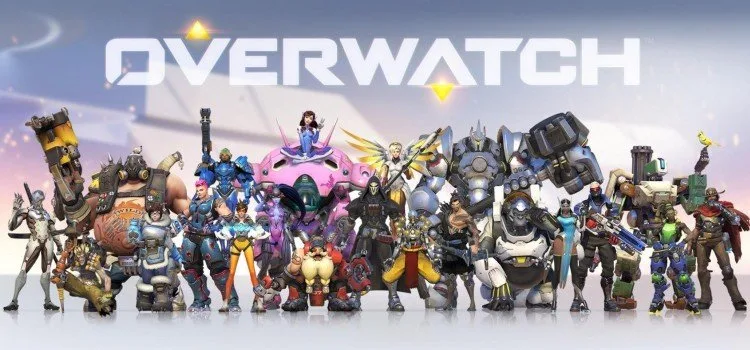
What is written on the walls of the city of Hanamura? What do Hanzo and Genji shout when they unleash their ultimate abilities? In this article, we will look at a few curiosities and study some phrases from Overwatch in Japanese. If you are part of the gaming universe and still don't know this epic 2016 release — an FPS (first-person shooter) that mixes heroic characters with unique abilities, each enabling a totally distinct playstyle — this is your invitation. I will also take the opportunity to share a few curiosities involving Overwatch in Japan.
Game description: In a time of global crisis, a group of heroes comes together in an international task force to restore peace to a world ravaged by war. The group, called Overwatch, ended the crisis and helped maintain peace for the following decades, inspiring an era of exploration, innovation, and discovery. But after many years, Overwatch's influence waned until one day it disbanded. Now, conflicts are once again erupting around the world, and new and old heroes are being called upon.
Contents 5
Hanzo and Genji — the Shimada clan
Let's start by translating two phrases from these dragon brothers. They are the ult voice lines, spoken in Japanese in-game regardless of the player's chosen language. The ultimates of both characters are tied to dragon imagery.
Hanzo — the skilled archer, when unleashing his ultimate ability:
龍が我が敵を食らう;
Ryū ga waga teki wo kurau;
The dragon devours our enemies.
- 龍 (Ryū) – dragon.
- が (ga) – particle marking the subject of the sentence.
- 我が (waga) – my (archaic).
- 敵 (teki) – enemy(ies).
- を (wo) – particle marking the direct object.
- 食らう (kurau) – to eat; to devour (in an aggressive or emphatic sense).
Word-for-word, the line translates as: "The dragon eats our enemies." In context, however, it is more poetically rendered as "The dragon devours our enemies." The verb devours adds a symbolic and dramatic weight, which is common in literary translations seeking to make an impact on the reader.
Hanzo's name is written 島田半蔵 (Shimada Hanzo). Shimada is a city in Shizuoka Prefecture, and also refers to a hairstyle and hairpin popular during the Edo period. Hanzo is composed of the kanji 半 (half; odd number) and 蔵 (to hide; to own a warehouse).
Hanzo's name is historically associated with Hattori Hanzo, a famous samurai and ninja master — a reference that lends the character an air of strength and mystery.
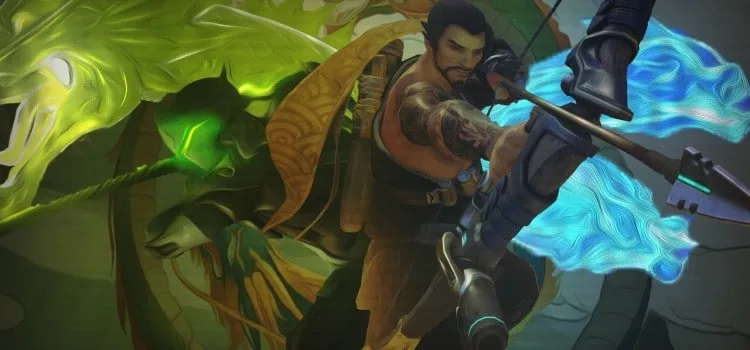
Genji — the cyborg ninja swordsman, when unleashing his ultimate ability:
竜神の剣を喰らえ;
Ryūjin no ken wo kurae;
Receive the sword of the dragon god.
- 竜神 (Ryūjin) – dragon god.
- の (no) – possessive particle ("of").
- 剣 (ken) – sword.
- を (wo) – particle marking the direct object.
- 喰らえ (kurae) – imperative form of "to devour".
Some sites translate the line as "Face the sword of the dragon," but the verb 喰らえ literally means "to receive a blow" — and is also used for eating and drinking. 竜神 combines the kanji for "dragon" and "god," so it does not necessarily refer to a dragon god; it can equally mean a dragon king. The kanji 剣 literally means "sword" — a double-edged blade, a saber, or any blade in general.
Genji's name is written 源氏, where 源 means "source, origin" and 氏 means "family name, surname, clan." These kanji carry additional historical meanings and references that go beyond the scope of this article.
Genji also has several other Japanese voice lines in the game:
- 「始め!」 — (hajime!) — Begin!
- 「水のように流れ」 (mizu no yō ni nagare) — Flow like water.
- 「俺は風だ!」 (ore wa kaze da) — I am the wind!
- 「覚悟」 (kakugo) — Resolve / I am ready.
- 「まだまだ」 (mada mada) — Not yet — not nearly!
- 「いざ尋常に勝負」 (iza jinjō ni shōbu) — Let us fight fairly.
- 「くそ」 (kuso) — Damn it.
- 「上等だ」 (jōtō da) — Bring it on.
- 「我が魂は まだ燃えておる」 (waga tamashī wa mada moete oru) — My soul still burns.
- 「防衛戦願おう」 (bōei-sen negaou) — Let us pray for the defense.
- 「我が心明鏡止水」 (waga kokoro meikyōshisui) — My heart is clear as a still mirror.
- 「我が魂は均衡を求める」 (waga tamashī wa kinkō o motomeru) — My soul seeks balance.
Exploring Overwatch in Japanese: a tour of Hanamura
The name of the map Hanamura (花村) means "village of flowers" in Japanese. On this map, several secrets and references to the Japanese language and to Japan itself are hidden. Entering the spawn area, you encounter a red curtain inscribed with the following text:
竜の吐息で魂も凍る (right side);
Ryū no iki de tamashī mo kōru;
From the dragon's breath, even the soul freezes.
竜の心で気合全開 (left side);
Ryū no kokoro de kiai zenkai;
With the dragon's heart, fighting spirit at full throttle.
The word 気合 can be translated as "war cry" or "fighting spirit." 全開 means "fully open" or "at full power." Inside the Shimada castle, you will also find two more identical inscriptions on the wall, quoting a famous Japanese proverb:
七転八起
shichiten hakki
nana korobi ya oki;
Fall seven times, stand up eight.
Halfway through the Shimada castle, in the cinematic animation, you will spot another large scroll bearing the inscription 竜頭蛇尾 (ryūtōdabi). This is yet another Japanese wordplay: the expression refers to an anticlimax — something that starts strong and ends weakly. But if you read the kanji individually, they simply mean "dragon's head, snake's tail."
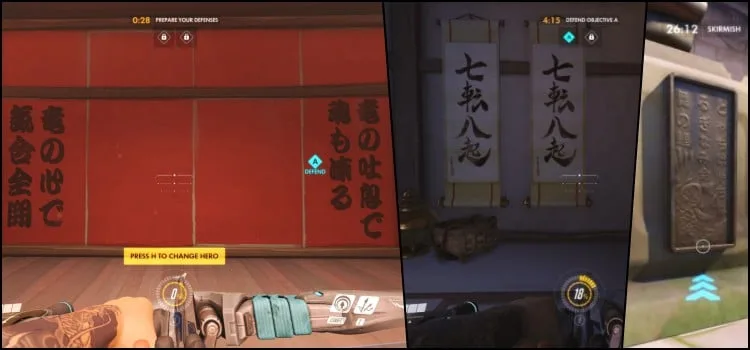
To wrap up, let's examine a particularly tricky phrase engraved on a robotic koi statue:
とやちはやちはるぎなみ命舞の鯉
To ya chi haya Chiharu gina mi inochi-mai no koi
Because the phrase is written entirely in hiragana, translating it is difficult. We can identify the kanji for "life" (命, inochi) and the syllables mai no koi, which can be read as "the dance of the carp." Some believe that 命 may refer to the deity Mikoto. It is also possible that the statue is connected to the legend of the dragon.
Curiosities about the Japanese voice cast
The voice of D.Va in the Japanese version of Overwatch is performed by Risa Taneda, well known for voicing Kaori in Shigatsu wa kimi no uso, Erina in Shokugeki no Sōma, and Mirai in Kyōkai no Kanata.
The voice of Pharah is performed by Romi Park, recognized for her work as Edward in Fullmetal Alchemist, Temari in Naruto, and Zoe in Shingeki no Bahamut. For more seiyū from the Japanese version of Overwatch, take a look at this external cast list on Behind The Voice Actors.
To conclude, we leave you with the first Japanese trailer of the game. I hope you enjoyed this short linguistic tour of Overwatch in Japanese! Don't forget to share the article and leave your comments below.


Community
Comments
0 comments
There are no published comments in this language yet.
Send comment