

Overwatch uses Japanese lines that are easy to remember because they arrive at the most tense moment of a match. Hanzo and Genji are the best place to start: their ultimate calls use dragons, older-sounding wording and forceful verbs. This guide explains what those phrases mean, how to read them and where a literal translation needs a little context.
The goal is not to memorize a speech before queuing. Listen for a few pieces at a time: ryū for dragon, teki for enemy and ken for sword. Once those words are familiar, the lines stop sounding like a single dramatic blur.
Contents 5
Hanzo: 竜が我が敵を喰らう
竜が我が敵を喰らう
Ryū ga waga teki o kurau
A close reading is “The dragon devours my enemies.” English subtitles and localizations may choose a more dramatic sentence, but the Japanese is useful precisely because its parts are clear:
- 竜 (ryū) — dragon. 龍 is another common character for dragon; both forms appear in Japanese writing.
- が (ga) — particle marking the subject.
- 我が (waga) — an old-fashioned or literary “my.” It gives the line a grand, theatrical tone.
- 敵 (teki) — enemy or enemies.
- を (o) — particle marking the object of the verb. It is often written wo in older romanization systems.
- 喰らう (kurau) — to devour; a rough, emphatic verb that also appears in expressions about taking or suffering a blow.
The important point is the verb. Kurau makes the dragon active and threatening, so “devours” fits better than a neutral “eats.” Waga also does more than add possession: it makes the line sound deliberately formal rather than conversational.
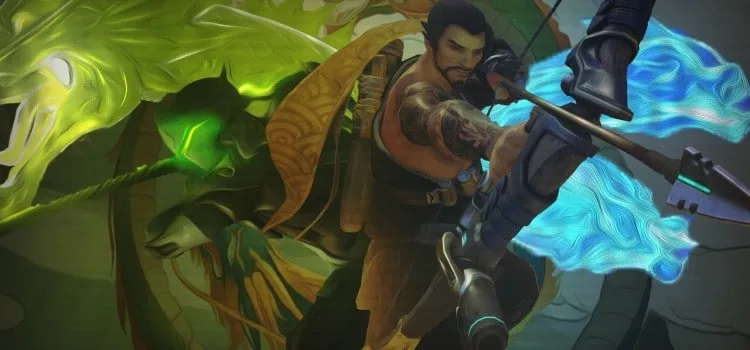
Genji: 竜神の剣を喰らえ
竜神の剣を喰らえ
Ryūjin no ken o kurae
The second line is often rendered as “Taste the blade of the dragon god!” Word for word, it is built from ryūjin (dragon deity), no (of), ken (sword) and kurae, an imperative form of kurau.
That imperative is why “taste” or “take this” sounds more natural in English than “eat.” In a combat line, it is a command aimed at an opponent: receive the force of this blade. The phrase is compact, but it has the same aggressive edge as Hanzo line.
- 竜神 (ryūjin) — dragon deity. Japanese uses this term in mythic and fantasy contexts.
- の (no) — connects nouns, here “of the dragon deity.”
- 剣 (ken) — sword or blade.
- 喰らえ (kurae) — “take it,” “taste it” or “receive it,” said with force.
How to study game voice lines without guessing
Japanese game dialogue often compresses grammar for pace and character. A subtitle can be a good translation while still leaving out the literal shape of a line. Start with the Japanese text, separate the particles, then compare the official subtitle as an adaptation rather than a dictionary answer.
- Listen once for the rhythm, without pausing.
- Read the line in kana or kanji and identify one new word.
- Check the particle: ga often marks what acts, while o often marks what receives the action.
- Say the line aloud slowly, then return to the audio at game speed.
If kana still feels intimidating, use this Japanese kana guide before trying to read game dialogue at full speed. Romanization can help at first, but the Japanese writing makes repeated words easier to notice.
Japanese flavor in Overwatch
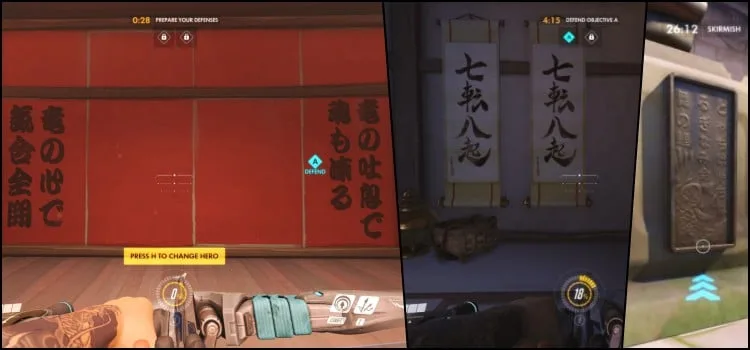
Hanzo and Genji lines work well for learners because they mix everyday grammar with a heightened fantasy register. The particles are ordinary Japanese; words such as waga, ryūjin and kurau give the delivery its heroic weight. You do not need to treat every line as a literal phrasebook entry. The value is hearing how word choice changes tone.
For a second kind of language play, explore Japanese puns known as dajare. They show a much lighter side of Japanese sound patterns than an ultimate ability, but the same habit helps: notice the repeated sound first, then check what each word can mean.
Quick reference
| Japanese | Reading | Useful meaning |
|---|---|---|
| 竜 | ryū | dragon |
| 敵 | teki | enemy |
| 剣 | ken | sword |
| 我が | waga | my, in a literary style |
| 喰らう | kurau | devour; take or suffer forcefully |
These two ultimates are short enough to revisit whenever you play. Learn the literal pieces first, keep the dramatic context in mind and let the audio do the rest.







Community
Comments
0 comments
There are no published comments in this language yet.
Send comment