
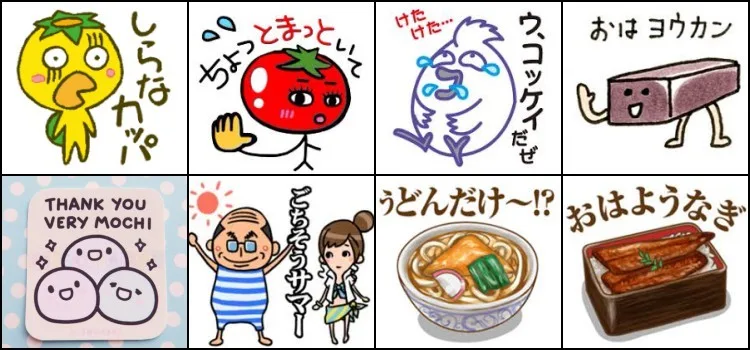
There are many different kinds of puns and word games. In Japanese, this phenomenon is even more pronounced, thanks to the countless expressions and the many possible readings of a single kanji. Bad puns in Japanese are called dajare (駄洒落) and can carry a slightly self-deprecating tone, often meaning a weak or corny joke. Studying these wordplay gems will not only make you laugh, but also widen your grasp of the language.
A pun can be a play on words or the act of combining words with similar sounds. There is a related concept called goroawase (語呂合わせ), which covers rhyming, wordplay, and humorous neologisms. The word is composed of the kanji for "language" (語), "spine" (呂), and the verb "to combine" (合わせ). Another umbrella term is kotobaasobi (言葉遊び), which literally means "play with words."
In Portuguese, bad puns often rely on similar sounds or identical words with different meanings. In Japanese, there are thousands of puns that play on identical words, partly because Japanese has a much smaller pool of syllables than most other languages.
The sheer number of linguistic and written ambiguities available to Japanese speakers makes possible types of wordplay we rarely encounter in other languages. In this article, we will focus on dajare, the bad puns. We will also drop in a few comic strips for you to decipher on your own. ;)
Contents 3
Bad puns in Japanese – so bad they're good
Sometimes the humour of a Japanese pun slips past us because of the language barrier. What works in English does not always translate into Japanese, and vice versa. Let's see if you can crack the ones below:
- パンダの好きな食べ物は何ですか?
- Panda no suki na tabemono wa nan desu ka?
- What is the panda's favourite food?
- Answer: パンだ! — pan da! ("bread")
The first pun works a bit like classic English riddles: the answer is hidden in the question. パン (pan) means "bread" in Japanese, and だ (da) is a colloquial short form of desu (です), essentially meaning "is." Put together, the answer literally declares "It's bread!"
- 先生:「Eu vou para Tokyo」を過去形にしなさい。 / 学生:「Eu vou para Edo」
- Sensei: … o kako-katachi ni shi nasai. Gakusei: …
- Teacher: Put the sentence "I am going to Tokyo" in the past tense. Student: I am going to Edo.
In Portuguese class, the teacher asks the student to put "I am going to Tokyo" into the past tense. The student answers "I am going to Edo" — because Edo was the old name of Tokyo until the mid-19th century. The pun doesn't rest on the Japanese language itself, but on a piece of Japanese history.
- 禁煙なんて簡単だよ。私はもう100回はやったね
- Kin'en nante kantan da yo. Watashi wa mou hyakukai yatta ne
- Quitting smoking is easy. I've done it about a hundred times.
This pun barely needs an explanation. It also works almost identically in English and other languages.
- アルミ缶の上にあるみかん
- arumi kan no ue ni aru mikan
- A tangerine on top of an aluminium can.
Arumi kan means "aluminium can"; mikan means "tangerine."
- ねえ、ちゃんと風呂入ってる? — Do you actually take a bath regularly?
- Can be confused with:
- 姉ちゃん、お風呂入ってる? — Is your older sister in the bath right now?
Puns with similar words
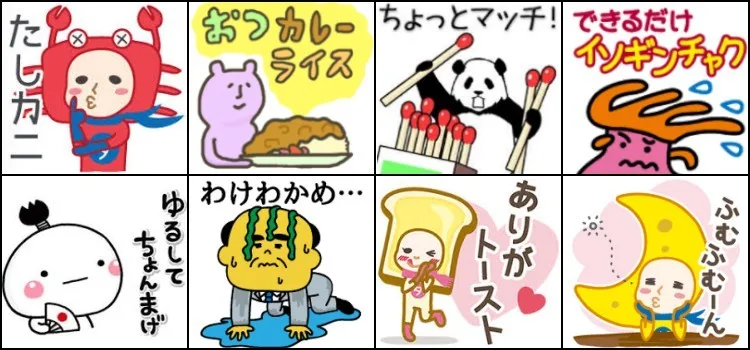
There are thousands of bad Japanese puns that play on identical-sounding words. Here are a few:
- イルカがいるか
- Iruka ga iruka?
- Are there dolphins?
Both the word "dolphin" and the question "are there?" are pronounced iruka. The only difference is the script: "dolphin" is written in katakana, while the question is entirely in hiragana.
- スキーが好き
- Sukī ga suki
- I like skiing.
Same principle: "skiing" (スキー, sukī) and "to like" (好き, suki) are homophones.
- 布団がお山の方まで吹っ飛んだ。おや、まあ!
- Futon ga oyama no hō made futtonda. Oya, mā!
- The futon flew all the way to the side of the mountain. Oh my!
Another example that stacks similar-sounding words. In this case, the sentence contains two puns at once: oyama ("mountain" + filler syllable) and futtonda ("flew off").
- パン作ったことある?
- Pan tsukutta koto aru?
- Have you ever baked bread?
Anyone hearing this without kanji might parse it as Pantsu kutta koto aru? ("Have you ever eaten underwear?"), which is exactly the kind of accidental humour dajare thrives on.
- 虫は無視する
- Mushi wa mushi suru
- Insects ignore insects. (Literally: "as for insects, insects do.")
Other puns involving Japanese
If you study Japanese, you have probably invented or stumbled upon a bad pun in Facebook groups or other social networks that mashes Japanese with another language. Japanese phonemes often ring familiar to non-Japanese ears — a Japanese word may sound like something funny in another language, and the result is a steady stream of cross-linguistic wordplay.
One well-known group that curates this kind of wordplay is Nihongo o benkyō suru hōhō! — take a look and you will be in stitches. I hope you enjoyed this article. Do you know any other bad puns involving the Japanese language? Drop them in the comments and share them with your friends!
Related articles on skdesu.com:




Community
Comments
0 comments
There are no published comments in this language yet.
Send comment