
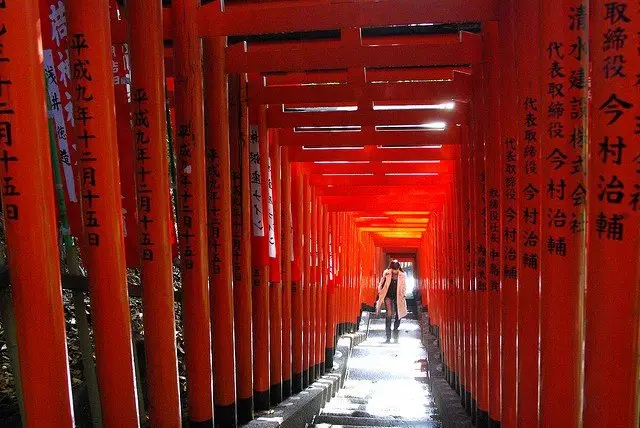
Torii are usually reddish or orange portals made up of two vertical pillars connected by a horizontal beam that surround Shinto shrines in Japan. These portals are famous worldwide and aesthetically pleasing, becoming a symbol of Japanese culture.
The torii [鳥居] are placed near lakes, forests, in the city, and even in the sea alongside the more than 90,000 Shinto shrines and temples found in Japan. Some are placed in rows and fill even mountains, resembling a portal to another world.
In this article, we will look at the five most impressive portals in Japan, as well as their meaning and architecture. We will visit the most popular, the largest, and the most notable in Japan.
Contents 7
Meaning and origin of a torii
The torii is an architectural ornament that represents the passage from the world to a sacred place. This portal marks the sacred entrance to a Shinto shrine or temple.
The name torii [鳥居] is often translated as "dwelling place of birds," though this is one of several proposed etymologies. In Japan, birds are seen as messengers of the kami (the deities of Shinto), and it is considered a good omen when one perches on the crossbar of a gate.
Buddhist temples can also have a portal, and in Japan these often carry the manji [卍], a symbol Buddhists have used for roughly a thousand years. The same character later reappeared in twentieth-century European iconography under a different name and with a different meaning; the two uses are independent of one another. It is common to find a Shinto shrine on the same grounds as a Buddhist temple in Japan, as the two traditions have long coexisted. For more on the history of this symbol, see our article on the Buddhist swastika and its later European counterpart.
The exact origin of these portals is not known. Some theories claim that it was an indigenous invention, while others say it was imported from other Asian cultures. China and Korea, for example, also use similar gateways, each with their own characteristics.
A torii is usually red because, in Japanese tradition, this color is believed to have the power to ward off disease. There are torii made of stone, bronze, and other materials as well, but the most common are red wooden portals.
Torii gates scattered across Japanese cities
We know that the portals mark the entrance to a sacred place, but why do we find various portals scattered in the large cities of Japan with no shrine nearby?
Generally, when there is a portal, you will find a shrine nearby, even if it is very small. However, some portals scattered throughout the city serve only as a warning for people not to litter or urinate in the area.
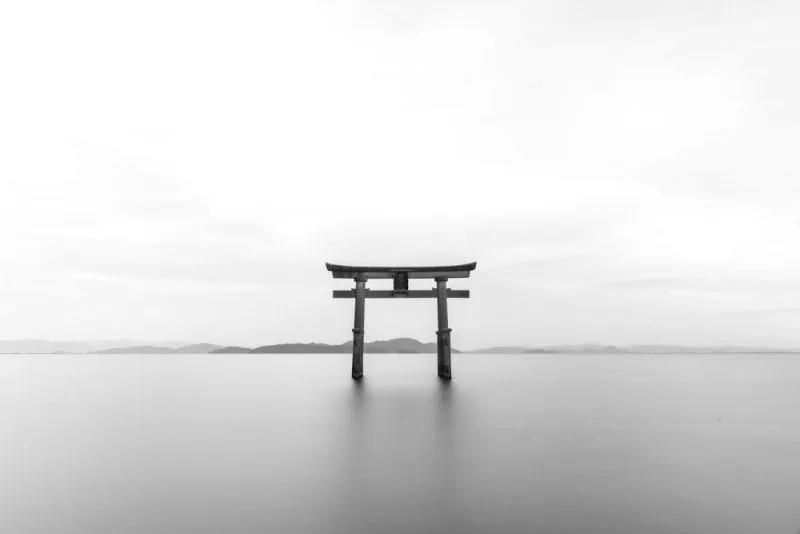
Others also use these portals simply for their architecture and tradition. They can also be placed to mark the entrance to imperial locations and some castles that usually have a shrine somewhere.
These torii can be found in various sizes, including a size so small that it can be placed on a table and where no one can pass underneath. These small portals can be purchased with a name carved into them as a kind of lucky charm.
Floating torii at Itsukushima Shrine
The floating torii of Itsukushima Shrine on Miyajima Island is one of the most iconic tourist spots in Japan. It is also one of the oldest torii in Japan, although it has been destroyed and rebuilt several times over the centuries.
The torii is placed slightly on the surface of the ocean to give the impression that it is floating. It looks dramatically different depending on the tide and the light. It is exactly in this place that one of the most popular photos in Japan is taken.
When the tide is high, the torii appears to be standing over the sea, but when the tide is low, the view becomes even more beautiful, revealing the sand and the clear water around the gate. We have already written an article about the islands of Japan, including Miyajima.
Fushimi Inari — the mountain of torii
The torii is a typical construction of Shinto, the indigenous religion of Japan. These red gates represent the entrance to a sacred territory, and the structure usually attracts the attention of tourists and locals alike. Mount Inari is filled with them, with an estimated more than 10,000 torii covering the slopes of the mountain.
Fushimi Inari is a mountain dedicated to the goddess Inari, who presides over business, rice, and prosperity. Businesspeople from across the Kansai region visit Fushimi Inari to pray for success in their ventures.
Those who enjoy success often donate a torii to the shrine, which is by no means cheap. They also usually engrave their name, or the name of their company, on the torii. The shrine has thousands of portals, creating a striking view.
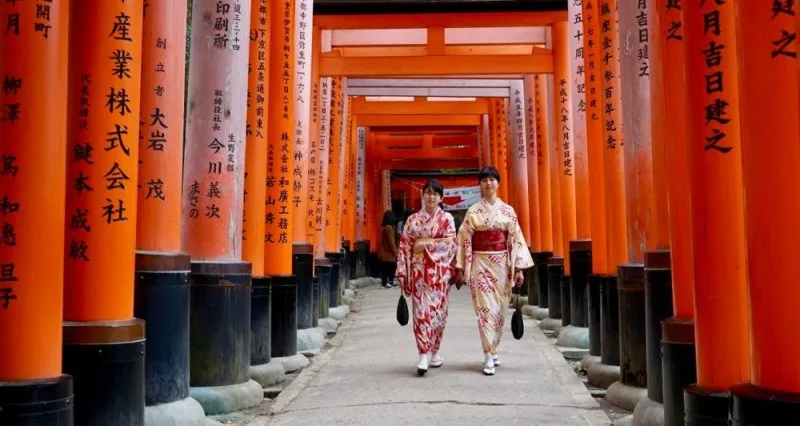
The mountain is 233 meters above sea level. It has several trails that spread over four kilometers and takes about two hours to traverse the entire mountain.
The mountain is also famous for the thousands of small shrines scattered throughout the area. In these places, you can often find small torii, fox statues, and shops and restaurants in the middle of the mountain.
I had the chance to visit this mountain and walk for hours through the thousands of torii that surround the slopes and the small shrines tucked into the corners. There are giant portals and very small ones.
I have already written an article about Fushimi Inari, but I will leave below a video of my walk on this incredible mountain located in the traditional and famous city of Kyoto, the former capital of Japan.
Fushimi Inari Taisha is the main Shinto shrine dedicated to Inari, located at the base of the mountain. Inari is the goddess of rice, fertility, agriculture, foxes, and success and prosperity in business.
Some of the structures on the mountain were first built in 711, and many of the torii are donated by businesspeople hoping for prosperity. People from across the Kansai region, and from Japan more broadly, often visit the site to pray for success in life. The torii are expensive: a small one usually costs around 400,000 yen and can easily exceed 1,000,000 yen.
Visitors also often make offerings of origami, miniature torii, or paper triangles shaped like a fox's face. These items can be bought in the little shops that surround the entire mountain. The view from the upper trails is unique and rewards the effort of climbing, with glimpses of the forest and even of Kyoto in the distance.
Floating torii at Hakone Shrine
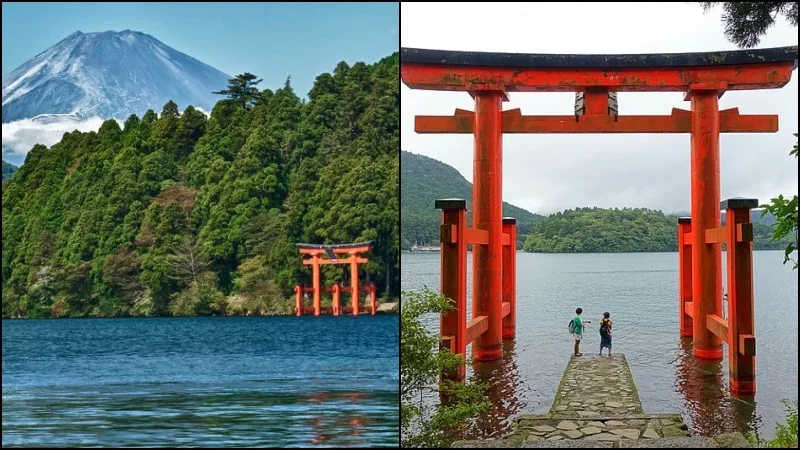
The torii of Hakone Shrine stands on Lake Ashinoko, near a large forest. On clear days, Mount Fuji appears behind the gate. Lake Ashinoko is a volcanic crater lake whose color shifts with the weather and the season.
I visited Hakone and had the chance to photograph this large torii while riding the famous pirate ship that crosses the lake, taking people from the wonderful cable car to the two small villages that provide access to other places such as hotels, onsen, and other cities.
Torii come in many styles. There are models that have a rope tied across the opening, called shimenawa, instead of a wooden crossbeam. There are also torii with three base pillars instead of just two.
Meiji Shrine in Yoyogi Park
When visiting Meiji Shrine, located in Shibuya in Tokyo, you will see a gigantic wooden torii of imperial size. This gate is stamped with the chrysanthemum seal of the Emperor of Japan. Among shrines, this seal marks the highest status.
You can reach this shrine in Yoyogi Park via Harajuku or Shibuya station. The park is huge, and you will find more than one portal while walking around. Be sure to take plenty of photos.
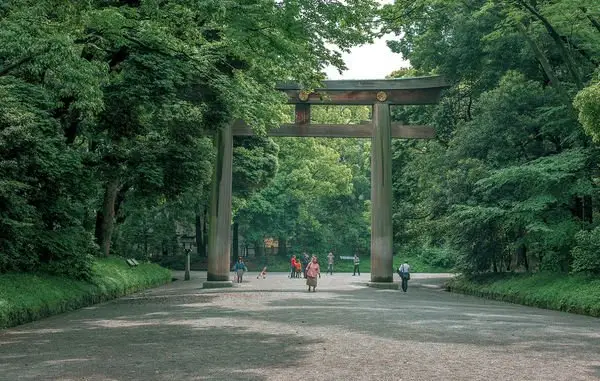
Torii are divided into two main families. The first are the portals that have a straight wooden top, called Shinmei. The second family has a slightly curved top, called Myojin.
Kumano Hongu Taisha — the largest torii in the world
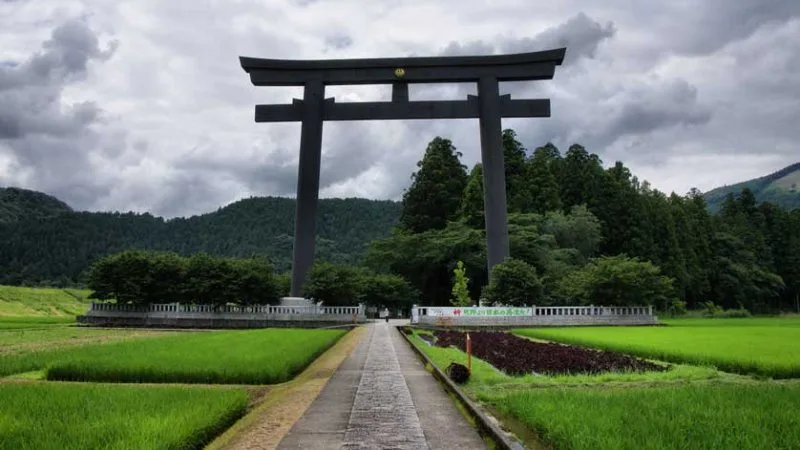
Let's close the article with the largest torii in the world, located at Kumano Hongu Taisha in Hongu, in Wakayama prefecture. It is not very well known, partly because it has no dramatic legend attached to it, and it was only built in 2000.
This is currently the largest torii in the world, measuring an incredible 40 meters in height and 42 meters in width, and it is made of steel. Before the 2000s, the largest torii in the world stood in Sakurai, in Nara prefecture.
Of the five gates we have looked at, which one would you visit first — the floating torii of Itsukushima, the red tunnels of Fushimi Inari, or the giant steel gate at Kumano Hongu? Let us know in the comments, and feel free to share this article with anyone planning a trip to Japan.





Community
Comments
0 comments
There are no published comments in this language yet.
Send comment