
Many people arrive at the same blunt question: is abortion legal in Japan? The short answer is yes — but it is never only a checkbox in a statute. In daily life the picture includes deadlines, designated doctors, grounds under the Maternal Health Protection Law, and often the spouse’s consent as well.
Even the Japanese word carries a tone of its own: 中絶 (chūzetsu). Look closer and you find falling official counts, a practice that is both narrower and broader than a pure list of paragraphs, and rituals such as mizuko kuyō that give grief a place to land.
Contents 6
The History of Abortion in Japan
Japan has a long, uneven history around pregnancy termination. In 1842 the shogunate banned induced abortion in Edo; later nationwide bans and the penal code tightened the net. From 1923, doctors could perform abortions in emergency cases when the mother’s life was at risk. Other circumstances remained legally hazardous.
After World War II, food shortages and population pressure reshaped policy. In 1948 Japan legalized abortion under special conditions through what was then the Eugenic Protection Law — later revised, in 1996, as the Maternal Health Protection Law. Economic hardship entered as a recognized ground early on, which made access far broader in practice than a strict “medical only” reading suggests.
Public debate in Japan often feels quieter than in many other countries. That does not mean the topic is light: it sits between law, clinic practice, family decisions and, for some people, temple ritual. Interfering in another household’s private choice is also widely treated as rude — a social habit that shapes how people talk (or avoid talking) about the issue.

When is abortion allowed in Japan?
Japan does not treat abortion as unrestricted on demand. Under the Maternal Health Protection Law, designated physicians may perform an induced abortion when defined conditions are met, generally within a limit of about 22 weeks of pregnancy. The criminal code still frames abortion as an offense in principle; the protection law is what opens lawful pathways.
In broad terms, the law points to situations such as:
- the pregnancy resulted from rape or sexual assault under circumstances in which resistance was not possible;
- continuing the pregnancy would seriously endanger the woman’s health for physical reasons;
- continuing the pregnancy would seriously endanger the woman’s health for economic reasons;
Economic grounds have long been applied widely in clinic practice, so many procedures are framed under maternal health protection rather than as a free-floating personal preference clause. Performing the procedure without the woman’s consent, or outside authorized medical channels, can still lead to punishment.

Partner consent: the detail many people miss
For married women, Article 14 of the Maternal Health Protection Law generally requires the spouse’s consent when an abortion is performed on socioeconomic grounds. That requirement is one of the points English-language coverage of Japan returns to again and again — and for good reason: it shapes real clinic forms and family negotiations.
There are important nuances. Consent is tied in the statute to a spouse; exceptions and interpretive guidance have been discussed for broken marriages, abuse, rape, and cases where the partner cannot be found or cannot express intent. Even so, advocates report that some clinics still ask for a male partner’s signature more broadly than the letter of the law requires, out of fear of later disputes.
In other words: “legal” and “simple to obtain” are not the same sentence. Cost also matters. Abortions are typically not covered by public health insurance, and reported prices for early procedures often fall in a high five-figure to low six-figure yen range depending on method and facility. Medical abortion was approved in Japan in 2023 for early pregnancies, still under medical control and with the same broader legal framework around consent.
Numbers and trends
Official tallies have fallen for decades from the mid-century peaks. Recent ministry-linked figures often cited in public summaries put reported induced abortions around the mid-100,000s per year in the late 2010s — for example on the order of about 156,000 in 2019 and about 145,000 in 2020 — far below the hundreds of thousands recorded in earlier postwar decades.
Those numbers are useful for scale, not for moral scorekeeping. Researchers have long noted possible under-reporting and the fact that most procedures are recorded under maternal-health grounds. Teenage pregnancy rates in Japan are low by international comparison, and only a minority of reported abortions involve very young women — yet stigma around early pregnancy remains part of the social picture.
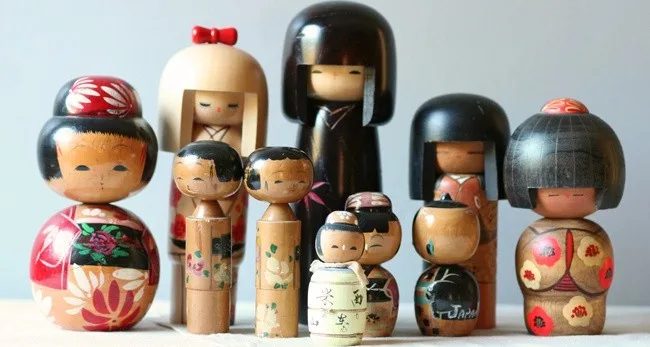
Kokeshi, mizuko and the cultural side
You have probably seen kokeshi — simple wooden dolls sold as souvenirs. One historical thread links some of these figures to families who had experienced pregnancy loss, natural or induced: a small presence in the house to acknowledge a life that never arrived. Not every kokeshi carries that story today, but the association still appears in cultural explanations of the craft.
Japan also has temples and practices connected to mizuko (水子), often translated as “water child.” One folk etymology plays on kanji that can suggest children “not yet seen” because they never reached birth. Mizuko kuyō is a memorial rite through which some people pray for the spirits of miscarried, stillborn or aborted fetuses — less a courtroom argument than a way to give loss a language of ritual care.
When I was traveling near Tokyo Tower, I came across memorial objects tied to this practice at a temple in the area. It is one of those corners of Japanese religious life that sits beside, not instead of, the legal discussion — and it pairs naturally with broader reading on religion in Japan and everyday Japanese culture for adults.

Putting it in perspective
What stays with me is the gap between a clean legal answer and the layered reality of clinics, forms, money and remembrance. On paper, abortion without any recognized ground is not an open free-for-all; in practice, economic and health framings cover a large share of cases, while partner consent and cost still shape who can actually access care.
Abortion in Japan remains a delicate subject. No single article can settle every medical, legal or personal angle — and clandestine procedures exist in many places where the law is stricter still. Understanding Japan means holding both the statute and the temple path at once: rules that make termination possible, and cultural habits that treat the aftermath as something some people still need to mark.





Community
Comments
0 comments
There are no published comments in this language yet.
Send comment