
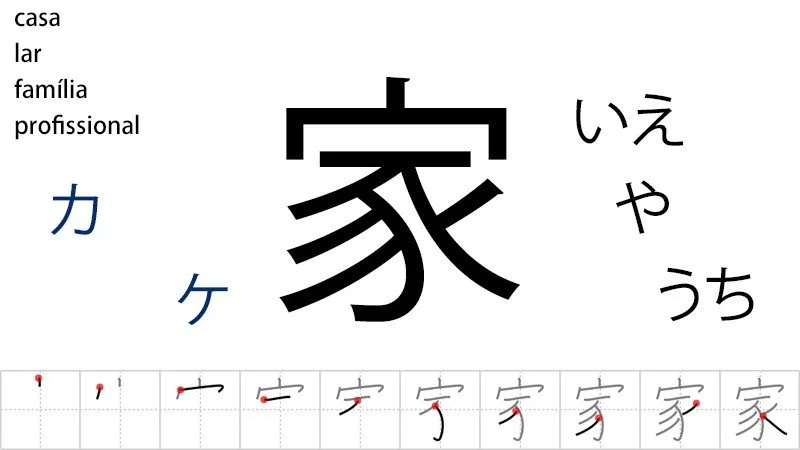
The kanji 家 looks simple on the page, but it does a lot of work in Japanese: it can mean house, home, family, a household name, or even “someone who does X for a living.” One character, several lives.
Once you meet the readings ie, uchi, ka, ke, and ya, compounds stop feeling random and start falling into patterns you can actually reuse.
家 ranks about 133rd among the kanji that show up most often in newspapers. It is a JLPT N4 character taught early, with a roof radical and ten strokes.
- Kun’yomi: いえ, や, うち
- On’yomi: カ, ケ (ka, ke)
- In names: あり, え, く, つか, べ
- Radical: 宀 (roof)
- Strokes: 10
The reading set is small, which helps memorization—if you keep the different roles of each reading clear.
Contents 5
うち vs いえ
Uchi (うち) and ie (いえ) share the same kanji and both point toward “house,” but not in the same way. いえ is the physical house—any dwelling as a building. うち is closer to “my place”: the home you belong to, the people there, the inside of your everyday life. Think structure versus the place you actually live.
When both use 家, how do you know which word it is in a text? Context does most of the work. うち often sits where “home / my household” is the natural English choice; いえ is common when the sentence is about a building, someone else’s house, or a house as an object. Over time the collocations become automatic.
A useful link: うち is related in feel to 内 (also uchi), “inside / among / home.” The “inside” idea bleeds into how speakers talk about their own household.
Because ie and uchi are kun readings, they show up less often in pure on-style compounds—but there are clear exceptions. How to tell whether a reading is ON or KUN helps when a compound looks “wrong” at first glance.
Here are compounds that still use the ie / uchi side of the character:
- 家出 – iede – running away from home
- 家路 – ieji – the way home
- 家々 – ieie – each house; houses (one after another)
- 家筋 – iesuji – lineage; family line
- 家中 – uchijū / iejū – the whole family; everyone in the household
Even when more than one kanji appears, these are often tight unions of native readings (家 + 中), not the Chinese-style on reading of 家.
In casual speech, うち can shrink further: the “u” drops and you hear only “chi,” as in 俺んち – orenchi – my place.
カ – KA
The reading ka often sits at the end of a word as a suffix for a specialist, professional, or someone devoted to a field. English often lands on “-ist” or “-er.”
- 作家 – sakka – writer; novelist; author
- 農家 – nōka – farmer; farm household
- 実業家 – jitsugyōka – businessperson; entrepreneur
- 画家 – gaka – painter; artist
- 漫画家 – mangaka – manga artist
- 生家 – seika – house where one was born; parents’ home
- 資本家 – shihonka – capitalist; financier
- 発明家 – hatsumeika – inventor
- 宗教家 – shūkyōka – religious figure; person of faith in a public sense
- 政治家 – seijika – politician
- 作曲家 – sakkyokka – composer
- 建築家 – kenchikuka – architect
- 歴史家 – rekishika – historian
The same ka also opens many everyday words tied to home and household:
- 家族 – kazoku – family
- 家庭 – katei – home; household; domestic life
- 家具 – kagu – furniture
- 家事 – kaji – housework; household chores
- 家畜 – kachiku – livestock; domestic animals
- 家計 – kakei – household budget; family finances
- 家宅 – kataku – domicile; residence (more formal/legal tone)
Most compounds that begin or end with 家 use ka, and a large share still orbit house, family, or the professional “-ist” sense.
ケ – KE
Ke often marks a household as a lineage or group—the “house of…” sense. Classic example: 徳川家 – Tokugawa-ke – the Tokugawa house/family.
- 摂家 – sekke – the regent houses (historical court families)
- 裏千家 – Urasenke – one of the main tea-ceremony schools
- 両家 – ryōke – both families (e.g. at a wedding)
- 王家 – ōke – royal family; royal house
- 分家 – bunke – branch family
- 後家 – goke – widow (older/literary usage)
- 良家 – ryōke – good family; respectable household
It can also start a word:
- 家来 – kerai – retainer; vassal; follower
や – YA
Some words ending in 家 are read ya. As a suffix, ya can mark a house of a certain type, a place of business, or a person associated with that place. It is not a free “add-on” for any noun—you learn it word by word.
A close cousin is the kanji 屋, also often ya, for shop, roof, or seller. A few items can be written with 屋 or 家 depending on the word and style.
Common words with the ya reading:
- 大屋 / 大家 – ōya – landlord; landlady
- 貸家 – kashiya – house for rent (compare 借家 – shakuya – rented house)
- 我が家 – wagaya – my/our home; one’s own house
- 空き家 – akiya – vacant house; empty house
- 長屋 – nagaya – row house; tenement-style housing
- 母屋 – omoya – main building; main house on a property
- 一つ家 – hitotsuya – one house; the same household
The reading can also lead the word:
- 家賃 – yachin – rent (payment)
- 家主 – yanushi – landlord; house owner
And then there is the outlier 家鴨 – ahiru – domestic duck, where the usual readings of 家 disappear into a special reading.
Examples of use
A few short sentences with 家 in real patterns:
僕は家にいるよ。
Boku wa ie ni iru yo.
I’m at home. / I’ll stay home.
彼らは画家だ。
Karera wa gaka da.
They are painters.
彼は家にいるか。
Kare wa ie ni iru ka.
Is he at home?
わが家にまさる所なし。
Wagaya ni masaru tokoro nashi.
There is no place like home.
その家に火がついた。
Sono ie ni hi ga tsuita.
That house caught fire.
Read widely and 家 will keep showing up—on doors, in job titles, in family talk, and in proverbs. The best drill is still real text: notice whether the word wants “building,” “my place,” “-ist,” “house of…,” or “shop/house as ya.”





Community
Comments
0 comments
There are no published comments in this language yet.
Send comment