
NicoNico Douga (ニコニコ動画 – nikoniko douga), today known simply as nico nico, is a popular Japanese video sharing site. The word niko niko is the onomatopoeia of laughter, while douga literally means «video». The site draws a lot of attention because of its real-time comment system, where comments appear directly over the video. It is also well known for its streams and live broadcasts, especially among otakus and Japanese gamers.
The site was founded by Niwango and launched in 2006, using YouTube as its video hosting service. It grew so fast that YouTube was forced to block access, and Nico Nico had to build its own video hosting service. NicoNico Douga was the first site to introduce a way to embed tags and comments directly into videos, allowing comments from 2channel and YouTube to be displayed side by side.
While Japanese people usually turn to YouTube for quick news and information, NicoNico Douga is the real place where they enjoy jokes, Vocaloid covers, gaming clips, dances, live broadcasts, music, anime scenes, and much of Japanese pop culture. The site already has more than 53 million registered users, receiving over 338 million visits per month. NicoNico is perfect for mingling with Japanese people and learning Japanese!
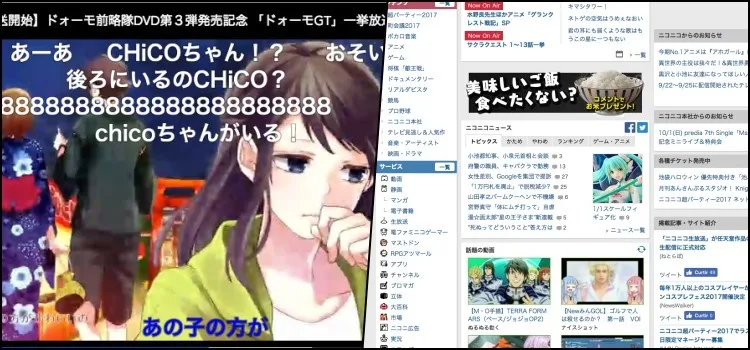
Getting to know NicoNico Douga
To access the nico nico douga website, simply open https://www.nicovideo.jp/.
To upload, comment on, and watch videos you need to register and log in. To see Japanese comments overlaid on a video, change the site language to Japanese at the bottom of the page. Watching videos on Nico Nico can feel visually busy – but that is exactly the point: a flood of comments appears over the video, and you can add your own at the right moment. It may seem unusual, but this comment strategy is what keeps people on the site longer.
The on-screen real-time comment system lets users share their feelings at the exact moment something happens in the video. NicoNico comments tend to contain many cross-references and inside jokes. The site is also a great source of viral content and memes. The strong sense of otaku community is the main reason for NicoNico Douga's success. That is because it can be difficult for some adults to talk openly about anime in real life, while NicoNico makes that easy.
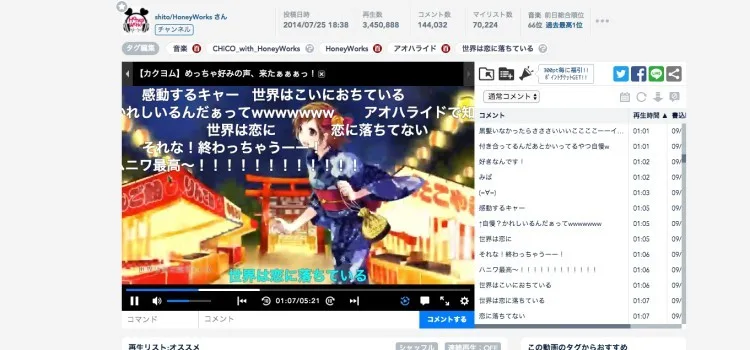
NicoNico also has a mylist system, where users can create up to 25 folders as a kind of bookmark collection. The site also has a dedicated section for live broadcasts called niconico live, a community of illustrators called niconico seiga, and an encyclopedia section called niconico pedia.
You can comment at any time using the text box below the video, and specify the position, font size, and color of each comment. You can also follow a list of comments beside the video together with the time they appear. NicoNico has a premium membership system that unlocks additional features and perks.
Terms used on NicoNico
NicoNico users tend to use a unique vocabulary, a set of phrases and characters that are common on the platform. If you are new to NicoNico, this can be confusing. That is why we have put together a small glossary to help you understand what people are saying in the comments.
- Shoken (初見) – first time watching a video.
- Namanushi (生主) – live streamer; abbreviation of 生放送主.
- WWWWWW – laughter (from warau 笑う).
- BBA – abbreviation of babba, meaning «old lady», often used teasingly.
- 888888888 – applause; read as pachi pachi, an onomatopoeia for clapping.
- KP – kanpai, meaning «cheers».
- こy – mix and abbreviation of Japanese kowai and English «scary»; means «creepy».
- おk – "OK".
- おこk – another way to write «OK OK».
- ひy – abbreviation of hiwai, meaning «obscene / over the top».
- Arashi (荒らし) – troll.
- NG – «no good».
- ggrks – abbreviation of guuguru kensaku, meaning «go Google it».
- JK / JD / JC / JS – joshi (girl/woman) of (kō) high school, (dai) university, (chū) junior high school, (shō) elementary school.
- 実況プレイ – gameplay with live commentary.
- 演奏してみた – «I tried playing it» – musical performance.
- 歌ってみた – «I tried singing it» – cover of a song.
- 踊ってみた – «I tried dancing to it» – dance video.
Have you had a chance to use this platform, which is so popular among Japanese people and otaku? How was your experience? Have you spotted any references to it in anime? I hope you enjoyed this short article – we appreciate comments and shares.
We also recommend reading:



Community
Comments
0 comments
There are no published comments in this language yet.
Send comment