
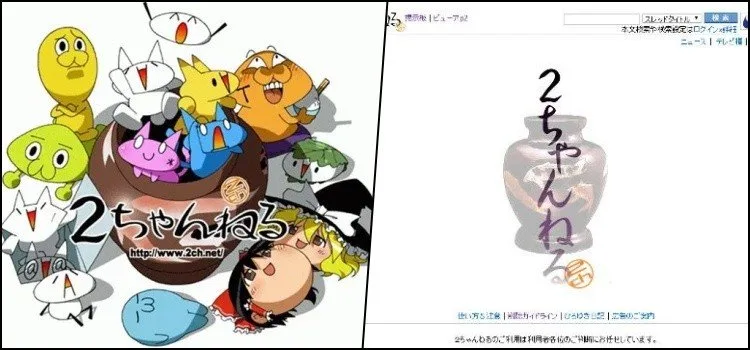
In the West, we treat Reddit as the default forum: communities for every topic, news that starts as a thread, jokes that leak into the rest of the internet. Japan had that energy earlier, and it did not look like Reddit. The boards behind Japanese virals — and, later, a huge chunk of English meme culture — are still mixed up by a single extra letter in the URL.
The Japanese online crowd is still very active on forums, especially otakus. Besides those boards, people pile into Niconico, Twitter, and other popular social networks in Japan. The old anonymous forums never really left. They just stayed ugly on purpose.
But what the hell is an imageboard? You may have never heard the term. It is a forum built around posting pictures with text, usually with no registration and a name that defaults to Anonymous. The first one that mattered at scale was 2chan, better known in Japan as Futaba Channel, spun out of the text-only forum 2channel. Those two creations — plus the English site they inspired — are why a lot of internet culture still looks the way it does.
Contents 6
2channel — Japan's giant anonymous textboard
2channel (2ちゃんねる, ni channeru, often written 2ch) is the anonymous Japanese textboard Hiroyuki Nishimura (西村博之) launched on May 30, 1999, while he was a student in Arkansas. The idea was simple: a place to post without a login, so the argument would have to stand without a username attached to it. In Japanese it is a keijiban — a bulletin board — not an image dump. You type. If you want a picture, you draw it with characters.
At its peak in the 2000s, 2channel sat in the same conversation as radio, magazines, TV, and newspapers inside Japan. Contemporary reports put it on the order of ten million visitors and more than two million posts a day. Those figures belong to that era, not to a live counter. The site itself is still stubbornly plain: threads, messages, almost no design. A lot of kaomoji and Shift_JIS art — Mona, Giko, the whole jar-of-characters look — exploded there because images were not an option.
Each thread on 2channel has a hard cap of 1,000 posts. After that, the topic is packed off into the archive (the old past-log / dat ochi system) and stops bumping. That is why 2ch culture feels so now-or-never: if you were not in the thread, the joke may already be gone unless someone copied it out.
2channel is not 2chan — and 5channel is the sequel
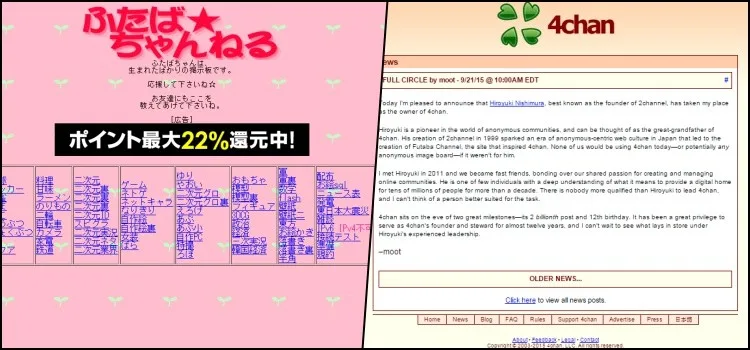
This is the mix-up that never dies. 2channel lived at 2ch.net and is a textboard. 2chan is Futaba Channel at 2chan.net, an imageboard. They are cousins, not the same site. Westerners mash both names into "2chan" and then wonder why the screenshots do not match.
2channel = anonymous Japanese textboard (1999). 2chan / Futaba = Japanese imageboard (2001). 4chan = English Futaba clone (2003), owned by Hiroyuki since 2015. 5channel = the old 2ch.net board after the 2014 split, renamed in 2017.
The original 2ch.net also did not stay one board. In February 2014, Jim Watkins — the American who hosted the domain — seized 2ch.net. Nishimura called it a hijack and stood up a rival at 2ch.sc. In October 2017, Watkins' side renamed the captured board 5channel (5ちゃんねる) on 5ch.net, in part because Nishimura held the "2channel" trademark in Japan. In 2026 the 5ch.net domain was suspended and the board continued at 5ch.io. 2ch.sc still exists, with far less traffic. When people in Japan say they posted on "2ch" today, they usually mean 5channel.
2chan, Futaba, and the imageboard
On August 30, 2001, when 2channel looked like it might go down, a refuge board opened: Futaba Channel (ふたば☆ちゃんねる), "two-leaf channel." It started as text and then added imageboards on GazouBBS. That is the software DNA of almost every later chan. English speakers call it 2chan because of the URL. In Japan it is just Futaba.
Futaba is where a lot of otaku visual gags were born, including Yaranaika and the OS-tan girls — operating systems drawn as characters, starting around Me-tan on Futaba's Nijiura board in 2003. Threads are not a museum. If a joke is not being bumped, it disappears, which is why users treat leaking a Futaba meme to the outside as a kind of theft. The culture is clannish on purpose.
Westerners who wanted that same anonymous image dump, in English, copied the Futaba script. That copy is 4chan.
4chan: the English copy that got huge
4chan went live on October 1, 2003, created by Christopher Poole (moot), then a teenager, using a translated Futaba codebase. It is English-first, with fat otaku boards — /a/, /jp/, wallpapers, mecha — which is not the same as "mostly Japanese users." It is where a ridiculous number of English memes and raids started, and where the name Anonymous stuck as a group, not just a default username.
In September 2015, Poole sold 4chan to Hiroyuki Nishimura, the same person who had founded 2channel. The sale closed a loop that still confuses people: Hiroyuki built the Japanese textboard, lost the original domain, and ended up owning the English imageboard that had copied Futaba, not 2channel itself.
Brazil built its own imageboard, 55chan, in the same anonymous style, and local memes grew there the way 4chan memes grew in English. Forks such as 8chan (later 8kun) and older rivals like 7chan chased a more anything-goes version of the same format. 8chan later sat in Watkins' orbit too — the same hosting story that split 2channel.
A short map of 4chan boards
4chan splits into lettered boards between slashes. /tv/ is television and film. /b/ is random, still the loudest and the one to treat as NSFW by default. Boards get created, renamed, and locked. The list below is a snapshot of the well-known ones, not a live directory.
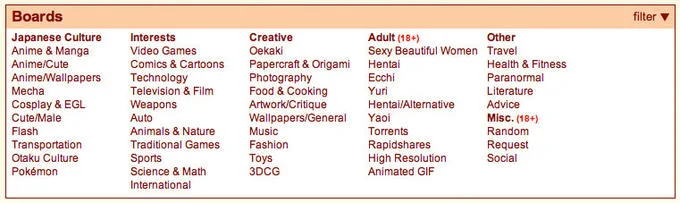
- /a/ Anime and Manga
- /jp/ Otaku Culture
- /v/ Video Games
- /g/ Technology
- /tv/ Television and Film
- /mu/ Music
- /biz/ Business and Finance
- /pol/ Politically Incorrect
- /r9k/ ROBOT9001
- /s4s/ Shit 4chan Says
- /b/ Random
What these boards actually changed
Anonymous boards of this kind are factories for two things at once: jokes that escape into the rest of the internet, and threads nobody should treat as a newsroom. 2channel helped turn a supposedly real train story — Densha Otoko, Train Man — into TV, film, and manga. 4chan helped turn Anonymous from a default name into a brand. Both also collected hate, raids, crime announcements, and lawsuits. That is not a side note. It is the same architecture.
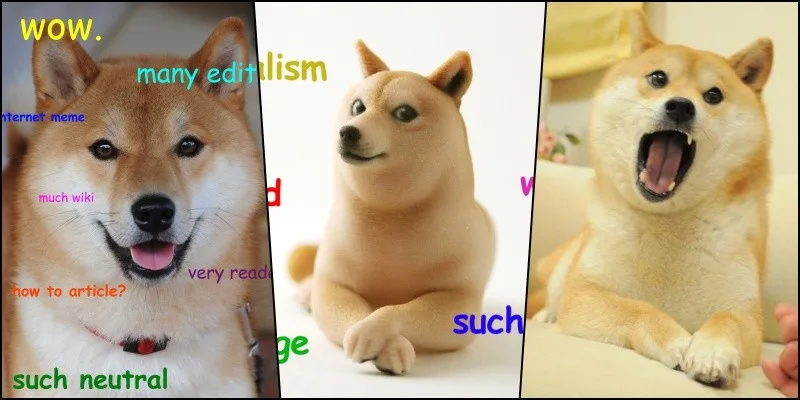
We have already written about some of the memes that crawled out of these boards:
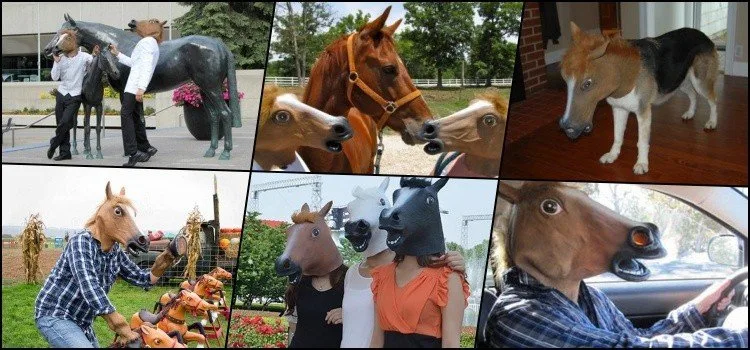
- Horse Head Mask — how did it go viral?
- Waifu — what it is and how it caught on
- What does Nico Nico ni mean? Why did it go viral?
- Do you know the famous Doge of memes?
- Nyan Cat — how did this viral come about?
If you keep one line in your head, keep the family tree: 2channel is the Japanese textboard. Futaba (2chan) is the Japanese imageboard. 4chan is the English Futaba clone. 5channel is the 2ch most people in Japan actually use now. Reddit did not invent this shape of the internet. It inherited a noisier Japanese version, with worse typography and a much meaner sense of humor. Have you lurked any of them, or only met the memes after they escaped?



Community
Comments
0 comments
There are no published comments in this language yet.
Send comment