
Kimigayo is Japan's national anthem. It is famous for two reasons: the lyrics are among the oldest still used by any national anthem, and the song itself is remarkably short. Behind those five lines, however, there is a longer story involving classical poetry, imperial symbolism, modern politics and the way Japan presents itself at official ceremonies.
If you want to understand why the anthem still sparks discussion, it helps to look at three things together: what the poem says, how the melody was adopted in the late nineteenth century and how the anthem was formally recognized in 1999.
Contents 6
What does Kimigayo mean?
The title Kimigayo is usually understood as "your reign" or "the reign of the sovereign." In historical context, the poem expressed a wish for a ruler's long life. In present-day Japan, the anthem is treated as a symbol of the state, but the imperial wording is one reason the song still carries political weight.
The text itself is only five lines long:
| Japanese | Romaji | Common English rendering |
|---|---|---|
| 君が代は | Kimigayo wa | May your reign |
| 千代に八千代に | Chiyo ni yachiyo ni | continue for a thousand, eight thousand generations |
| さざれ石の | Sazare-ishi no | until the pebbles |
| 巌となりて | Iwao to narite | grow into mighty rocks |
| 苔の生すまで | Koke no musu made | and become covered with moss |
Even in translation, the tone is poetic rather than explanatory. Instead of naming Japan directly, the lyrics use images of pebbles, rocks and moss to express longevity, continuity and endurance.
Where the lyrics come from
The words come from an anonymous waka poem included in the Kokin Wakashu, a classical anthology compiled in the early tenth century. Long before it became a national anthem, the poem was used as a celebratory verse wishing long life and lasting stability.
That literary origin matters because it explains why the wording feels formal and symbolic. Kimigayo was not originally written as a modern patriotic song. It was a much older poem that later acquired a national role.
How Kimigayo became Japan's national anthem
In the Meiji period, Japan was building the institutions of a modern state and needed an anthem for diplomatic and military occasions. In 1869, the Irish bandmaster John William Fenton urged Japanese officials to adopt one, and an early melody was performed in 1870.
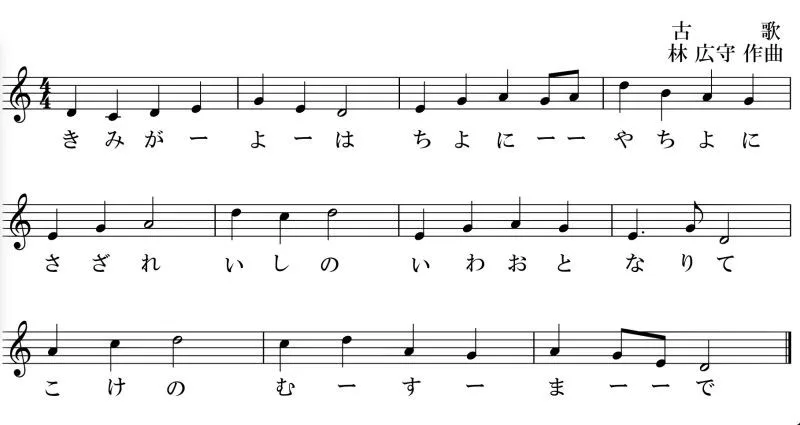
That first musical version did not last. In 1880, a new melody was prepared by Yoshiisa Oku and Akimori Hayashi under the supervision of Hiromori Hayashi, and later arranged in Western-style harmony by Franz Eckert. This became the musical basis of the version still heard today.
Kimigayo was used officially long before it received a clear legal foundation. The turning point came in 1999, when Japan formalized both the anthem and the national flag under the Act on National Flag and Anthem.
Why is Kimigayo controversial?
Kimigayo is short, but the meaning around it is not neutral. Before 1945, the emperor stood at the center of state ideology, and the anthem was closely tied to that world. After the war, the emperor became a constitutional symbol rather than a sovereign ruler, but the lyrics themselves did not change.
Because of that, some people hear the song as a traditional wish for peace and continuity, while others still hear an imperial message that sits uneasily in a modern democracy. The debate appears most visibly around school ceremonies, graduation events and expectations that teachers and students stand and sing.
When is the anthem used today?
Today Kimigayo is most familiar at international sports events, official ceremonies, state occasions and some school functions. For many people outside Japan, it is the song they hear at Olympic medal ceremonies or before major matches rather than something they first encounter as classical poetry.
That difference is part of what makes the anthem interesting. A poem from more than a thousand years ago now operates as a modern state symbol, yet it still carries echoes of the era that gave it meaning.
Why this tiny anthem leaves such a strong impression
Kimigayo lasts only a few moments, but it condenses a surprising amount of Japanese history. A court poem became an anthem, an imperial-era symbol survived constitutional change and five lines continue to provoke discussion about memory, identity and public ritual.
That is why the song keeps drawing attention. It is not simply short. It is one of those rare anthems in which every line feels loaded with history.







Community
Comments
0 comments
There are no published comments in this language yet.
Send comment