
Ninjutsu [忍術] is the collective set of strategies, martial techniques, and survival skills used by the historical agents known as shinobi [忍者] in feudal Japan. Pop culture, especially the anime Naruto, has turned ninjas into superhuman fighters, but the real art was much more grounded: stealth, espionage, disguise, and the ability to survive in hostile terrain.
In this guide, we walk through what ninjutsu actually is, where it came from, the techniques and weapons it covers, the main schools still teaching it today, and how to find a legitimate place to train. Use the table of contents below to jump around.
Contents 19
What is ninjutsu?
Ninjutsu is the methodology used by shinobi (often translated as "ninja") for espionage, reconnaissance, sabotage, and unconventional combat. It draws on multiple Japanese martial arts, strategic thinking, weather and terrain knowledge, and a strong emphasis on discretion. A practitioner is trained to finish a mission, not to win a duel.
The word ninjutsu [忍術] combines two kanji: 忍 ("shinobi"), suggesting endurance, patience, and self-restraint, and 術 ("jutsu"), meaning art, technique, method, or skill. The person trained in it is a shinobi [忍者] or, in popular usage, a ninja.
Ninjutsu is also commonly called ninpo [忍法], which leans more on the philosophical side: "the way of the ninja." The added kanji 法 refers to method, principle, and system. Practitioners follow a code of conduct known as Ninpo Ikkan, meaning a single-hearted commitment to the path of ninpo.

The fundamentals of ninjutsu
Ninjutsu aims to bring body, mind, and spirit into alignment, putting the practitioner in harmony with their environment rather than at odds with it. The training develops the whole person: physical conditioning, situational awareness, and the ability to read people and terrain.
The fighting side of ninjutsu covers hand-to-hand combat, grappling, weapons work, and improvised tools. A shinobi is also expected to handle disguise, body movement, vital-point knowledge, psychological pressure, and self-sufficiency in the field.
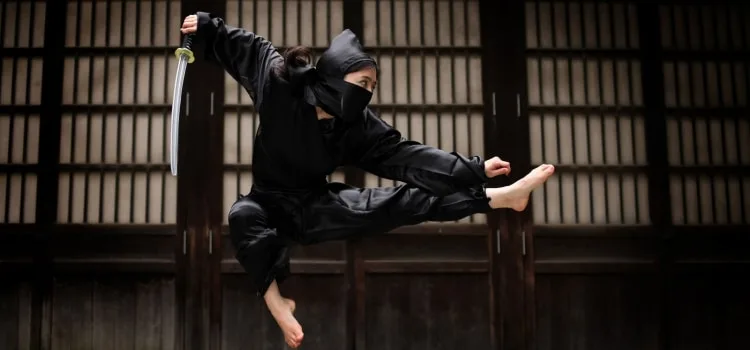
Many historical shinobi also practiced meditation, controlled breathing, and other forms of mental training to manage fear and emotional reactivity. Beyond the dojo, the curriculum traditionally included swimming, climbing, survival, archery, and target practice. The breadth of the curriculum is why some modern special-operations units have studied ninjutsu as a historical reference for infiltration and close-quarter work.
Ninja virtues, rules, and training stages
Traditional ninjutsu training is built on three stages, inherited from Japanese classical arts and known as shu-ha-ri [守破離]:
- Shu (守) — protect: copy the master exactly and learn the foundations without deviation.
- Ha (破) — break: once the basics are solid, the student can begin to adapt and explore variations.
- Ri (離) — leave: the techniques become automatic and the student develops their own style, free of conscious imitation.
Alongside this progression, a few core rules are drilled in early: never underestimate an opponent, never hesitate, never let fear dictate the response, and never train with the goal of showing off.
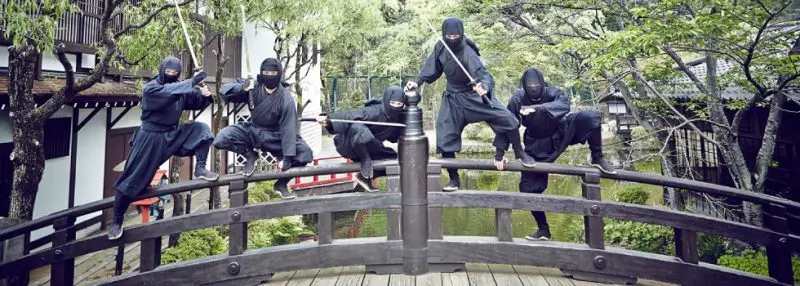
The seven ninja virtues
Most modern ninjutsu schools (especially those in the Bujinkan lineage) teach a set of seven virtues the student is expected to carry off the mat as well:
- Gi (義) — justice, right decision, and honesty.
- Yu (勇) — courage and the bravery to act.
- Jin (仁) — benevolence toward other people.
- Rei (礼) — respect, etiquette, and balanced behavior.
- Makoto (誠) — total sincerity.
- Meiyo (名誉) — honor and reputation.
- Chugi (忠義) — loyalty and devotion.
Dojo rules (Ninja Hiden)
Some traditional schools also recite a set of dojo rules, sometimes called the Ninja Hiden, at the start or end of class. Common lines include:
- Do not show fear or panic in the face of danger.
- Drop your ego, be patient, and do not fear death.
- Keep an indomitable spirit against any opponent.
- Serve and protect the teacher as you would your own parents.
- Avoid intoxicants that cloud judgment.
- Defeat the enemy but spare their life when you can.
- Do not teach what you have learned without the master's permission.
- Release grudges, anger, and hatred before stepping on the mat.
- Stay on the path of righteousness; ambition and lust destroy the ninja.
- Devote your time and focus to the practice of Budo Taijutsu.
- Accept hardship, loss, and pain as part of the training.

The eight fighting secrets (Ninja no Hachimon)
Older lineages also teach a checklist of eight competencies, sometimes called Ninja no Hachimon [八門], which a well-rounded shinobi should master:
- Ninja no Kiai — the explosive expression of spirit and internal energy.
- Ninja no Taijutsu — the study and practice of body techniques (unarmed combat, throws, and grappling).
- Ninja no Kenpo — sword technique.
- Ninja no Soojutsu — spear and polearm methods.
- Ninja no Shuriken — the art of throwing darts, knives, and star-shaped blades.
- Ninja no Kajutsu — the art of using fire and smoke as a tactical tool.
- Ninja no Ugei — deception, trickery, and psychological games.
- Ninja no Kyomon — the study of religion, medicine, philosophy, meditation, history, mathematics, chemistry, physics, and psychology.
History and origin of ninjutsu
The roots of ninjutsu are difficult to date precisely, and historians still debate the timeline. What is generally accepted is that by the Sengoku period (roughly the 15th to 17th centuries), organized groups of shinobi were already working as spies, scouts, and raiders for feudal lords, and that their skills drew on a mix of regional combat traditions, mountain ascetic practices, and Chinese military and strategic thought.
The popular story that the art was brought to Japan by displaced monks fleeing the fall of a Chinese dynasty does not hold up historically, but it reflects a real influence: Chinese military manuals, meditation practices, and philosophical frameworks all fed into what eventually became the shinobi tradition.
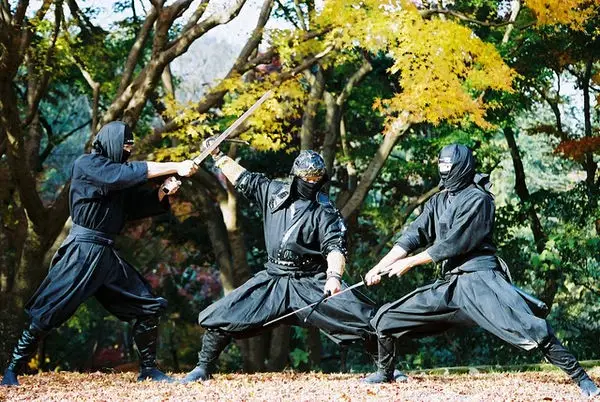
Many shinobi were ronin (masterless samurai) or came from the lower samurai and peasant classes, which made the profession one of the few paths of upward mobility through service. Some clans turned shinobi work into a family business: the most famous is the Iga region (modern Mie Prefecture) and the Kōga region (modern Shiga Prefecture), both of which gave their names to whole schools of ninjutsu.
Shinobi continued to operate in various capacities, including as intelligence assets, well into the early modern period. With the Meiji Restoration in 1868 and the abolition of the samurai class, the tradition went underground, surviving mostly through family lines and small private schools. It resurfaced publicly in the 20th century through a handful of masters who opened their schools to foreign students.
Weapons used in ninjutsu
A core principle in ninjutsu is that the tool matters less than the person using it. Farmers' sickles, carpenter's squares, brooms, and even a folded paper sheet can all become weapons in trained hands. The classic shinobi arsenal includes the following items, several of which are shared with samurai, peasant, or other martial traditions:
- Bokken — wooden training saber.
- Bō — long staff, roughly 1.8 m.
- Fukiya — blowgun.
- Fukumi Bari — small throwing needles blown from the mouth.
- Hanbō — short staff, roughly 90 cm.
- Jitte — short iron truncheon used to catch and break swords.
- Kaginawa — rope with a cross hook, used to climb walls and trees.
- Kama yari — long staff topped with a sickle blade.
- Kama — short sickle, originally a farming tool.
- Kemuridama — smoke bomb, used for cover or signaling.
- Kodachi — short saber, similar to a wakizashi but without a tsuba guard.
- Kunai — a trowel-like blade, originally a masonry or gardening tool.
- Kusari-fundo — chain with a weight at each end.
- Kusarigama — a kama attached to a weighted chain.
- Kyoketsu Shoge — a chain-and-hook weapon similar to the kusarigama.
- Musubinawa — knotted rope with a single hook, used for climbing.
- Naginata — polearm with a curved, single-edged blade.
- Sasumata — staff with a two-pronged fork at the tip, used to pin a sword arm.
- Shaken — throwing dart.
- Shikomi Zue — wooden staff that conceals a blade or chain.
- Shinobi Kumade — climbing rope with a claw-shaped hook.
- Shinobi Zue — staff with a hidden chain or blade.
- Shinobigatana — short, curved saber.
- Shuriken — throwing star or spike.
- Tanbō — short wooden sticks, used in pairs for attack and defense.
- Tantō — short Japanese knife or dagger.
- Te yari — small spear with a side hook.
- Tessen — iron war fan, often associated with high-ranking samurai as well as shinobi.
- Tetsubishi — small pyramid-shaped spikes scattered on the ground to slow pursuers.
- Wakizashi — short curved saber, paired with the katana.
- Yari — straight spear, around 2 m long.
- Yumi and Ya — Japanese longbow and arrow, the basis of kyudo.
Famous ninja schools still teaching today
After the Meiji Restoration scattered the older shinobi clans, the art was preserved by a small number of masters and their students. In the 20th century, three large umbrella schools opened their doors to international students, and they are where most modern ninjutsu practitioners in the West train today.
Bujinkan (武神館)
The Bujinkan was founded in the 1970s by Masaaki Hatsumi, drawing on the Togakure-ryū tradition and several related lineages. It is by far the largest ninjutsu organization in the world, with dojos across Japan, Europe, the Americas, and Asia. The curriculum combines taijutsu, weapon work, and the classical scrolls (the so-called "densho") of the old schools.
Genbukan (玄武館)
The Genbukan was founded by Toshitsugu Takamatsu's senior student, Shoto Tanemura, after a disagreement with the Bujinkan leadership in the 1980s. It is more conservative in its transmission and is known for strict adherence to koryu (old-school) curriculum. Its dojo network is smaller than the Bujinkan's, but it has a strong presence in Japan, Europe, and the Americas.
Jinenkan (自然館)
The Jinenkan was founded in the early 2000s by Fumio Manaka, another senior student of Hatsumi, and represents a further split from the Bujinkan. It focuses on a smaller, tightly curated set of schools within the traditional ryuha and on training intensity, with dojos in Japan, Europe, North America, and Brazil.
Togakure-ryū (戸隠流)
Of the historical ryuha, the Togakure-ryū is the most closely associated with ninjutsu in popular imagination. Founded in the Iga region during the Sengoku period, it is one of the lineages that eventually fed into the Bujinkan. It is rarely taught as a stand-alone school today and is usually encountered as part of a larger curriculum.
Naruto's ninjutsu vs. real life
The anime Naruto borrows a lot of vocabulary from real ninjutsu (jutsu, taijutsu, shuriken, kunai) but uses it for fantasy combat, not historical espionage. The result is a version of ninjutsu that has very little to do with the real art.

The biggest difference is intent. A historical shinobi's job was to avoid a fight when possible, gather information, and leave no trace. In the anime, ninjas fight loud, public battles and announce their presence. Their outfits are bright and easy to spot, which is the opposite of what real concealment looks like.
The weapons shown in the anime (kunai, shuriken, swords) are real items, but in the show they are mostly cosmetic: the characters rely on supernatural abilities rather than on the actual use of those tools. Real ninjutsu treats every weapon as something to be used with intent and economy, and an unwitnessed outcome as a successful one.
None of this means the anime is bad, just that it is a fantasy built on a small set of Japanese terms. The vocabulary is the part that is real; almost everything else is invention.
Ninja disciplines: the eighteen skills (Jūhakkei)
Traditional ninjutsu is presented as a set of eighteen disciplines, called jūhakkei [十八技]. Some of these overlap with samurai arts, while others are shinobi-specific. A serious school will touch on all of them in some form, even if only a few become a personal specialty:
- Bajutsu — horsemanship.
- Bōjutsu — long staff.
- Bōryaku — military strategy and tactics.
- Chi-mon — geography and terrain study.
- Chōhō — espionage and intelligence gathering.
- Hensōjutsu — disguise and camouflage.
- Intonjutsu — the art of escape and evasion.
- Kayakujutsu — explosives and pyrotechnics.
- Kenjutsu — sword technique.
- Kusarigamajutsu — sickle and chain.
- Naginatajutsu — naginata technique.
- Seishin-teki kyōyō — spiritual and mental cultivation.
- Shinobi-iri — stealth and infiltration.
- Shurikenjutsu — throwing blades.
- Sui-ren — water training and aquatic movement.
- Sōjutsu — spear technique.
- Taijutsu — unarmed combat.
- Tenmon — meteorology and weather reading.
How to learn ninjutsu (in the US, UK, and beyond)
Most people who study ninjutsu outside Japan do so through one of the three large schools mentioned above (Bujinkan, Genbukan, or Jinenkan) or, less commonly, through a small independent koryu dojo. There is no single "official" certificate, and any school claiming to issue a government- or Japanese-Empire-issued license is misrepresenting the lineage.
How to spot a legitimate dojo
Before signing up, it is worth checking a few things that almost all serious schools share:
- Lineage is published. The head teacher (sensei) can name their teacher, and that teacher can be traced back to a known Japanese master. If that chain is missing or hidden, walk away.
- Curriculum is in the open. A real dojo will tell you which ryuha it teaches, which weapons and taijutsu you will learn, and roughly how the progression works.
- Training is graded but unhurried. Look for a clear progression of kyu/dan ranks and a realistic timeline (years, not months) before any high rank is awarded.
- The focus is on the art, not on marketing. A legitimate school talks about what you will learn. A "fake-jutsu" school sells uniforms, certificates, and stories of combat effectiveness.
Where to start in the US, UK, and EU
The fastest way to find a legitimate school is to go to the official websites of the three large organizations and use their dojo directory:
- Bujinkan — bujinkan.com publishes an international dojo list. There are active branches in most major US cities, the UK, Germany, France, the Netherlands, and Scandinavia.
- Genbukan — genbukan.org has a dojo search, with a strong presence in the US, Brazil, and parts of Europe.
- Jinenkan — jinenkan.org maintains a smaller but well-distributed network in Japan, Europe, North America, and Brazil.
Visiting a class as an observer before committing is normal and welcomed at any of these schools. A first year of training is usually a mix of basic movement (taihenjutsu), breakfalls, and a few foundational weapons, with a focus on building the body and the basics before anything flashy.
If your local area does not have a recognized dojo, traveling once or twice a year for a seminar (called a taikai) with a senior Japanese instructor is a common way to keep progressing. Many of the umbrella schools host annual international events that draw hundreds of students from dozens of countries.
Final thoughts
Ninjutsu is a real historical art, but the popular image of the ninja owes more to Edo-period fiction, kabuki theater, and 20th-century manga than to what shinobi actually did in the field. The version taught in modern dojos is closer to a comprehensive self-defense and survival system than to the fantasy of invisible assassins, and that is part of why it has aged better than most "ninja" imitations.
If a specific school or a particular weapon caught your attention in this article, that is a good place to start a search. And if you have trained ninjutsu before, we would like to know which lineage and which aspect of the art you found most useful in practice.






Community
Comments
0 comments
There are no published comments in this language yet.
Send comment