
The 5-yen coin — goen — is almost worthless as change and still one of Japan’s most talked-about pieces of pocket money. Not because of the exchange rate, but because of a wordplay: say “go-en” and you might mean 五円 (five yen) — or 御縁 / ご縁, a respectful way to talk about fate, encounters, and relationships. That is why the coin shows up at shrines, in wallets, and on keychains.
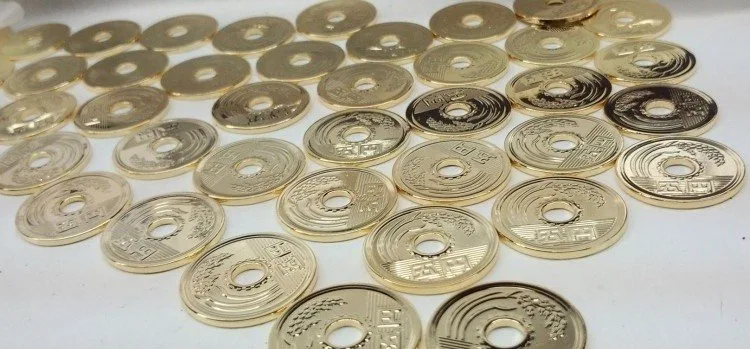
On the face, rice grows out of water; around the center hole sits a gear. Agriculture, fisheries, and industry on a tiny brass disc — plus a hole that makes the coin unmistakable by touch. Below we unpack the pronunciation, お賽銭 (osaisen), the hole itself, and a few related wordplay superstitions.
Getting to know the yen — Japan’s currency
Why doesn’t the yen have cents?
Contents 4
Why is goen considered a lucky coin?
The 5-yen coin is treated as lucky mainly because its pronunciation matches 御縁 (goen). That word points to destiny, opportunity, connection and relationship — often the sense of a favorable encounter that “was meant to be.” Many people link the coin to love, work, or new contacts, not to magical wealth.
Taken separately, the kanji in 御縁 can be read as:
- 御 — an honorific prefix (polite, elevated);
- 縁 — affinity, relation, connection; also edge or border.
The first character is often a respectful prefix. The second suggests a force or bond that links two people — or a person and a place, a deity, a chance. Because 5円 and ご縁 sound the same, thousands reach for this coin when they want to ask for a good connection.
How is the 5-yen coin used?
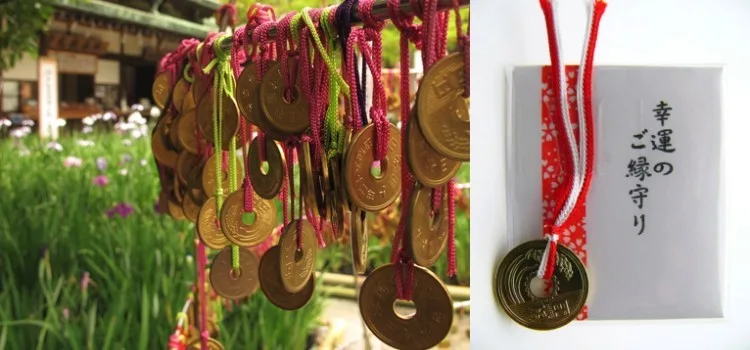
Besides charms, cords, and accessories, the coin appears most often as お賽銭 (osaisen): the offering tossed into the box at a Shinto shrine or Buddhist temple. Many people deliberately choose 5 yen to form a “good connection” (ご縁) with the deity or the place — or to ask for meetings, business, friendships, or love.
Some put a 5-yen coin first in the wallet. Others favor the also-holed 50-yen coin and read that as “five times” the luck. Japan is full of superstitions that ride on pronunciation: 4 and 9 feel unlucky to some because 四 (shi) recalls 死 (death) and 九 (ku) recalls 苦 (suffering).
A related wordplay is Kit Kat chocolate: “kitto katsu” sounds like “you will surely win,” so parents sometimes buy it before exams. These sound games are everyday culture — not law and not a guarantee.
Common osaisen wordplays include 5 yen as “go-en” (good connection), two 5-yen coins (10 yen) as “kasanegasane go-en” (connection upon connection), or 45 yen as “shijū go-en” in the sense of “always a connection.” At the same time, some treat 10 yen as awkward because 十 (tō) can recall 遠 (far) — as if the connection were distant. The Jinja Honchō is clear: there is no required amount. What matters is a sincere attitude, not the pun.
Why do the 5 and 50 yen coins have a hole?
Many people wonder about the hole in Japan’s 5 and 50 yen coins. Even in Japan, not everyone tells the same story — and there really are several layers.
Holed coins are not a Japanese monopoly. Countries such as Norway, China, and Denmark have or had coins with a hole. The modern brass 5-yen piece (copper–zinc) arrived after World War II: first strikes in 1948 without today’s design; from 1949 came the version with a center hole. One practical reason was saving metal. The 50-yen coin later gained a hole as well, partly to tell similar-sized coins apart and to make them easier to identify by touch — a real help for people with visual impairment.
Historically the hole goes further back in East Asia: for centuries Chinese and Japanese coins had a square hole in the middle, including in the Edo period (1603–1868). The circle could hint at heaven’s “roundness,” the square at the earth; practically, coins could be strung or carried at the waist, and during casting the opening helped separate blanks. Today’s round hole in the 5-yen coin is both a long tradition and a postwar minting choice.
On the current face, rice, water, and a gear stand for agriculture, fisheries, and industry. The coin is one of the few still in circulation without Arabic numerals: value and year appear in Japanese script.
Gold 5-yen coins of the nineteenth and early twentieth centuries are another story — collectors’ pieces, not the brass goen in a daily wallet. When people say “since 1870,” they often mean the long-lived denomination “5 yen,” not the holed design from 1949.
Which Danish coin does not have a hole in the middle?
Why does Denmark show up in a piece about 5 yen? Because holed coins invite comparison — and readers often ask who has a hole and who does not.
Denmark’s currency is the krone (DKK), divided into 100 øre. Circulating or recent issues have included 1, 2, and 5 krone coins with a hole; higher krone values and the øre pieces look different without that opening. When someone asks “which Danish coin has no hole in the middle?,” they are usually looking at the series beyond the classic holed kroner — not a single secret coin, but the pieces without a center hole.
Whether Japan or Denmark: the hole is technique, history, and everyday recognition — and with goen it is also a sound that people connect to ご縁. Whether the coin truly “brings luck” stays belief and culture. That it ties together encounters, shrines, and wordplay is concrete enough.





Community
Comments
0 comments
There are no published comments in this language yet.
Send comment