
Money in Japanese is okane [お金]. The official currency unit is en [円] — what English speakers call the yen. The funny part is that en can also mean “circle” or simply “coin,” so Japanese people talk about money in a way that feels both precise and oddly poetic.
Plenty of travelers assume Japan has always run on the yen alone. The country’s pockets, markets, and mint records tell a longer story: copper discs with square holes, gold weighed by warlords, fractional sen and rin, and the six circulating coins you still dig out of a convenience-store tray today.
Contents 21
Curiosities about money in Japan
Japan’s money history stretches back more than a thousand years and borrowed early ideas from mainland Asia. The modern yen arrived in the Meiji era in 1871, with a decimal system that once included smaller units. Before that, other coins and metal pieces carried different names — and many of them still hide behind the same character 円 when people talk about “money” in general.
In Japanese, the currency is always en. There is no plural form for the word, and there are no cents on today’s coins. One yen, ten yen, or ten thousand yen: you still say en.
Wadō — early official Japanese coins
Japan’s first widely known official coins were minted around 708 and took the shape of small discs with a square hole, modeled on Chinese coins of the period. They are known as Wadōkaichin or Wadō Kaihō (和同開珎). The government treated the new currency as a political project as much as an economic one — court rank could even be linked to holding large quantities of coin.
From early on, the government was hunting for money. lol
Minting is the process of striking a design into metal with a die. That basic idea — disc, stamp, official mark — has stayed with Japanese coins even when the metals and holes changed.
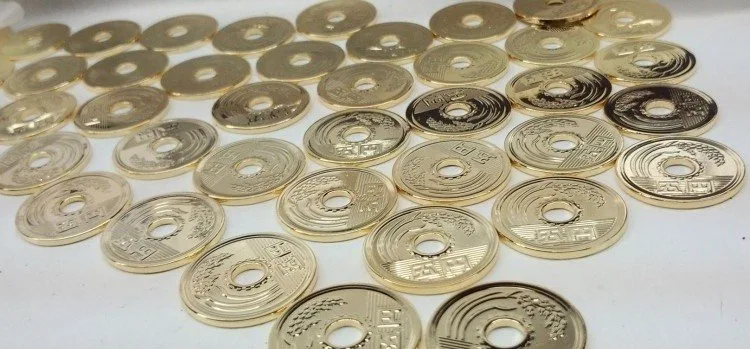
Kōchōsen — imperial copper coins
Between 708 and 958, Japan issued a series of copper coins in different sizes, still as discs with a square hole. These imperial issues are often grouped under the name kōchōsen — roughly, “domestic imperial copper.” Minting later stalled; copper shortages and mismanagement eroded trust until ordinary people refused the coins for daily trade.
Kōshū kin — currency by weight
It took centuries before metal money returned in forms that again dominated local trade. In the late medieval period, some gold and silver pieces — including types associated with the Kōshū region — were valued by weight rather than a fixed face value. Warlords and regional powers used them as a practical way to pay for land, arms, and alliances.
What the yen looks like in your hand
Today’s unit is the yen [円], written in the West with the symbol ¥. In everyday circulation you will meet:
- Coins: ¥1, ¥5, ¥10, ¥50, ¥100, ¥500
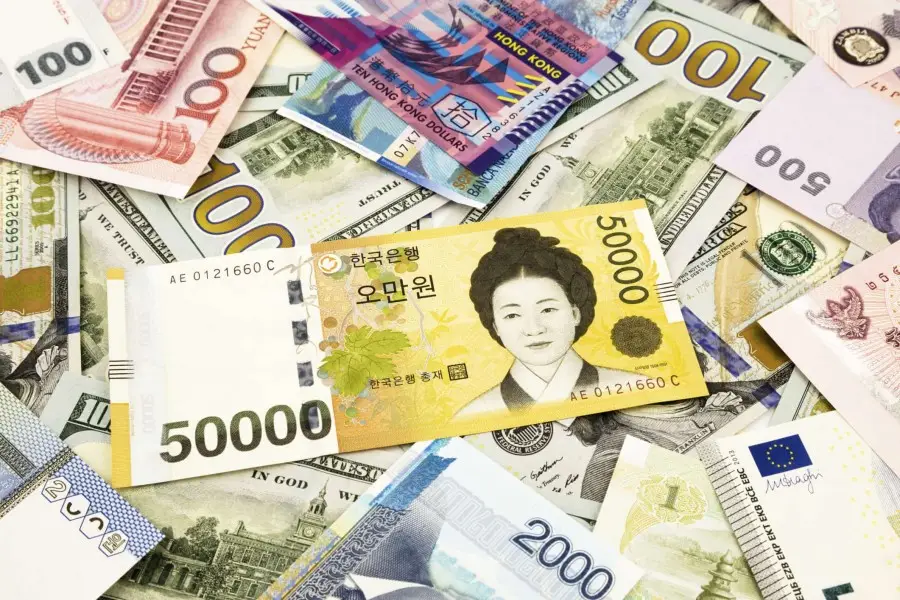
- Banknotes: ¥1,000, ¥2,000, ¥5,000, ¥10,000
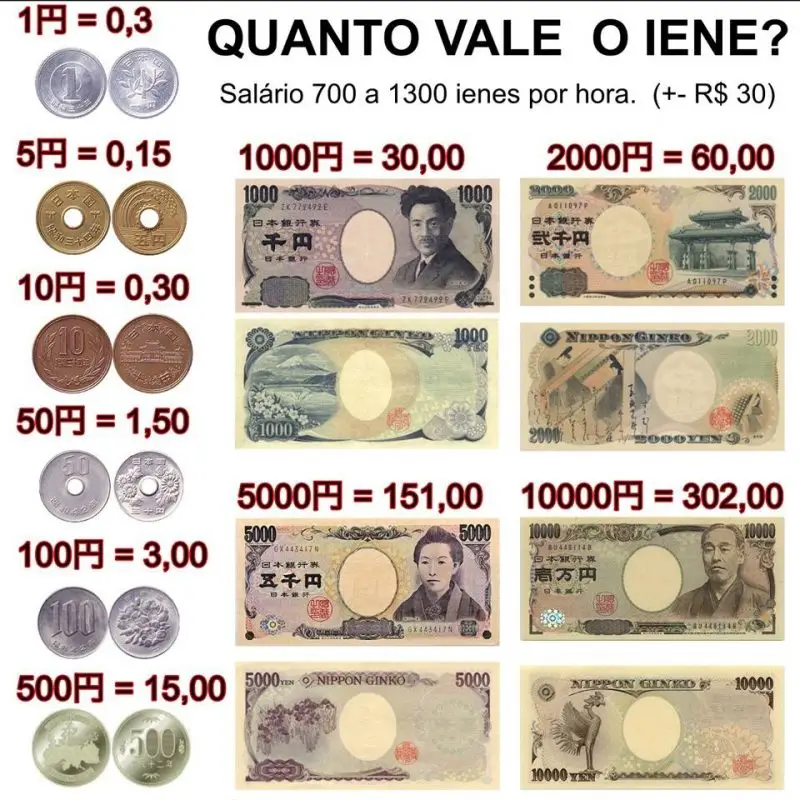
Those numbers look huge if you come from a currency that still uses cents. Japan simply stopped using fractional coins long ago: the smallest cash unit in ordinary life is one yen. That is why a ¥100 coin can feel closer to a small bill elsewhere — and why a ¥10,000 note still buys a solid night out or a stack of souvenirs, depending on the city and the season.
If you want the full story of why there are no cents left in the system, we walk through the history and the myths in Why doesn’t the yen have cents? Is it devalued?.
A rough mental map many travelers use is to think in whole yen units without decimals. Exchange rates move every day, so any fixed conversion table goes stale fast — but the habit of reading prices as full yen amounts, not “dollars and cents,” is what makes Japanese coins click.
Japan can feel expensive when you convert every ramen bowl back into your home currency. When you earn and spend in yen, the same stack of coins and notes measures rent, train passes, and convenience-store dinners inside one economy — which is why the “sticker shock” of tourism and the lived cost of living are not the same conversation.
Sen and rin — when the yen had fractions
Did the yen ever have cents? When the Meiji government introduced the yen in 1871, it also defined smaller units:
- 10 rin [厘] = 1 sen [銭]
- 100 sen = 1 en [円]
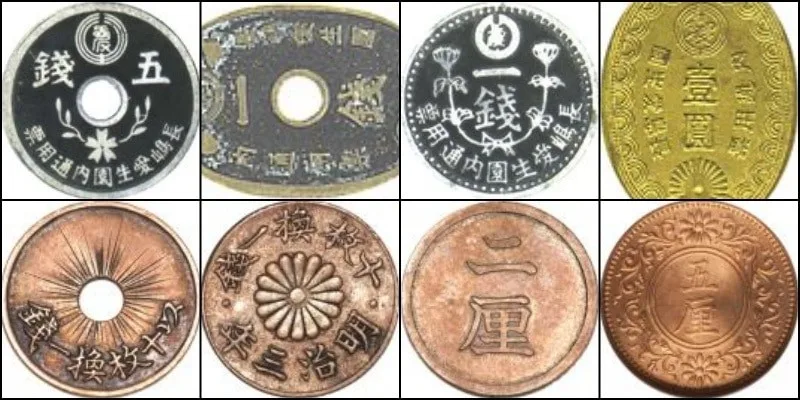
That fractional world lasted until the early 1950s. There were coins of 1 and 5 rin, plus 1, 2, 5, 10, 20, and 50 sen, alongside higher yen values. Some old pieces were not even fully round. After postwar inflation and currency reform, the small change simply stopped mattering in daily trade.
How the yen’s value shifted over time
Comparing old yen to modern prices is messy. Early data often sit next to gold, rice, or newspaper subscriptions rather than a clean dollar chart — and every country has rewritten its own money story since then.
One widely repeated sketch of the early 20th century says that around 1914 one yen was near half a U.S. dollar, and that 100 yen in that world would feel enormous by later standards. Another popular illustration claims that around 1920, 100 yen could cover huge piles of rice, eggs, cinema tickets, or bowls of ramen — the point is not the exact shopping list, but the reminder that “100 yen” used to buy a different life.
Before fractional coins disappeared, holding 100 yen could mark real wealth; paper denominations were far smaller than the ¥10,000 notes people fold today. After the Bretton Woods system broke down in the early 1970s, the yen floated against the dollar and spent decades swinging between weak and strong phases.
The table below shows approximate yen-per-dollar levels by year from 1973 to 2016 — a long view of how the pair moved, not a promise of today’s rate:
| Year | Yen per USD | Year | Yen per USD |
| 1973 | 301.15 | 1974 | 299.00 |
| 1975 | 297.85 | 1976 | 303.70 |
| 1977 | 288.25 | 1978 | 241.74 |
| 1979 | 201.40 | 1980 | 237.73 |
| 1981 | 202.19 | 1982 | 224.55 |
| 1983 | 232.90 | 1984 | 233.95 |
| 1985 | 254.11 | 1986 | 200.05 |
| 1987 | 154.48 | 1988 | 127.44 |
| 1989 | 127.24 | 1990 | 145.09 |
| 1991 | 133.65 | 1992 | 125.05 |
| 1993 | 125.02 | 1994 | 111.49 |
| 1995 | 99.79 | 1996 | 105.81 |
| 1997 | 118.18 | 1998 | 129.45 |
| 1999 | 113.14 | 2000 | 105.21 |
| 2001 | 117.10 | 2002 | 132.66 |
| 2003 | 118.67 | 2004 | 106.39 |
| 2005 | 103.27 | 2006 | 115.33 |
| 2007 | 120.59 | 2008 | 107.60 |
| 2009 | 90.35 | 2010 | 91.26 |
| 2011 | 82.63 | 2012 | 76.94 |
| 2013 | 89.15 | 2014 | 103.94 |
| 2015 | 118.25 | 2016 | 118.18 |
Older systems are even harder to convert. In the Edo period, cash like the mon lived alongside gold and silver; in the Meiji era, one yen of the new system was already a different animal from today’s aluminum ¥1. The safe reading is cultural: Japanese coins have always mixed metal scarcity, politics, and daily habit — not a single unbroken “price tag” across 1,300 years.
Why do the ¥5 and ¥50 coins have holes?
Hole-centered coins are an old East Asian idea. Japan used square holes for centuries on early copper cash; strings of coins could hang from a cord, travel on a belt, or even be recycled as buttons and ornaments. China and Japan both kept versions of that design language long after many countries switched to solid discs.
On modern yen, the holes do practical work. The brass ¥5 with a center hole was introduced in the late 1940s; the ¥50 later gained a hole so it would not be confused with the ¥100 in size and color. The openings also help people who read coins by touch. Saving scarce metal after wartime shortages is another reason often given for keeping the design.
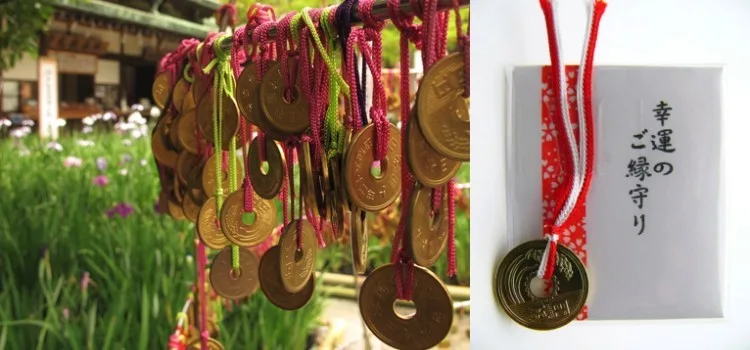
The ¥5 coin has one more cultural life: go-en (五円) sounds like goen (ご縁), the word for a fateful connection. That is why many people drop a five-yen coin into shrine offering boxes — a small metal wish for good ties, not just loose change.
Portraits on Japanese banknotes
Coins carry plants, temples, and symbols. Banknotes carry faces — and those faces change when Japan redesigns its paper money. The series first issued on 3 July 2024 still circulates alongside older notes that remain legal tender.
Who is on the ¥1,000 note?
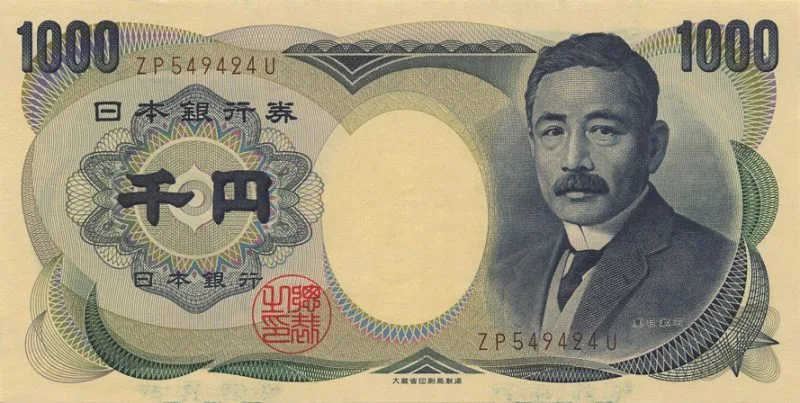
The current ¥1,000 note features bacteriologist Kitasato Shibasaburō, with a reverse inspired by Hokusai’s “Under the Great Wave off Kanagawa.” The previous series (from 2004) showed Hideyo Noguchi (1876–1928), the bacteriologist who worked on syphilis research and yellow fever, with Mount Fuji and cherry blossoms on the reverse.
Who is on the ¥5,000 note?
The 2024 ¥5,000 note honors educator Tsuda Umeko, with Japanese wisteria on the reverse. The 2004 series carried novelist and poet Higuchi Ichiyō (1872–1896), also known as Natsuko Higuchi, with Ogata Kōrin’s iris painting on the back. Her short life left stories that still sit in modern Japanese literature, including works often linked to titles such as Takekurabe.
Who is on the ¥10,000 note?
The 2024 ¥10,000 note features industrialist and reformer Shibusawa Eiichi, with Tokyo Station’s Marunouchi building on the reverse. For two decades before that, the note showed Fukuzawa Yukichi (1835–1901) — journalist, educator, and liberal modernizer whom people still nickname “Yukichi-san” when they hand over a big bill. His older reverse showed the phoenix of Byōdō-in Temple.
Other notes and older faces
The ¥2,000 note is uncommon in daily change. It shows Shureimon in Naha, Okinawa, on the front and a scene from The Tale of Genji with author Murasaki Shikibu on the back — no modern portrait in the style of the higher bills.
Between 1984 and 2004, the ¥1,000 note carried novelist Natsume Sōseki. Earlier ¥5,000 notes featured Nitobe Inazō. Prince Shōtoku appeared on mid-20th-century issues of several denominations. Older paper values also honored figures such as Ninomiya Sontoku, Takahashi Korekiyo, Itagaki Taisuke, Iwakura Tomomi, and Itō Hirobumi on notes that collectors still chase today.
Questions people ask about the yen
How do you read “yen” in Japanese?
You say en [円]. One yen or ten yen — the Japanese word does not pluralize. English “yen” is the familiar international name; the character still means circle or coin at heart.
Why are there no cents?
Because fractional coins stopped being useful. The yen once had sen and rin, but inflation and reform after the mid-20th century left only whole yen. The absence of cents is not automatic proof that the currency is “weak”; it is a design choice of the cash system. For the longer argument, see Why doesn’t the yen have cents?.
Why does the yen look “cheap” next to the dollar?
Unit size and purchasing power are different questions. Without cents, prices are written in larger whole numbers, so people sometimes assume the money itself is devalued. After Bretton Woods ended, the yen floated and Japan’s industrial economy shaped decades of strong and weak stretches against the dollar. Look at what a train ticket, a bowl of noodles, or an hour of work costs in Japan — not only how many yen equal one dollar on a given morning.
Is the yen a major world currency?
Yes. The yen is one of the most traded currencies in global markets, usually discussed alongside the U.S. dollar and the euro. That market role is separate from the everyday feel of a ¥1 aluminum coin floating in a glass of water at a science demo.
How much do people earn in Japan?
Pay is usually discussed by the hour or month and varies by prefecture, industry, and experience. National minimum-wage rules are set in yen per hour and differ by region, so any single monthly number goes out of date quickly. For a deeper look at wages and better-paid jobs, read What is the minimum wage in Japan? Which jobs pay more?.
How many yen is one U.S. dollar?
It changes. For years, travelers treated “about 100 yen ≈ 1 dollar” as a rough mental trick — useful when the pair sat near that level, misleading when the yen weakens or strengthens. Check a live rate before you exchange cash or plan a budget. For everyday shopping, it is often easier to learn a few yen price anchors (a convenience-store onigiri, a subway ride, a coffee) than to convert every coin on the spot.
A quick guide to the six circulating coins
According to the Bank of Japan and the Japan Mint, the coins you still receive as change are:
- ¥1 — aluminum, young tree design, first issued in 1955; light enough to float on still water.
- ¥5 — brass with a center hole; rice, gear, and water on the face; value written in characters rather than Arabic numerals on the classic design.
- ¥10 — bronze; Phoenix Hall of Byōdō-in on the face.
- ¥50 — cupronickel with a center hole and chrysanthemums.
- ¥100 — cupronickel with cherry blossoms (current type from 1967).
- ¥500 — today’s bicolor clad coin (from 2021) with paulownia on the face and bamboo and tachibana on the reverse; earlier cupronickel and nickel-brass versions still turn up in change.
That is the practical side of the same history: from square-hole copper of the Nara period to a two-tone ¥500 that has to survive vending machines and counterfeiters. Pocket the coins, keep a few notes, and the country’s cash system starts to feel less mysterious — and a lot more tactile — than a single exchange-rate ticker.



Community
Comments
0 comments
There are no published comments in this language yet.
Send comment