
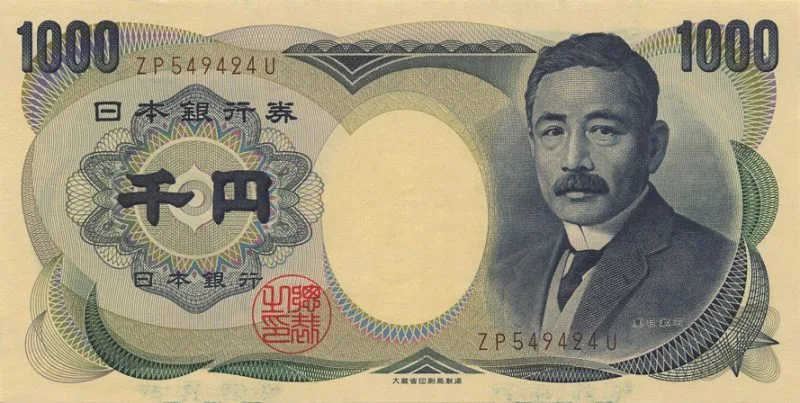
Have you ever noticed and wondered why there are no cents in Japanese currency? Is it because it has devalued to this point? Do the Japanese get confused when making purchases? Has the yen always been this way, or was it once fractional?
When we talk about the value of the yen to people, the first statement they make is that the currency is super devalued. There is always confusion when trying to explain that there is no fractioning or cents in Japanese currency.
In this article, we will address the following topics:
Contents 4
Is the Japanese currency YEN devalued?
For a currency to be considered devalued, it needs to increase the prices of things, discourage investments, and end industrialization. Japan is completely the opposite of this with an inflation rate of 1%. Very different from the cruzado and the cruzeiro where inflation reached 2000 and the currencies were still fractional (there were cents or decimals).
The Japanese yen ¥ (円 - en) is made up of coins of 1, 5, 10, 50, and 100 yen, while its notes are 1,000, 2,000, 5,000, and 10,000 yen. About 100 yen is equivalent to 0.90 cents in dollars (2018), making the currency cheaper than the dollar itself.
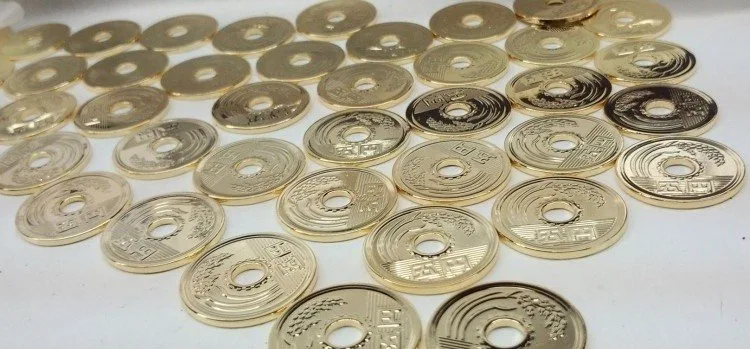
In Japan, one earns more than 700 yen per hour of work, making a 100 yen coin as insignificant as 1 real. Fortunately, with 100 yen, you can buy a drink, a chocolate, or a snack. I think of the Japanese yen the same way I think of the dollar; just place an imaginary comma before the last two zeros.
Although currently the currency of Japan is as valuable as the dollar, the main reason the yen has no fractioning was indeed the devaluation of its currency in the past.
Yen is not fractional? Japanese currency without cents?
Now that we know the yen is not devalued, we must understand why the Japanese yen is not fractional and does not have measures of cents or decimal values. The answer is simple; the people preferred it this way!
In 1953, a law was enacted called Shōgaku tsūka no seiri oyobi shiharaikin no hasūkeisan ni kan suru hōritsu [小額通貨の整理及び支払金の端数計算に関する法律] which literally means Law on the Disposition of Small Coins and Fractional Payment Rounding.
Some may find this decision strange, but it has been this way for many years, and the Japanese do not think about changing it just for the convenience of the rest of the world. There is no difficulty in denoting 50,000 instead of 500.00. Especially for the Japanese where the counting of numbers in the language changes to 1万 [ichi man] when reaching 10,000.
The only valid reason currently for cutting zeros in the Japanese yen would be inflation. This is exactly what happened to the yen before 1953, where there were fractional measures before the yen. In other words! There used to be cents in Japan...
The yen was once fractional, meet the sen!
The yen was introduced in Japan in 1871 and had not one, but two fractions called RIN [厘] and SEN [銭]. 10 RIN is equivalent to 1 SEN, while 100 SEN is equivalent to 1 YEN. This is how things worked in Japan until 1953.
There were coins of 1 and 5 RIN, followed by 1, 2, 5, 10, 20, and 50 SEN. At the time of fractioning, the yen was 1, 2, 5, 10, 20, 50, 100, and 500. In Japan, there were even coins that were not completely round, as in the case of some versions of 1 SEN and 1 YEN.
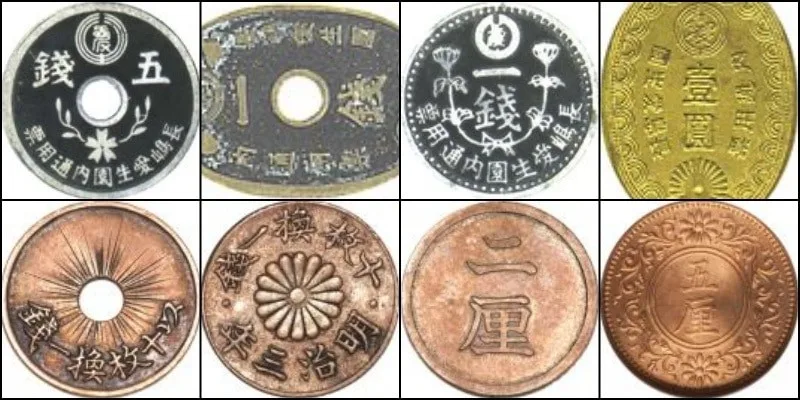
I question the need for RIN, but the SEN was equivalent to our cent. The ideogram for sen [銭] can still be found in words like sentou [銭湯], which means public baths. Referring to the low price of bathhouses in the past.
Currently, 1 RIN has become a relic, as its last mintings were before 1900. One of the first RIN was auctioned for more than 60,000 dollars. We have already written a bit about the value of the yen throughout the ages, we recommend reading the article to understand the history of the Japanese currency that we will highlight below.
WHY DID THE YEN STOP BEING FRACTIONAL?
Before 1900, the yen used silver as the monetary standard of the country, but this silver standard devalued and lost to the gold standard. Only in 1897 did Japan manage to switch to the gold standard after winning the Sino-Japanese War, but it was too late, and the yen devalued to only half of a US dollar.
The Gold Standard was abandoned by Japan because of the Great Depression of 1930. Things worsened during World War II when Japan suffered hyperinflation, causing the yen to lose more than 99% of its value, becoming what it is today.
The US imposed the Bretton Woods System on Japan, making 360 yen equal to one dollar. With this exchange rate, the sen and rin fell out of use and were officially discontinued in 1953 with the law mentioned earlier.
When the Bretton Woods System collapsed in 1971, Japan's currency began to float. All thanks to the country's efforts to become one of the largest economic and industrial powers in the world.
| Date | # yen = $1 US |
|---|---|
| 1914 | 2 |
| 1946 | 15 |
| 1947 | 50 |
| 1948 | 270 |
| 1949 | 360 |
| 1971 | 308 |
| 1998 | 115 |
| 2008 | 92 |
| 2011 | 80 |
| 2018 | 90 |
Thus, the Yen really became without cents because of the devaluation of the currency and inflation. Just like the real plan, this strategy worked and improved the country's economy. However, in this case, the Japanese decided to eliminate decimal and fractional values from their currency altogether.
I hope this article has answered all your questions about why the yen has no cents and about the devaluation of the Japanese currency and how Japan turned things around, making its currency valuable again. If you liked the article, share it and leave your comments.







Community
Comments
0 comments
There are no published comments in this language yet.
Send comment