
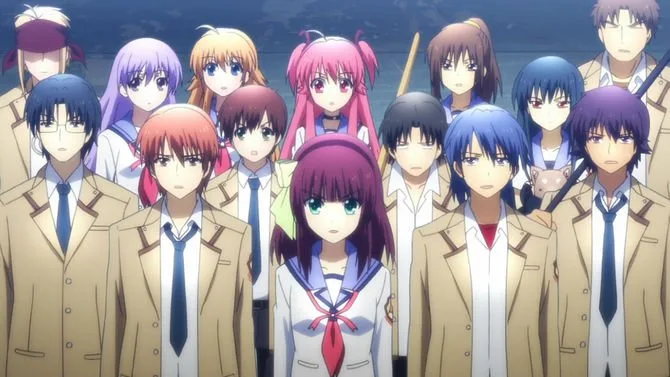
In this entry of Translating Songs, we will study 一番の宝物 (Ichiban no Takaramono), or "My most precious treasure." It is a beautiful and, at the same time, deeply sad song that turns on loneliness, perseverance, and the warmth of precious memories. Below is a link to the full track:
The song comes from the anime Angel Beats! (2010) and is performed by the in-series band Girls Dead Monster. In the story, the protagonist Yui sings it in the last episode as a farewell to the other characters, just before she herself disappears. That context gives the track an unusual emotional weight: it is not simply a song about two people parting, but about learning to keep living after a final goodbye.
Contents 8
Original lyrics of the song
Below is the original Japanese text of the song as it is heard in the final episode of Angel Beats!. Kanji and kana are kept in their original form.
Click here to expand the text
顔を合わしたら喧嘩してばかり
それもいい思い出だった
きみが教えてくれたんだ もう恐くない
どんな不自由でも幸せは掴める だから
ひとりでもゆくよ 例え辛くても
きみと見た夢は 必ず持ってくよ
きみとがよかった ほかの誰でもない
でも目覚めた朝 きみは居ないんだね
ずっと遊んでれる そんな気がしてた
気がしていただけ わかってる
生まれてきたこともう後悔はしない
祭りの後みたい 寂しいけどそろそろ行こう
どこまでもゆくよ ここで知ったこと
幸せという夢を叶えてみせるよ
きみと離れても どんなに遠くなっても
新しい麻に あたしは生きるよ
ひとりでもゆくよ 死にたくなっても
声が聞こえるよ 死んではいけないと
例え辛くても 寂しさに泣いても
心の奥には 温もりを感じるよ
巡って流れて 時は移ろいだ
もう何があったか 思い出せないけど
目を閉じてみれば 誰かの笑い声
なぜかそれが今一番の宝物
一人でも行くよ
どこまでも行くよ
Romanized lyrics of the song
The romanized version (romaji) follows the conventional Hepburn system and helps you follow the pronunciation without needing to read the Japanese characters.
Click here to expand the text
Kao o awashitara kenka shite bakari
Sore mo ii omoide datta
Kimi ga oshiete kureta nda mō kowakunai
Donna fujiyū demo shiawase wa tsukameru dakara
Hitori demo yuku yo tatoe tsurakute mo
Kimi to mita yume wa kanarazu motteku yo
Kimi to ga yokatta hoka no dare demo nai
Demo mezameta asa kimi wa inai nda ne
Zutto asondereru sonna ki ga shiteta
Ki ga shiteita dake wakatteru
Umaretekita koto mō kōkai wa shinai
Matsuri no ato mitai samishii kedo sorosoro ikō
Dokomademo yuku yo koko de shitta koto
Shiawase to iu yume o kanaete miseru yo
Kimi to hanaretemo donnani tōku nattemo
Atarashii asa ni atashi wa ikiru yo
Hitori de mo yuku yo shinitaku natte mo
Koe ga kikoeru yo shinde wa ikenai to
Tatoe tsurakute mo samishisa ni naite mo
Kokoro no oku ni wa nukumori o kanjiru yo
Megutte nagarete toki wa utsuroi da
Mō nani ga atta ka omoidasenai kedo
Me o tojite mireba dareka no waraigoe
Naze ka sore ga ima ichiban no takaramono
Hitori demo yuku yo!
Dokomademo yuku yo.
Translation of the song
The English version below tries to keep the tone and imagery of the original without falling into a word-for-word translation. Wherever the Japanese deliberately leaves a line open to more than one reading, that openness is preserved in English as well.
Click here to expand the text
Whenever we met, we always fought.
But those are good memories too.
You taught me so many things, so I'm not afraid anymore.
No matter how hard it gets, I feel like I can grasp happiness, so…
Even if I'm alone, I will keep going, even if it is painful.
I will carry the dream I had with you, without fail.
I'm glad it was you, and no one else.
But when I wake up in the morning, you are not here.
I felt like we could keep playing forever.
But I know that was just a feeling.
I no longer regret having been born.
It is lonely, like the end of a festival, but it is time for us to move on.
I will go anywhere, carrying what I learned here.
I will show you that I can make the dream called happiness come true.
Even if I am separated from you, no matter how far apart we are,
I will live on into a new dawn.
Even if I'm alone, I will keep going, even if I want to die.
I can hear a voice saying that I must not die.
Even if it is painful, even if I cry from the loneliness,
deep inside my heart, I can still feel warmth.
Time has circled and flowed on, shifting and fading.
I can no longer remember what happened, but
if I close my eyes, I can hear someone's laughter,
and somehow that is now my most precious treasure.
Even alone, I will keep going.
I will go anywhere.
Breaking down the song
Now let us look at a few key lines of the song more closely. The examples below pair the original Japanese text, the romanization, and the meaning of the main building blocks, so you can see how each phrase is put together.
Example 1: You taught me not to be afraid
きみが教えてくれたんだ もう恐くない。
Kimi ga oshiete kureta nda mō kowakunai.
"You taught me so many things, so I'm not afraid anymore."
- きみ (君) – you
- 教えてくれたんだ – taught me; the explanatory ~んだ gives the line a soft, emotional weight
- もう恐くない – not afraid anymore (mō = already/anymore; kowakunai = not scared)
Example 2: Happiness can be grasped
どんな不自由でも幸せは掴める だから
Don'na fujiyū demo shiawase wa tsukameru dakara
"No matter how hard it gets, I feel like I can grasp happiness, so…"
- どんな不自由 – literally "any hardship / inconvenience"; in context, "no matter how hard things are"
- でも – even, even if
- 幸せは掴める – can grasp happiness; tsukameru is the potential form of tsukamu ("to grab, to seize")
- だから – therefore, so
Example 3: You are not there in the morning
でも目覚めた朝 きみは居ないんだね
Demo mezameta asa kimi wa inai nda ne
"But when I wake up in the morning, you are not here."
- でも – but
- 目覚めた – woke up (past tense of mezameru)
- 朝 – morning
- きみ (君) – you
- 居ないんだね – is not here; the ~んだね ending turns the line into a quiet, almost self-addressed realization
What holds the song together
Three threads run through the lyrics: fighting as affection in the opening verse, defiance and keeping going in the middle stanzas, and memory as treasure at the close. The ending quietly flips the early sadness around: what has been lost is exactly what remains most precious. That is also why the song fits so well in Angel Beats! – it is less a farewell than a quiet permission to keep living.
A full vocabulary list, a complete word-by-word analysis, and alternative translation variants will be added in a future update.
Thank you for reading, and happy studying! ^_^


Community
Comments
0 comments
There are no published comments in this language yet.
Send comment