
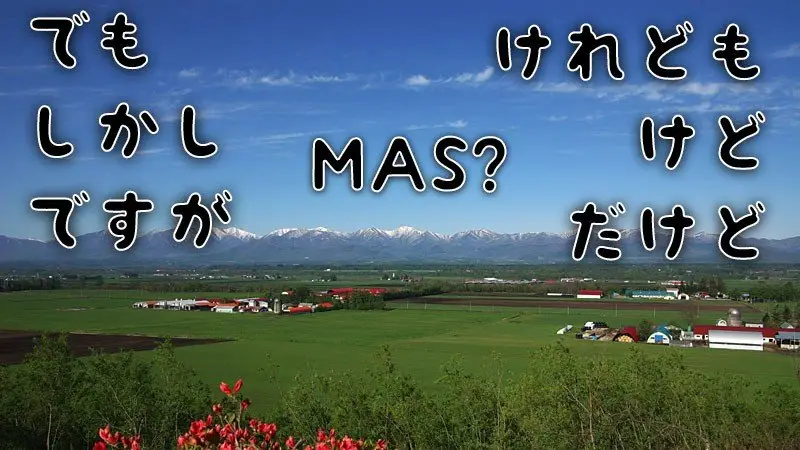
English has one everyday “but.” Japanese spreads the same job across several words—and the real puzzle is not the dictionary gloss. It is where the word sits in the sentence, how formal it sounds, and whether you are finishing the contrast or leaving it hanging.
This page walks through でも, the けど family, しかし, ただし, and conjunctive が, with examples so you can hear the difference instead of guessing from a single translation.
Contents 6
Demo (でも)
This is one of the most well-known and used forms. It usually sits at the beginning of a new sentence, contrasting with what came just before. It does not work like けど in the middle of a clause chain. でも fits casual conversation; for a more formal sentence-initial “however,” Japanese leans on しかし.
Examples:
- 友達の家に行くつもりでした。でも、彼女は病気です。
- Tomodachi no ie ni iku tsumori deshita. Demo, kanojo wa byōki desu.
- I was going to a friend’s house. But she is sick.
- 今日、学校に行きません。でも明日行きます。
- Kyō, gakkō ni ikimasen. Demo ashita ikimasu.
- Today I am not going to school, but tomorrow I will.
- 私はあなたがすき。でも、君はバカです。
- Watashi wa anata ga suki. Demo, kimi wa baka desu.
- I like you. But you are an idiot.
- でも、あなたにあげるりんごはありません。
- Demo, anata ni ageru ringo wa arimasen.
- But I don’t have apples to give you.
Kedo or keredomo (けど / けれども)
けど can mean “but,” “however,” or “even so.” Unlike でも, it usually links two clauses in one sentence, creating a clear contrast inside the same line. Formality steps down the ladder:
- けれども (keredomo) — quite formal
- けれど (keredo) — polite / neutral
- けど (kedo) — informal, everyday speech
In conversation, people often trail off after けど (“…けど…”) to soften a request, invitation, or mild complaint without stating the rest out loud.
Usage examples:
- 頼まれた仕事は終わりましたけど、部品が一個足りなかった。
- Tanomareta shigoto wa owarimashita kedo, buhin ga ikko tarinakatta.
- I finished the job I was asked for, but one part was missing.
- 彼はあまり勉強しないけれども、成績がいい。
- Kare wa amari benkyō shinai keredomo, seiseki ga ii.
- He doesn’t study much, but he gets good grades.
After a noun or a na-adjective, speakers often insert the plain copula だ before けど, giving forms like だけど / だけれども.
- ケビンは先生だけれども、教えるのが嫌いです。
- Kebin wa sensei da keredomo, oshieru no ga kirai desu.
- Kevin is a teacher, but he doesn’t like to teach.
- 友達はたくさんいるんだけど、なんか寂しい。
- Tomodachi wa takusan irun dakedo, nanka sabishii.
- I have many friends, but somehow I feel lonely.
Shikashi (しかし) and tadashi (ただし)
しかし also means “but” or “however,” with a stronger, more formal punch than でも. You hear and see it in speeches, essays, news, and careful writing more than in chat with friends. Like でも, it typically opens a sentence, while the けれども family stays inside the clause.
Examples:
- しかし今や事態は大きく変わった。
- Shikashi imaya jitai wa ōkiku kawatta.
- But now the situation has changed a lot.
- しかし、私はあなたが大好きですよ。
- Shikashi, watashi wa anata ga daisuki desu yo.
- However, I really like you.
A close cousin is ただし (often written 但し). It often introduces a condition or exception rather than a pure reverse turn—think “however” as in “free entry, provided that…”. Do not confuse it with 正しい (“correct”), which is a different word.
- 入場自由。ただし、6歳未満は保護者同伴のこと。
- Nyūjō jiyū. Tadashi, 6-sai miman wa hogosha dōhan no koto.
- Free entry. However, children under 6 must be accompanied by a guardian.
What is the difference between shikashi and tadashi?
Both can look like “however” in English, but the job differs. しかし tends to push against the previous idea—an opposing turn. ただし adds a supplementary limit or rule that still belongs to the same policy. Pick しかし for contrast; pick ただし when you are listing the exception after a general statement.
Particle ga (が) as “but”
When が follows a predicate (often after です / だ or a verb), it can link two clauses and translate as “but,” “and,” or “however.” Compared with けど, the opposition often feels a little softer or more formal, with a touch of hesitation. You can also stop after が—“明日は行きますが…”—and leave the rest implied, the same soft landing you get with trailing けど.
Using が for contrast everywhere in casual chat can sound stiff; in speech among friends, けど is usually the natural pick. And not every が after a verb is a “but”: the same form is also the subject marker, so position and context decide the reading. If you are still sorting は and が as particles, see the difference between は and が and は / が with verbs.
- 明日は雨だが、ピクニックに行く。
- Ashita wa ame da ga, pikunikku ni iku.
- It will rain tomorrow, but we are going on a picnic.
- 学ぶつもりですが…
- Manabu tsumori desu ga…
- I plan to learn, but…
Quick guide: which “but” to pick
- でも — new sentence, everyday speech, clear contrast with what was just said.
- けど / けれど / けれども — inside one sentence; choose the form by how polite you need to sound; trailing けど softens unfinished thoughts.
- が — clause linker, often more formal or hesitant; common before soft requests in polite speech.
- しかし — formal writing and speeches; strong sentence-initial “however.”
- ただし — exception or condition attached to a rule, not a full U-turn.
In short: でも and しかし open sentences (casual vs formal); the けど family and conjunctive が sit after a clause. Direction particles such as へ, に, and で answer a different question—location and means—not contrast, so keep that toolbox separate.
None of this is hard once you hear it a few times. The reliable way to choose is not a single English gloss, but the whole language around the line—formality, position, and the feeling Japanese speakers attach to each form.



Community
Comments
0 comments
There are no published comments in this language yet.
Send comment