
When people think of Stitch they think of Hawaii, of Lilo, and of a blue alien who eats everything. That the same character got a Japanese series of his own is less known. It does not take place in Hawaii but in Okinawa.
The series is called スティッチ! in Japanese, spoken Sutitchi. It ran from October 2008 to June 2011 and is the second television series of the Lilo & Stitch franchise. Two specials followed.
Contents 7
What the series is about
Stitch left Lilo when she went to college. He took Dr. Jumba Jookiba’s vehicle and fell back into his destructive programming. While Jumba chases him through space, both are caught in a wormhole.
Stitch crash lands on Izayoi, a fictional island in the Ryukyus off Okinawa. There he meets Yuna Kamihara, a girl who lives with her grandmother and practises karate. Her father is a marine biologist, away at sea for weeks.
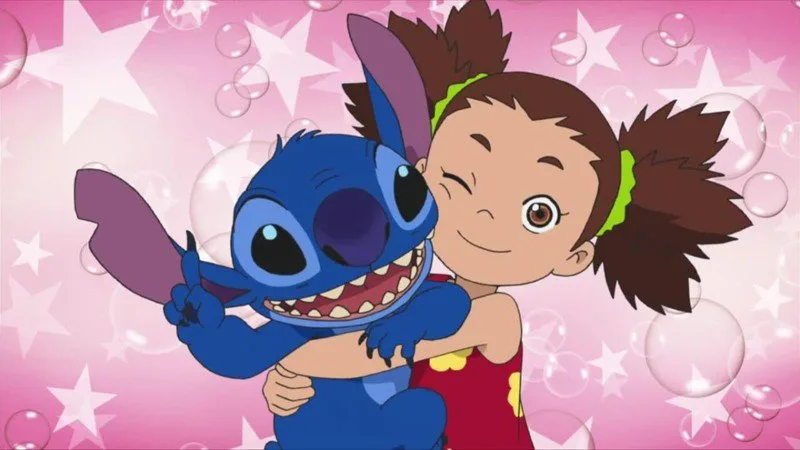
After an initial fight, a lot of chaos and a storm, the two become friends. Yuna and her grandmother take Stitch in and show him the Chitama Forest, home to yokai, the spirits of Japanese folklore.
The wish and the 43 good deeds
At the heart of the forest stands the Chitama Stone. It holds the life force of the yokai and can grant one wish, but only to someone who proves worthy with 43 good deeds.
Stitch wants to become the strongest being in the universe. Jumba builds him a good deed counter, and the series follows how a chaos maker turns into a neighbour who helps.
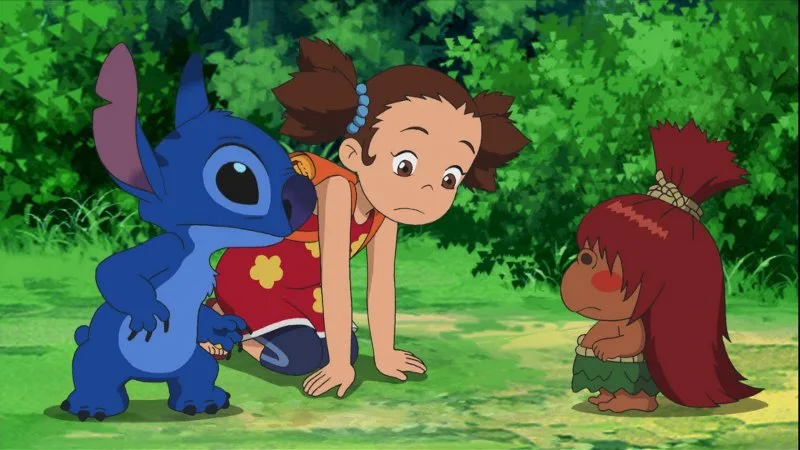
A recurring ally is Kijimunaa, a small yokai with long red hair and a powerful sneeze. The pair free him when a bully takes over his tree.
Who returns and who is new
Jumba and Pleakley come back from an asteroid in Saturn’s rings and stay on the island. The villain Jacques von Hämsterviel pursues the same goal with Gantu and Reuben, the stone.
New faces join in the second half. BooGoo, a purple insect like alien, had been brainwashed by Hämsterviel. Sasha becomes Yuna’s new classmate, and Tigerlily Sakai her cousin, who bullies her and Stitch.
The three parts of the series
The first part was produced by Madhouse and aired from 8 October 2008 to 25 March 2009. A special followed on 26 June 2009, Stitch Day, a nod to his experiment number, 626.
The second part, スティッチ! ~いたずらエイリアンの大冒険~, aired from 13 October 2009 to 29 June 2010, with another special on 8 August 2010. That completed Madhouse’s run of 56 episodes.
The third part, スティッチ! ~ずっと最高のトモダチ~, came from Shin-Ei Animation and aired on TV Asahi from 6 July 2010 to 8 March 2011. It has 29 episodes and moves the cast to a fictional city called Okinawa New Town.
The ending and the specials
By the end of the second part Stitch has his 43 deeds. He redirects a warhead from Experiment Zero into a black hole and survives because the Chitama Stone brings him back to Yuna. He spends his wish not on power but on staying with her forever.
In the third part Hämsterviel teams up with Delia, who wants a power cell inside Stitch, called Neo-PowerChip in the Japanese version. Two specials closed the run, スティッチと砂の惑星 in June 2012 and スティッチ!パーフェクト・メモリー in August 2015.
Why the series is set in Okinawa
The move from Kauai to Okinawa carries meaning beyond scenery. The series takes Japanese material, the yokai, the forest and the stone, and translates the Hawaiian idea of ohana into another setting.
Instead of a sister from Hawaii, the centre is a girl from the provinces, with a grandmother, karate and an absent father. The bond stays the same: a family that is not made of blood alone.
Where to watch it today
The first season did not stay in Japan and even aired on Brazilian television. For viewers elsewhere it is harder to find, since it never had a wide release in many markets.
The series ended in 2015 with a last special. In 2017 Stitch & Ai, a Chinese series, took over the role of the Japanese spin off.
Anyone who likes the origins can read the series as another corner of the character after the films. Anyone learning Japanese also finds everyday speech from Okinawa and a show that ran on Japanese television. For a lighter tone nearby, the comedy anime list is a good next stop, and the piece on Studio Ghibli covers the other great branch of Japanese animation.


Community
Comments
0 comments
There are no published comments in this language yet.
Send comment