
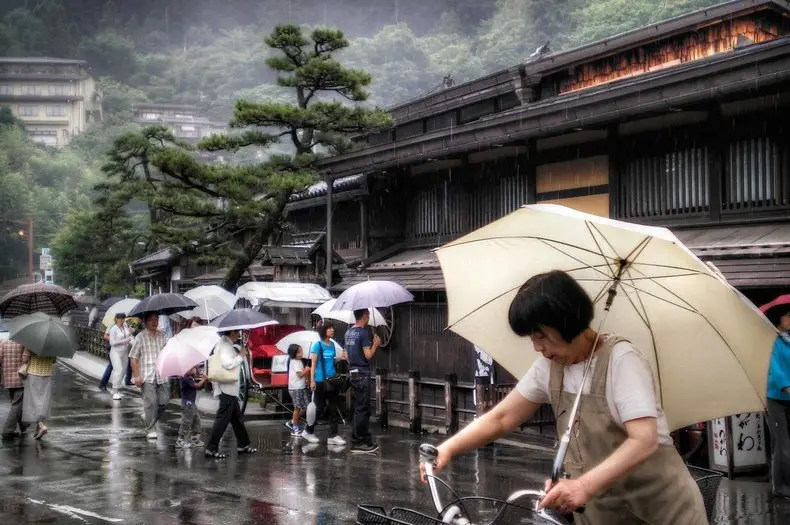
While some people treat parasols as sun-only gear and umbrellas as rain gear — and quietly file parasols as a women’s accessory — Japanese does not bother with that split. Rain or shine, both are kasa [傘].
On Japanese streets the word works harder than English allows. Transparent vinyl kasa flood the rainy season; I bought one and then left it behind, which is almost a national sport. Fold a traditional wagasa shut, though, and it looks like a single stick of bamboo — which is when you realize the 500-yen vinyl is not the whole family.
Contents 5
Two kanji, two objects: 傘 and 笠
Japanese writes two different kasa. 傘 is the folding umbrella or parasol you hold. 笠 is a traditional hat — often wide, conical, and meant to shed rain or sun the way an umbrella does, except it stays on the head. They share a reading and an old idea of “cover,” not a single object.
When another word attaches, the sound often becomes -gasa: jingasa, sugegasa, bangasa. That is why the same syllable keeps turning up in names that look unrelated until you see the kanji.
The hat side is a whole wardrobe. A sugegasa [菅笠] is a pointed sedge hat, the kind farmers and travelers wore. A jingasa [陣笠] was a war hat for samurai and ashigaru, made of iron, leather, lacquered paper, or other tough stuff, often with a crest. Straw amigasa still appear in folk dance. None of these is a wagasa. If someone points at a conical straw hat and calls it an “umbrella,” they have mixed the two kanji.
Wagasa — the traditional Japanese paper umbrella
Let’s begin with the object people picture when they say “Japanese umbrella”: the wagasa [和傘]. It is handcrafted from bamboo ribs and washi. Rain versions are oiled so the paper actually sheds water. Closed, a well-made one looks like one piece of bamboo; open, it shows a crowd of ribs — often 36 or more — because the paper has to fold tightly between them.
The ancestor came from the continent with Buddhist culture: early versions were large canopies that attendants held, more status and spirit-warding than a personal rain tool. Paper and bamboo work advanced in the Heian period, and the folding, everyday wagasa spread in the Edo period, when domains even pushed umbrella-making as a local industry. Geisha, kabuki, tea gatherings, and ukiyo-e prints all grabbed it. It is still the umbrella you see at a wedding, a festival dance, or a tea ceremony — now treated as craft as much as rain gear.
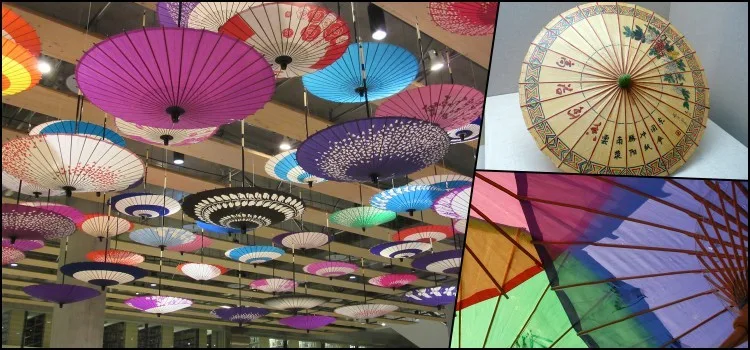
Kyoto shops that still supply geisha and dancers have long sorted colors by who is carrying the umbrella: purple for geisha, pink for dancers, green or red for middle-aged clients, dark blue for men and elders, black or brown for actors. White shows up at funerals. These are shop customs and stage habits, not a law — but they explain why a wagasa in a period drama is rarely a random color.
Bangasa, janomegasa, and higasa
Wagasa is the family name. The useful split is rain versus sun, and sturdy versus dressed-up.
- Bangasa [番傘] — a thick, plain rain umbrella with a raw bamboo handle. Edo shops numbered them to lend when a sudden shower hit, which is one story behind the name. Cheap, tough, often stamped. Still the look of a neighborhood restaurant umbrella.
- Janomegasa [蛇の目傘] — the “snake-eye” rain umbrella: a bold white ring on navy, red, or another ground color. Lighter, slimmer, with decorative thread on the ribs. Kabuki made it famous; some patterns are still read as lucky or protective.
- Higasa and maigasa — smaller sun and dance umbrellas. They are not oiled, so they are not for rain. The washi keeps its color, which is the point under stage lights or summer sun.
Today a genuine wagasa is festival gear, a photo prop, or a piece you buy from a remaining workshop in Kyoto or Gifu. It is not what you grab at the station when the sky opens.
The transparent vinyl kasa everyone actually uses
Transparent umbrellas were incredibly easy to find; I even bought one, but unfortunately left it behind in Japan. These really only serve to protect you from the rain, although the material is surprisingly durable — and you can see the bicycle coming at you through the canopy.
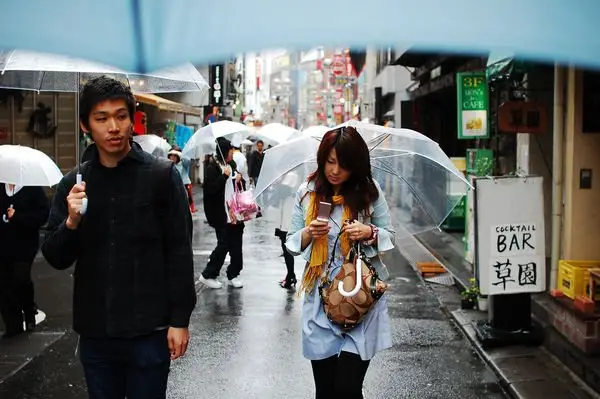
Japan sells on the order of 130 million umbrellas a year, many of them cheap vinyl from convenience stores at around 500 yen. The clear plastic kasa started as a Japanese idea: White Rose, an Asakusa maker that goes back to 1721, put vinyl on an umbrella frame after the war, when cotton covers still faded and leaked. Department stores did not want it. Pharmacies and clothing shops did. For a while the umbrellas even went to New York; cheaper copies then took the mass market.
White Rose still makes vinyl umbrellas in Tokyo, one of the last domestic factories in a sea of imports. The clear canopy is not only a look: in a crowded street you see traffic and other people, and they see you. Most of the 500-yen ones are disposable. The original pitch was the opposite — repair the frame, keep the handle, treat it like a tool.
Japanese creativity in umbrellas
Since Japan loves to reinvent everyday things, it should come as no surprise that there is a long list of quirky umbrellas out there. Here are some themed and special umbrellas that have truly pushed the limit. Not all of them are easy to find, let alone popular.
Some umbrellas have hidden patterns that only appear when the fabric comes into contact with water. Others feature a built-in visor that covers the head completely while still allowing you to see. There are even umbrellas that open and close in reverse.
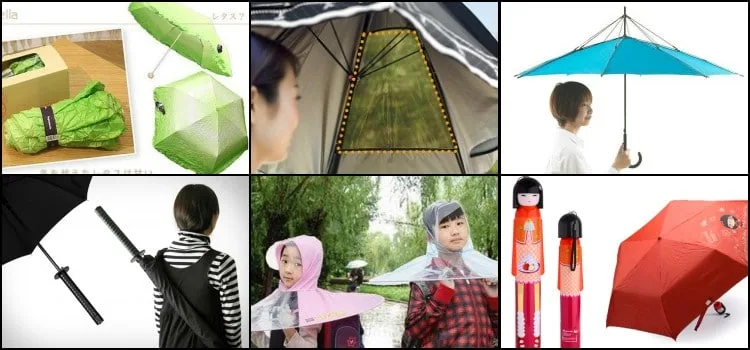
The Japanese have repeatedly tried to make daily life easier, even with umbrellas. Some can be strapped to your arms so you do not have to hold them. Others are umbrella hats — and there is even a hat you can sit on like a chair.
- Samurai umbrella — a regular umbrella shaped like a katana;
- Kokeshi umbrella — as the name suggests, it has a kokeshi doll on the handle;
- Vegetabrella — this one went too far and literally turned into a salad;
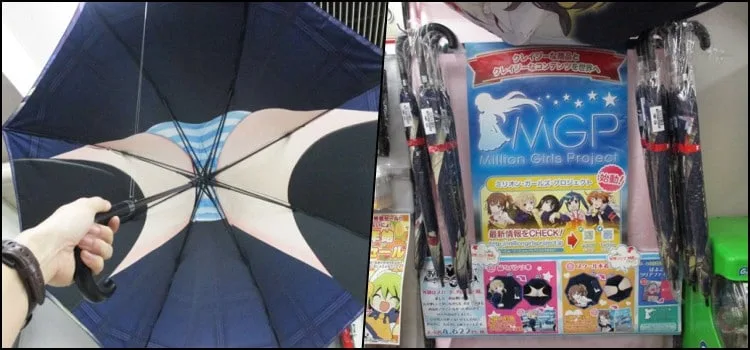
A project called The Million Girls, designed to promote the idea of “bizarre Japan,” created an umbrella named Upskirt Umbrella. On its underside, you can see the legs and underwear of a Japanese schoolgirl drawn in anime style.
Folklore got there first: the karakasa-obake is an old umbrella that grew one eye and a tongue. If a paper kasa lives long enough, the stories say, it stops being polite.
If you share a vinyl kasa on a wet walk home, you are already in aiaigasa territory — one umbrella, two people, a word that shows up in love songs. The paper wagasa is the photograph. The numbered bangasa is the shop loaner. The clear plastic one is what you will actually carry, and probably lose, before the next sudden rain.



Community
Comments
0 comments
There are no published comments in this language yet.
Send comment