
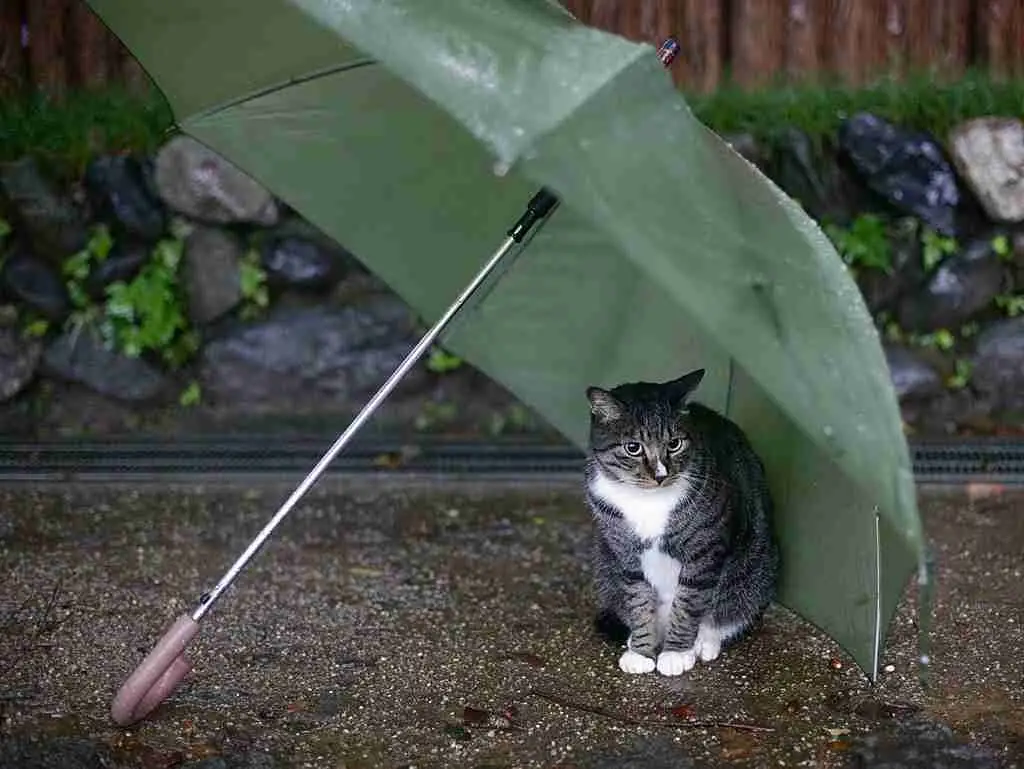
Rain can change character quickly: a few drops, a fine mist, then a hard summer shower that seems to arrive without warning. Japanese gives those shifts their own names, which makes weather talk a surprisingly rich place to start learning vocabulary.
The familiar claim that Japanese has 50 words for rain is better treated as an invitation than a fixed count. Some expressions are everyday language, others belong to forecasts, poetry or seasonal memory. Start with the words you can use, then let the more evocative ones sharpen the picture.
Contents 6
The everyday Japanese word for rain
雨(あめ, ame) is the ordinary word for rain. You will hear it in simple phrases such as ame ga furu (雨が降る, “it rains”) and ame ga futte iru (雨が降っている, “it is raining”). The verb furu is used for rain and snow falling; it is more natural here than trying to translate English word by word.
When a forecast, a friend or a shop sign needs more detail, Japanese often adds another word to 雨. The result may describe the rain’s strength, how suddenly it arrives, or the season around it.
Rain words by intensity and shape
| Japanese | Reading | Useful sense |
|---|---|---|
| 小雨 | こさめ kosame | Light rain or a small shower. |
| 霧雨 | きりさめ kirisame | Fine, mist-like drizzle. |
| 大雨 | おおあめ ōame | Heavy rain. |
| 豪雨 | ごうう gōu | Torrential or very heavy rain; common in weather reporting. |
| 土砂降り | どしゃぶり doshaburi | A downpour, rain falling in force. |
| にわか雨 | にわかあめ niwaka ame | A sudden shower. |
小雨 and 霧雨 are useful when ordinary rain feels too broad: kosame is light rain, while kirisame suggests tiny drops and a misty texture. At the other end, 大雨 is a plain “heavy rain,” whereas 豪雨 has a stronger, report-like tone. 土砂降り is the word to remember when the rain is coming down in sheets.

Seasonal rain words
Japanese rain vocabulary also follows the calendar. These terms are not interchangeable weather labels; each brings a particular season or atmosphere with it.
| Japanese | Reading | When it is used |
|---|---|---|
| 梅雨 | つゆ tsuyu | The rainy season, usually discussed from late spring into early summer. |
| 夕立 | ゆうだち yūdachi | A sudden evening shower, often associated with summer. |
| 春雨 | はるさめ harusame | Spring rain; it can sound gentle or literary depending on context. |
| 五月雨 | さみだれ samidare | Early-summer rain, often with a poetic or seasonal feel. |
| 秋雨 | あきさめ akisame | Autumn rain. |
| 時雨 | しぐれ shigure | A brief shower associated especially with late autumn or early winter. |
| 氷雨 | ひさめ hisame | Cold rain in wintery weather. |
梅雨 deserves special attention because it names a season rather than one passing shower. You may also see the reading baiu in formal compounds such as baiu zensen (梅雨前線), the rainy-season front. 夕立, meanwhile, carries the abrupt feeling of a summer evening shower; it is a word worth recognizing in stories as well as forecasts.
Japanese sound words for rain
Not every useful rain expression is written as a neat noun. Japanese onomatopoeia often supplies the sound and rhythm that an English weather app might reduce to “light” or “heavy.”
- しとしと(shito-shito) — rain falling quietly and steadily.
- ぽつぽつ(potsu-potsu) — scattered drops, often when rain is beginning.
- ぱらぱら(para-para) — light, intermittent drops.
- ザーザー(zāzā) — rain pouring down loudly.
These words usually work with a verb rather than replacing 雨 altogether. A speaker might describe rain as shito-shito futte iru, for example, to stress its soft, persistent fall. They are small words, but they add more texture than a direct translation of “rainy.”
Why there are so many ways to describe rain
Japanese can build precise compounds, and its seasonal vocabulary has long mattered in conversation, literature and art. That does not mean every rain word is an everyday substitute for ame. The useful distinction is between words you can say in a forecast or casual chat and words that carry a more literary, regional or seasonal shade.
Kanji can offer a clue to how a compound is assembled, but it is not a shortcut to every reading or nuance. If you are exploring why Japanese uses kanji, treat the rain words as vocabulary to learn in context. The same goes for the wider question of how many kanji learners need to know: recognition grows more reliably through repeated encounters than by memorizing a long list at once.

A simple way to remember the vocabulary
Begin with ame, kosame, ōame and niwaka ame. Next, learn tsuyu and yūdachi when you read about the seasons. Add the sound words only after you can picture the rain they describe. This creates a usable set of terms instead of a trivia list, and it leaves room for the more poetic expressions to make sense when you meet them in a song, novel or forecast.
The number is not the interesting part. The interesting part is how a change in rain can change the word a Japanese speaker chooses.





Community
Comments
0 comments
There are no published comments in this language yet.
Send comment