
Intimate grooming is shaped less by personal preference than by the culture someone grows up in. In Japan, the default for many women has long been to leave pubic hair alone, and that pattern is worth understanding on its own terms before judging it.
This is not uniquely Japanese. Women in China, Korea and large parts of Southeast Asia, Europe and Africa also tend not to remove pubic hair as a matter of course. The expectation that body hair is unhygienic and must be removed is mostly a modern Western habit, and one that overlooks the basic fact that hair exists to protect the skin in the first place.
To give a useful comparison: a Brazilian man who shaves his chest and arms completely is often seen as odd, and a Japanese woman who shaves her pubic area completely can feel similarly exposed. Underarm hair and visible beard growth, on the other hand, are read in Japan as poor grooming and are expected to be trimmed.
The honest question is the other way round: why do people in Western countries shave their pubic hair in the first place?

Contents 4
How did the habit of not shaving pubic hair arise?
As with many Japanese customs, China had a strong influence here. The most useful starting point, though, is simply to look at the daily reality of our ancestors, where it is very unlikely that anyone trimmed that area routinely.
Today, women in every country can choose to remove or keep their pubic hair. In some places the choice is made to please a partner, in others to follow local norms. In hotter Western climates, the practical arguments for removing hair (sweat, chafing, fungal irritation) carry more weight, which helps explain why full removal is more common there.
It may sound like a stretch, but a Chinese proverb attributed to Confucius captures the underlying attitude well:
身体发肤,受之父母,不敢毁伤,孝之始也。
"Our body, skin and hair are received from our parents; we should not presume to damage them. This is the beginning of filial piety." (Opening of the Classic of Filial Piety, 孝經, traditionally ascribed to Confucius.)
The proverb is about the body in general, not specifically about pubic hair, but it reflects a wider East Asian idea that the body, hair included, is something to be respected and not casually altered. That background helps frame the Japanese attitude discussed in the next section.
Why do Japanese women not shave their pubic hair?
There is no single official reason. In Japan, the subject is treated as a private matter and most people genuinely do not care whether a woman removes the hair or not. A few cultural threads, though, are often cited and together explain the default:
Puberty and adulthood. For many Japanese women, pubic hair is read as a visible sign of having reached puberty. Removing it entirely is sometimes associated with looking pre-pubescent, and a number of women see that as a kind of regression they are not comfortable with.
Onsen etiquette. Onsen and public bath culture is often raised here. In a shared bath where everyone is uncovered, full removal stands out and can attract unwanted attention or gossip. Keeping the area covered by hair is a way of not drawing the eye.

Historical associations with prostitution. Historical accounts mention that some prostitutes in the Edo period (1603–1868) removed their pubic hair. In a culture where that history is still half-remembered, ordinary women sometimes avoid full removal so they are not, even unfairly, lumped in with that image.
Climate and necessity. Japan does not have the year-round tropical heat of, say, Brazil. The sweating, chafing and fungal irritation that drive removal in hotter countries are simply less of a concern, so there is less practical pressure to remove the hair.
Hair is read as a sign of adulthood and maturity. In much of Japanese culture it is something to be kept, not something to get rid of.
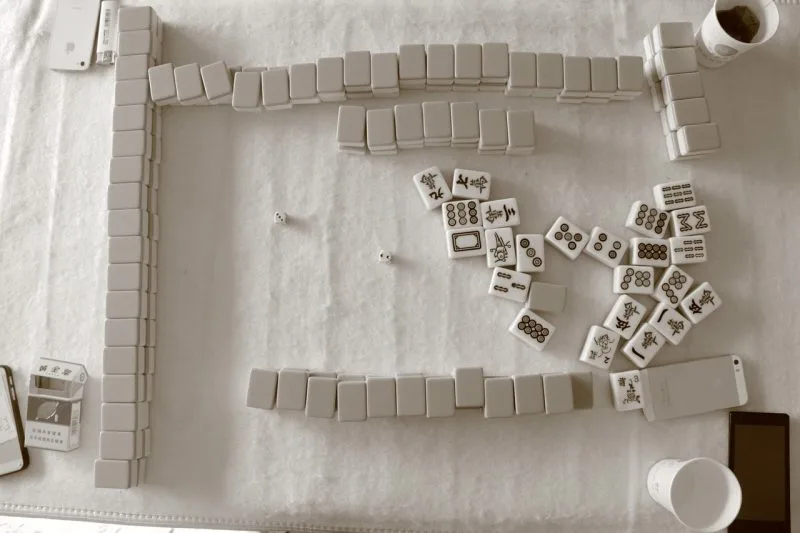
Shaved hair is like a White Tile in Mahjong
There is a Japanese term for a shaved or nearly hairless pubic area: paipan (パイパン). The word is sometimes extended to any part of the body that is unusually hairless (glabrous, in medical language).
Its origin is Chinese: the characters 白板 (báibǎn), literally "white slab", refer to the white dragon tile in Mahjong. In the game this tile is completely blank on both sides, and that image of a blank, all-white tile gradually became a slang metaphor for a hairless pubic area.
Paipan became more widely known in Japan when Western pornography started circulating more freely and brought with it a strong preference for hairless bodies. The impact on mainstream Japanese culture has, on the whole, been limited: the market for hairless Japanese women in adult entertainment has stayed relatively small, and surveys (discussed in the next section) suggest most women still keep at least some hair.
As a small side note, hair is also rarely drawn in adult-oriented anime and manga, but for a very different reason: it is genuinely hard to render in that art style and tends to break the line work.
For reference, the main Japanese vocabulary for the topic is:
| 陰毛 | inmou | pubic hair (standard, neutral) |
| 恥毛 | chimou | pubic hair (slightly more clinical) |
| お毛々 | okeke | pubic hair (informal, childish euphemism) |
| マン毛 | mange | female pubic hair (very informal slang) |
| ちん毛 | chinge | male pubic hair (very informal slang) |
Are Japanese women's lower parts trimmed?
It is worth saying up front that body hair in general tends to be sparser and finer in East Asian populations, including in Japan, than in many other groups. Some Japanese men, for example, never develop facial hair heavy enough to need regular shaving. Following that same pattern, more than half of Japanese women report that they have never needed to trim or cut the area.
News Post Seven, citing an online survey, reports that roughly 26% of Japanese women usually remove the hair that shows along the bikini line, another 23% trim it to make it shorter, and only about 7% remove the hair completely. The remaining women leave it as it is. These are self-reported survey figures, not clinical measurements, so they should be read as a rough snapshot rather than a precise count.
How much of this is changing among younger generations, in bigger cities, and in fashion-conscious circles is harder to pin down from the public data. Trends in beauty standards in Japan are real, but they do not erase the older cultural norm described above; they sit on top of it.
Where do you stand on this? Does the cultural explanation above match what you have read or seen about Japan, or does it contradict the image you had? Share your take in the comments — respectful disagreement is welcome. You may also enjoy:




Community
Comments
0 comments
There are no published comments in this language yet.
Send comment