
We live in a time full of discussions involving nudity, sexuality and gender – especially when it comes to how our children fit into all of this. How does Japan view these issues? Some people see Japan as a sexually unusual country because of certain cultural events and the prominence of its animation and sex industries.
It is common to come across arguments from Japan being used in online debates to defend ideas such as exposing children to sexual topics at a young age. In this article we try to address the subject as carefully as possible.
While the Christian religion dominates Brazil and pushes a strong moral framework, Japan is much more open about sex – fewer than five percent of Japanese people are Christian. At the same time, Japan does not allow same-sex marriage and rarely intervenes in questions of sex or gender identity.
The Japanese are generally reserved and prefer not to engage in controversial debates; the cultural norm is that each person can do what they want. There are, of course, movements and discussions on these topics – but on a much smaller scale than in many other countries.
The minimum age for sexual consent in Japan is 13, according to the Japanese penal code, although the exact rule can vary between prefectures. A separate law, however, prohibits sexual relations between adults and minors under 18.
Even dating can be complicated during school years, because Japanese law may require parental consent. Some private schools actively try to prevent students from dating to avoid legal trouble.
Exposure to sex in Japan
One event that triggered thousands of online discussions was an artistic performance by a naked man, performed in front of a child audience. It generated countless controversies. Personally, I think linking such a performance to pedophilia is a gross exaggeration.
On the other hand, I cannot see any artistic merit in the performance either. Japan does have laws restricting public nudity, so the artist likely obtained specific permits for the event. Beyond such one-off cases, some media outlets keep bringing up the topic of gender and sexuality involving children.
These events fuel thousands of discussions. Can Japan be a model here? Culturally, it is common for children and adults to bathe naked together at an onsen (hot spring) – and it is considered completely innocent. The baths are usually separated by sex, but mixed baths still exist, generally without children.
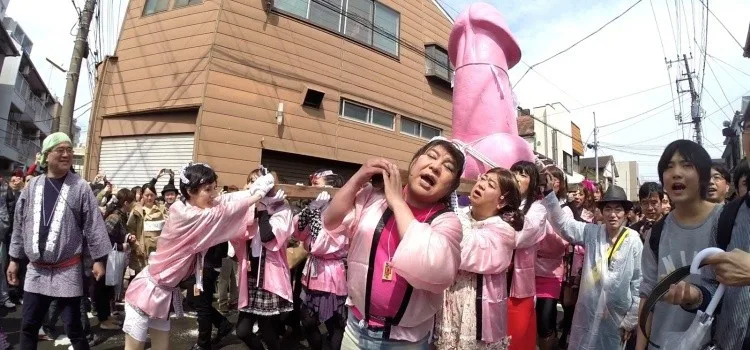
Another very popular event is the Kanamara Matsuri, a fertility festival where you can find giant penises, penis-shaped objects and even food in the shape of a penis. Despite this, Japanese children do not grow up to be perverted; many only discover an interest in sex in adulthood.
Many believe the stricter gender separation in Japanese baths was influenced by Western visitors who were shocked to see men and women bathing naked together with no sexual intent – an attitude that led the Japanese to separate the baths by gender.
Talking about sex is a taboo in Japan for some – partly out of shyness, partly because it is considered a very personal topic. It is culturally uncommon to use sexualized expressions as is common in Brazilian slang, for example.
The influence of sexual media
Sexual imagery is very present in the Japanese media. Many Japanese people do not mind buying or reading erotic material in public. That ties back to the fact that Japanese religions have no concept of sexual sin.
A highly controversial topic is the depiction of minors in anime-related media. Many believe this can encourage pedophilia, but thanks to existing laws the number of recorded abuse cases is low. Cultural norms tend to channel the most extreme behaviors into relatively harmless outlets, such as panty theft or the consumption of fringe products.

It is not only adult content aimed at children that is common – even anime for teenagers often includes sensual scenes. So-called lolita imagery appears in many series in suggestive poses, with bouncing breasts and visible panties – almost a tradition. In Japan, sensual imagery is often treated more as an art form; close to half of Japanese women consume this kind of media.
The Japanese government has repeatedly tried to regulate adult content involving minors in manga and anime, but faces a major loophole: artists can easily mark a character as an adult while still drawing them with a childlike appearance.
Defenders of the status quo argue that it is precisely the existence of such material that keeps actual abuse rates low in Japan. The general innocence and carefree attitude of many Japanese people means that themes considered highly controversial in the West are often treated as harmless locally.
Japanese pornographic media is quite different from Western media – including the famous mosaic censorship over the genitals. To wrap up, you will find some further reading below that can help you better understand sex in Japan.




Community
Comments
0 comments
There are no published comments in this language yet.
Send comment