

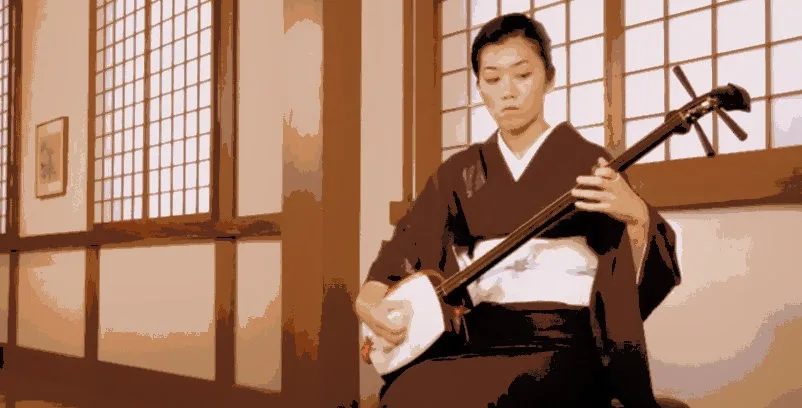
Japanese music often has a sound that feels smooth, balanced, and easy to recognize. The melody, rhythm, and phrasing usually work together in a way that makes many songs pleasant to hear from the very first notes.
For people outside music theory, it is not always obvious why Japanese songs and soundtracks have that distinct feeling. Musicians and students, however, have probably heard of the famous Japanese pentatonic scale at least once.
One of the best-known examples is the Hirajoshi scale, a structure that appears in traditional music, modern compositions, and even many anime soundtracks.
In this article, we will look at what the Japanese pentatonic scale is and why it sounds different from other musical structures.
Contents 4
What does "Hirajoshi" mean?
The term Hirajoshi, written in Japanese as 平調子 (ひらぢょうし, Hirajoushi), combines the kanji 平 (ひら, hira), which can suggest something calm, balanced, or harmonious, with 調子 (ちょうし, choushi), a word related to tone, condition, tuning, or melody. Put together, Hirajoshi carries the sense of a calm or harmonious melodic pattern.
In many styles of music, especially rock, pop, and jazz, Japanese musicians often work with this kind of pattern. Part of its appeal is the way the notes connect smoothly, helping the melody feel natural and pleasant to the listener.
Of course, this pattern does not appear in every Eastern song, but it is present in a large part of Japanese music.
Exotic scales in music theory
In music theory, a scale is a sequence of notes and intervals used as the basis for melody and harmony. There are several types of scales, including diatonic, chromatic, and what many musicians call exotic scales, such as the Chinese scale, the Hirajoshi scale, and Arabic or Oriental patterns.

In general, exotic scales use interval relationships that feel different from the more familiar Western structures. That difference in spacing between notes is one reason they can sound unusual, atmospheric, or instantly recognizable.
The Hirajoshi scale and pentatonic scales
In general, pentatonic scales are named that way because they are built with five notes. The two best-known forms are the major pentatonic scale and the minor pentatonic scale.
The pentatonic system probably originated in the East, more specifically in China, and became one of the most common foundations in Japanese music.
This article does not go deep into note formulas or technical subdivisions. The goal here is to explain the subject in a clear way for readers who want to understand why this sound is so associated with Japan.
Why Japanese music sounds different from Western music
As mentioned earlier, much of Eastern music places strong emphasis on the relationship between each tone. Because of that, the Hirajoshi scale and other pentatonic patterns often serve as a strong base during composition.
In a simplified comparison, Japanese music often relies on five-note structures, while much of Western music is based on the seven-note diatonic system. That is why Western theory often works with the classic sequence "C, D, E, F, G, A, B" and a different arrangement of whole steps and semitones.
Another point that helps explain the sound of Japanese songs is the language itself. The rhythm of hiragana and katakana can influence phrasing and lyrical flow, and some syllables may be adjusted in songs to avoid awkward or harsh sound combinations.

In the end, the best way to notice these differences is to keep listening to many kinds of songs. Once you start paying attention to the scale behind the melody, Japanese music becomes even more interesting to hear.
If a Japanese song or soundtrack ever gave you that unmistakable feeling, there is a good chance this kind of scale helped create it.





Community
Comments
0 comments
There are no published comments in this language yet.
Send comment