
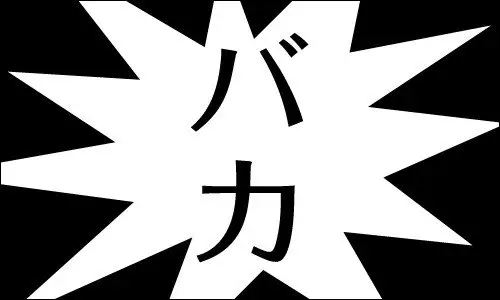
Japanese swear words do not line up neatly with English insults. A word such as baka (ばか / 馬鹿) can sound like a light “you dummy” between close friends, yet become hurtful when said with contempt. Kuso (くそ) can be an outburst of frustration, while a rough pronoun or command can turn an argument hostile very quickly.
If you are learning Japanese, the useful goal is not to collect insults for casual use. It is to recognize what you hear in anime, games, films and real conversations, then understand the tone well enough not to repeat something careless. The expressions below are best treated as comprehension vocabulary, not default conversation tools.
Contents 6
Why tone matters so much in Japanese
Rudeness in Japanese often comes from more than one word. Voice, relationship, age, setting and the level of directness all matter. A blunt second-person pronoun, an imperative ending or a familiar word said sharply can carry more force than a literal translation suggests.
This is why subtitles can be misleading. A line translated as “idiot,” “jerk” or “damn it” may be mild in one scene and much harsher in another. Anime also favors dramatic speech: phrases used by angry characters can sound unnatural or offensive in ordinary life.
The broad expression warui kotoba (悪い言葉) means “bad words.” It is useful as a general label, but it does not describe one fixed list. Some terms are insults, some are crude exclamations, and some are ordinary words that become rude only when aimed at a person.
Common Japanese insults and rough expressions
These are common terms a learner may encounter. The English gloss is only a starting point; context decides how close it is to a true insult.
| Japanese | Rōmaji | Usual sense | Practical caution |
|---|---|---|---|
| ばか / 馬鹿 | baka | fool, idiot, silly | Can be teasing among friends, but directed at someone in anger it is insulting. |
| アホ | aho | fool, idiot | Often associated with Kansai speech; its warmth or harshness changes by region and relationship. |
| くそ | kuso | damn, shit | Used as an angry exclamation or intensifier. Avoid it in polite settings. |
| うるさい | urusai | noisy, annoying | It may mean “you are noisy”; shouted at someone, it functions like “shut up.” |
| うざい | uzai | annoying, a pain | Casual slang; rude when it targets a person. |
| きもい | kimoi | gross, creepy | Short for kimochi warui. It is dismissive and easily hurts when used about someone. |
| ださい | dasai | lame, uncool, outdated | Usually comments on style, taste or behavior; saying it directly to someone is impolite. |
| お前 | omae | you | Can be familiar in some relationships, but it is not a safe default for learners. |
| てめえ | temee | you | A very rough form heard in confrontational fiction. Do not use it with people. |
Baka is the word most learners recognize first. It can describe a foolish action as well as a person, and it appears in hiragana, katakana and kanji. For a closer look at its range, see what baka means in Japanese. It is still safer to avoid calling someone baka until you understand the relationship and mood.
Aho overlaps with baka, but regional feeling matters. It is particularly familiar in Kansai speech, where it may be used in playful banter. That does not make it universally gentle: a learner cannot assume that an anime exchange will sound friendly outside its scene.
Kuso is closer to a crude exclamation than a direct name for another person. Someone may say kuso! after a mistake or add it before another word to make the complaint stronger. It is still coarse language, so leave it out of school, work and first conversations.
Expressions that cross a clearer line
Some phrases are built to confront someone rather than merely complain. They are worth recognizing, but they are poor choices for practice.
- ばかやろう (baka yarō) — a stronger “you idiot” or “you bastard,” depending on delivery.
- このやろう (kono yarō) — a hostile “you bastard” often heard before a fight in fiction.
- だまれ (damare) — “shut up,” an abrupt command from the verb damaru, “to be silent.”
- ふざけるな (fuzakeru na) — “don’t mess around” or “don’t mess with me,” said angrily.
- 死ね (shine) — “die.” This is an extremely aggressive command and should not be used.
Knowing these expressions helps with comprehension, especially in action stories and heated scenes. It does not mean that they are normal speech. If a subtitle makes a line sound casual, listen for the speaker’s age, status, facial expression and the reaction of everyone else before treating it as useful everyday language.
Not every negative Japanese word is a swear word
A few expressions are routinely translated too aggressively. Mendokusai (めんどくさい) means “what a hassle” or “troublesome.” It can express irritation, but it is not a direct swear word. Yabai (やばい) has many modern uses, from “this is bad” to “that is amazing,” so its meaning depends heavily on context.
Kimoi (きもい) is closer to “gross” or “creepy.” It is slang and can be cruel when directed at somebody. Urusai literally describes something noisy or annoying; in a sharp exchange it can imply “be quiet,” while in another situation it may simply describe a loud room.
The same caution applies to pronouns. Japanese often drops “you” altogether. Choosing omae, temee or another direct form when a name, title or no pronoun would do can make a sentence sound far rougher than a learner intended.
Safer ways to react when someone is rude
You do not need an insult to set a boundary. In many situations, a calm phrase is clearer and safer:
- やめてください (yamete kudasai) — “Please stop.”
- 失礼です (shitsurei desu) — “That is rude.”
- 聞こえませんでした (kikoemasen deshita) — “I did not catch that,” useful when you want to slow a tense exchange down.
- 大丈夫です (daijōbu desu) — “I am fine, thank you,” a polite way to decline without escalating.
These alternatives are especially valuable for visitors, students and workplace learners. They let you respond without guessing whether a dramatic phrase is playful, regional or genuinely aggressive.
Learning from anime without copying anime speech
Anime can teach you recognition, rhythm and emotion, but it often gives characters speech designed to signal personality. A villain, delinquent or hot-headed hero may use rough pronouns and commands precisely because they sound abrasive. Treat those lines as character language, then compare them with polite forms used by teachers, coworkers and strangers.
For more expressions you may hear in animated dialogue, read our guide to Japanese slang, insults and vulgarities in anime. The best habit is simple: understand the word, notice the context, and choose a calmer Japanese phrase when you speak.




Community
Comments
0 comments
There are no published comments in this language yet.
Send comment