
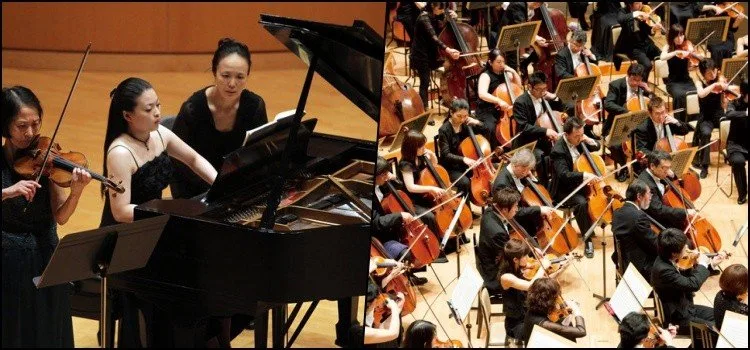
English is happy with one verb. You play the guitar, play the flute, play the drums. Japanese is not that generous: the verb follows the family of the instrument. Strings — and, surprisingly, the piano — take hiku [弾く]. Wind takes fuku [吹く]. Percussion takes tataku [叩く]. The first time you hear someone “pluck” a piano, that is the system talking, not a bad translation.
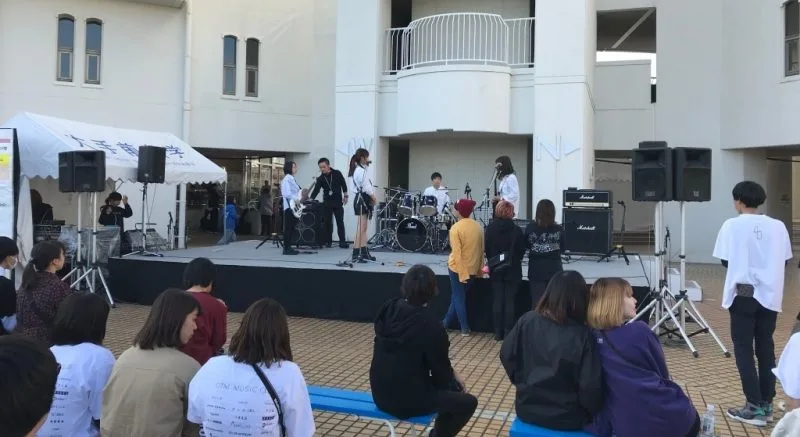
Once that split clicks, the rest of the language sits in place, including the older instruments that still turn up at a school bunkasai.
Contents 5
Playing an instrument in Japanese
The everyday English verb “play” does not map one-to-one. Use the verb that matches the instrument family:
- kanaderu [奏でる] — to play an instrument in general;
- hiku [弾く] — to play a string instrument, including piano and organ;
- fuku [吹く] — to play a flute or other wind instrument;
- tataku [叩く] — to play drums, percussion, xylophone, and similar instruments;
- souhou [奏法] — a way of playing an instrument.
So a pianist hiku the piano, a flutist fuku the flute, and a drummer tataku the drums. The general verb kanaderu works when you are not naming the family.
Musical terms in Japanese
These are the words that show up in a conversation, a rehearsal note, or a write-up about a piece.
- anpu [暗譜] — to memorize or reproduce a piece from memory
- au [合う] — to be in sync
- baiorin [ヴァイオリン] — violin
- bando [バンド] — band
- biburaato [ビブラート] — vibrato, for violin, singing, and similar [also ヴィブラート]
- chiisai [小さい] — soft, literally “small”
- chouchou [長調] — major key
- chouritsu [調律] — tuning that fixes the pitch of an instrument
- chouritsushi [調律師] — tuner, the person who tunes instruments
- choushi [調子] — tone, pitch, rhythm
- choushihazure [調子外れ] — playing or singing out of tune
- doramaa [ドラマー] — drummer
- doramu [ドラム] — drums
- doramusutikku [ドラムスティック] — drumstick
- ensou [演奏] — performance (also 演奏会, a concert)
- fue [笛] — flute or pipe
- furuuto [フルート] — flute
- gakki [楽器] — musical instrument
- gakkiten [楽器店] — musical instrument store
- gakufu [楽譜] — sheet music
- gen [弦] — string
- gitaa [ギター] — guitar
- gitarisuto [ギタリスト] — guitarist
- haamonika [ハーモニカ] — harmonica
- haapu [ハープ] — harp
- happyoukai [発表会] — recital
- henkyoku [編曲] — arrangement
- hibiku [響く] — to ring, to resonate
- ken [鍵] — key (on a keyboard)
- kenban [鍵盤] — keyboard (the set of keys)
- kyoku [曲] — a piece of music, often without lyrics
- neiro [音色] — tone color of an instrument
- ongaku [音楽] — music
- ongakuka [音楽家] — musician
- onkai [音階] — musical scale
- onpu [音符] — note
- ontei [音程] — interval
- ookesutora [オーケストラ] — orchestra
- ookii [大きい] — loud, literally “big”
- oto ga deru [音が出る] — a sound is produced
- oto / ne [音] — sound
- oto wo dasu [音を出す] — to produce a sound
- pianisuto [ピアニスト] — pianist
- piano [ピアノ] — piano
- picchi [ピッチ] — pitch / tuning
- renshuu [練習] — practice
- ressun [レッスン] — lesson
- rizumu [リズム] — rhythm
- sakkusu [サックス] — saxophone
- sakkyoku [作曲] — to compose
- shikisha [指揮者] — conductor
- shinbaru [シンバル] — cymbal
- sokkyou [即興] — to improvise or make music on the spot
- tanchou [短調] — minor key
- tenpo [テンポ] — tempo
- toraianguru [トライアングル] — triangle
- toranpetto [トランペット] — trumpet
- toronboon [トロンボーン] — trombone
- uta [歌] — a song, often with lyrics
- utau [歌う] — to sing
- zureru [ズレる] — to drift, to go off, to be out of time or out of tune
Two pairs are worth keeping straight. Kyoku [曲] is the piece; uta [歌] is the song with words. Chouchou [長調] is a major key; tanchou [短調] is a minor key. Mix those and a rehearsal note starts lying.
Rhythms and types of music in Japanese
Most contemporary genre names arrive as katakana. One trap is worth flagging: dabu [ダブ] is dub, the reggae-born studio style. Dubstep is a different word, dabusuteppu [ダブステップ].
- orutanativu [オルタナティヴ] — alternative
- gareeji rokku [ガレージ・ロック] — garage rock
- guramu rokku [グラム・ロック] — glam rock
- guranji [グランジ] — grunge
- panku rokku [パンク・ロック] — punk rock
- saikederikku [サイケデリック] — psychedelic
- desu metaru [デス・メタル] — death metal
- nyuu weehu [ニューウェーブ] — new wave
- haado rokku [ハード・ロック] — hard rock
- buritisshu rokku [ブリティッシュ・ロック] — British rock
- puroguresshivu rokku [プログレッシヴ・ロック] — progressive rock
- hevii metaru [ヘヴィ・メタル] — heavy metal
- rokkun rooru [ロックン・ロール] — rock ’n’ roll
- hausu [ハウス] — house
- doramun beesu [ドラムン・ベース] — drum ’n’ bass
- hippuhoppu [ヒップホップ] — hip-hop
- fanku [ファンク] — funk
- dabu [ダブ] — dub
- dabusuteppu [ダブステップ] — dubstep
- tekuno [テクノ] — techno
- buritto poppu [ブリット・ポップ] — Britpop
- poppu [ポップ] — pop
- rappu [ラップ] — rap
- regee [レゲエ] — reggae
- aaru ando bii [アール・アンド・ビー] — R&B
- kantorii [カントリー] — country
- buruusu [ブルース] — blues
- fooku rokku [フォーク・ロック] — folk rock
- kurashikku [クラシック] — classical
- jazu [ジャズ] — jazz
- suka [スカ] — ska
- souru [ソウル] — soul
Musical instruments in Japanese
Western instruments usually keep their international names in katakana. Traditional ones keep the kanji. For the Japanese families themselves — koto, shamisen, shakuhachi, taiko — there is a separate guide to musical instruments from Japan.
- gakki [楽器] — musical instrument
- gitaa [ギター] — guitar
- gen [弦] — strings
- beesu [ベース] — bass guitar
- doramu [ドラム] — drums
- piano [ピアノ] — piano
- kiiboodo [キーボード] — keyboard
- maiku [マイク] — microphone
- baiorin [バイオリン] — violin
- chero [チェロ] — cello
- ooboe [オーボエ] — oboe
- toranpetto [トランペット] — trumpet
- sakkusu [サックス] — saxophone
- haapu [ハープ] — harp
- haamonika [ハーモニカ] — harmonica
- tanburin [タンバリン] — tambourine
Traditional Japanese instruments
- biwa [琵琶] — biwa, a short-necked lute
- shamisen [三味線] — shamisen, a three-string instrument
- koto [琴] — koto, a long zither
- taiko [太鼓] — taiko, a Japanese drum
- shakuhachi [尺八] — shakuhachi, a vertical bamboo flute
- sanshin [三線] — sanshin, the Okinawan three-string instrument
In Japanese you will also hear hougaku [邦楽] for traditional Japanese music and yougaku [洋楽] for Western music. The same person can study both; the verbs still follow the instrument, not the repertoire.





Community
Comments
0 comments
There are no published comments in this language yet.
Send comment