
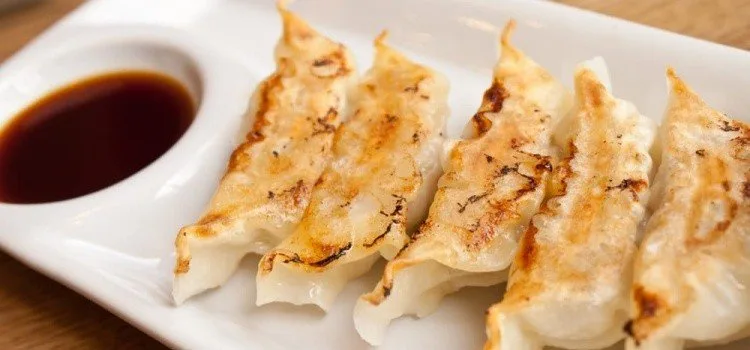
Gyoza (餃子) is one of those dishes that shows up almost everywhere in Japan: in ramen shops, in izakayas, in specialty gyoza restaurants, at street stalls, and in the freezer aisle of any konbini. The small parcels are thin-skinned, crispy on the bottom, juicy in the middle, and usually eaten with a soy-and-vinegar dipping sauce.
In China the same dish is called Jiaozi (饺子) and has been made for centuries. The Japanese version we know today shares that tradition but has its own story and has adapted to Japanese tastes, becoming a casual everyday food rather than a festival staple.
Contents 8
Origin and history
The first gyoza reached Japan during the Edo period. The story usually told is that the Chinese scholar Zhu Shunshui (朱舜水) visited Japan and prepared gyoza for the daimyō Tokugawa Mitsukuni. Those early parcels had a thicker wrapper and were simply boiled, closer to the Chinese jiaozi of the time.
The thin-skinned, pan-fried gyoza most people picture only appeared after the Second World War. Japanese who had lived in Manchuria came back to Japan and started selling a leaner version of the dumpling, shaped by the food shortages of the post-war years: less meat, more vegetables, a thinner wrapper, and the pan-fry-then-steam method that defines the dish today.
From Tokyo and Yokohama the dish spread quickly across the country, and each region developed its own preferences for size, filling, and how to serve the gyoza on the plate.
Types and regional variations
Most gyoza you meet in Japan fall into one of three styles:
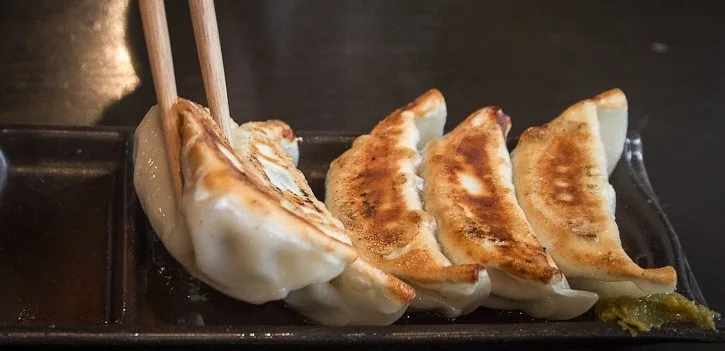
- Yaki-Gyoza (焼き餃子): pan-fried first, then finished with a splash of water and a lid so the top steams while the bottom crisps up. This is the default in most ramen shops and izakayas.
- Sui-Gyoza (水餃子): boiled and served in a light broth, closer to the original Chinese jiaozi.
- Age-Gyoza (揚げ餃子): deep-fried until the wrapper turns crackling and golden all over.
Beyond the cooking method, a few cities have made gyoza their signature dish. Utsunomiya (宇都宮) in Tochigi Prefecture is famous for a garlicky, vegetable-heavy filling and a row of dedicated gyoza shops around the station. Hamamatsu in Shizuoka is the other classic gyoza town, known for parcels laid out on the plate in a fan shape with cabbage underneath. In Kyushu, Hakata (博多) gyoza tends to be smaller, with a thinner wrapper and a crispier bite, usually served with mustard on the side. There is even an annual Hakata Gyoza Festival in Fukuoka, where visitors can compare styles from different stalls in a single afternoon.
You will find gyoza in dedicated restaurants, in street-food stalls, inside many ramen shops, in Chinese restaurants, and as a standard izakaya starter. A plate of six usually runs between 300 and 600 yen, depending on the filling and the neighborhood.
The classic dipping sauce is a mix of soy sauce and vinegar, often with a small splash of rāyu (ラー油) chili oil. Some places lean sweet with mirin, others go heavy on the vinegar, and a few add grated garlic or ginger. A simple version at home works well as a starting point: 100 ml soy sauce, 100 ml vinegar, a little grated ginger, a clove of crushed garlic, and a few drops of sesame oil.
Filling and wrapper
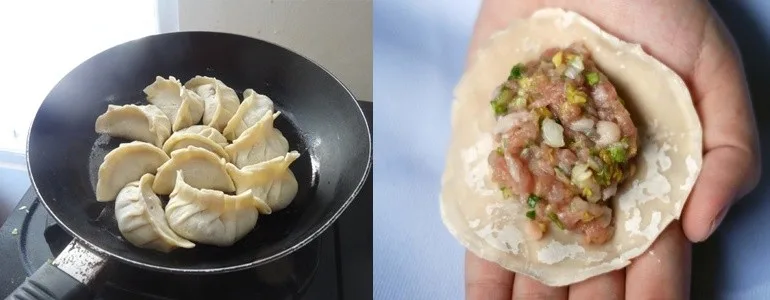
The most common Japanese filling is a mix of ground pork, finely chopped cabbage, nira (garlic chives), ginger, and sesame oil, seasoned with soy sauce, salt, a touch of rice wine, and white pepper. Some cooks add a little grated onion or a splash of water to keep the filling juicy while it cooks. Modern shops also play with the format: shrimp, cheese, garlic-heavy versions, or even kimchi-inspired fillings have become common, especially around Utsunomiya and Hamamatsu.
For the wrapper, the everyday Japanese gyoza uses a thin, round, ready-made sheet, similar to a small won ton wrapper but rolled a little thicker. You can buy it in any supermarket, or make a quick dough at home from flour, water, and a pinch of salt.
A simple gyoza recipe at home
This is a basic home version. Quantities are enough for roughly 30 to 35 gyoza, which serves about four people as a starter or two as a main.
Wrapper dough
- 1/4 teaspoon of salt
- 1 and 1/4 cups of warm water
- 3 cups of plain wheat flour, or 2 cups of wheat flour plus 1 cup of rice or tapioca flour for a slightly chewier wrapper
Mix the flour and salt in a bowl, add the warm water gradually, and knead until the dough is smooth and no longer sticks to your hands. Place it in a plastic bag, seal it, and let it rest for 1 to 2 hours. After resting, roll the dough into a thin sheet and cut small rounds with a glass or a cookie cutter. If you prefer, skip this step and use store-bought gyoza wrappers, which work very well.
Filling
- 500 g ground pork (or a 50/50 mix of pork and chicken)
- 1 tablespoon soy sauce
- 1 teaspoon salt
- 1 tablespoon rice wine (or sake)
- A pinch of ground white pepper
- 3 tablespoons sesame oil
- 1 stalk of finely chopped green onion
- A handful of finely chopped cabbage
- A small piece of fresh ginger, finely grated
- 1 crushed garlic clove (optional)
- A pinch of MSG or a small spoon of dashi powder (optional)
Mix everything in a bowl until the meat just holds together. Do not overwork the mixture, or the filling turns tough.
Folding and pan-frying
- Place a small spoonful of filling in the center of each wrapper.
- Wet the edge with a little water, fold the wrapper in half, and pinch pleats along the seam so the gyoza looks like a small half-moon. Watch the technique once before trying: the pleats are decorative but they also help the parcel seal.
- Heat a tablespoon of sesame oil in a non-stick skillet over medium-high heat. Place the gyoza flat-side down in a single layer, leaving a little space between them.
- Fry for about 2 minutes until the bottoms turn golden and crisp.
- Pour about 100 ml of hot water into the pan, cover with a lid, and let the gyoza steam for 4 to 5 minutes, until the wrappers turn translucent and the filling cooks through.
- Remove the lid and let any remaining water evaporate so the bottom crisps up again. Serve hot, with the soy-and-vinegar dipping sauce on the side.
For a step-by-step visual, the video below by Allrecipes Brasil walks through the folding and pan-frying with a simple store-bought wrapper. It is in Portuguese, but the technique is easy to follow in any language.
Tips and where to try gyoza in Japan
A few small habits make a real difference at the pan:
- Keep the filling cold until you fold. Cold filling is easier to seal and stays juicier once cooked.
- Do not overcrowd the skillet. Gyoza need contact with the pan to crisp up, and steam needs room to escape.
- Use sesame oil for frying, not neutral oil. The flavor carries the dish.
- Rest the dough. A short rest relaxes the gluten and makes rolling easier.
- Balance the dip. Soy sauce brings salt, vinegar brings brightness, and rāyu brings heat. Most Japanese tables adjust the mix to taste.
If you are traveling and want to compare regional styles without planning a whole trip around dumplings, start in three places: a ramen shop in Tokyo for the everyday version, Utsunomiya for a garlicky take in a city that calls itself the gyoza capital, and Hamamatsu for the cabbage-on-the-plate presentation. Each gives a different angle on the same small parcel.
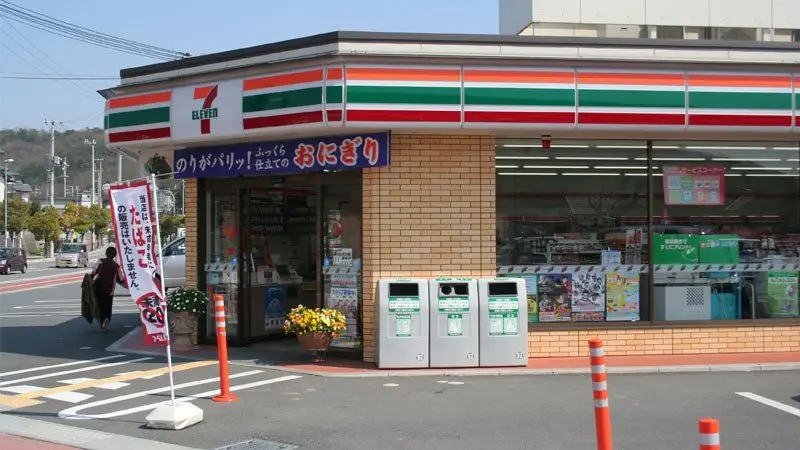
For more on the everyday food culture around these parcels, take a look at our guide to Japanese ramen, our notes on onigiri and how it fits into casual Japanese meals, and our broader look at traditional Japanese food.



Community
Comments
0 comments
There are no published comments in this language yet.
Send comment