
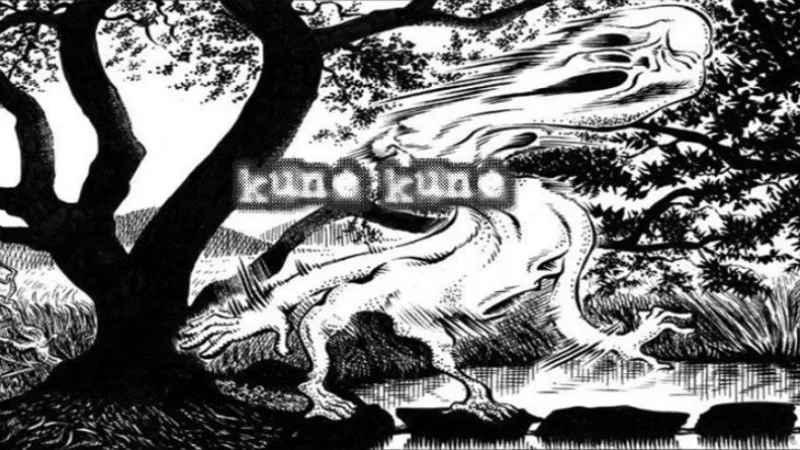
Kunekune (くねくね) is a figure from a Japanese urban legend that spread through the internet. It is described as a pale, human-like shape far out in a rice field or by the sea, bending and twisting in angles a body cannot make. Staring at it too long, the story goes, drives people mad.
Contents 8
How the figure is described
From a distance it looks like a person in pale clothing. Eyes and mouth are not visible, and age or gender cannot be read. What witnesses mention is only a tall, thin two-legged shape, closer to a doll than to a human.

When and where it appears
Accounts name midday or the hour before sunset. The places are green rice fields and farm land, sometimes a coast where the wind feels different. After a sighting, a thick white fog often sits over the field and slowly disappears.
Every retelling keeps one structure: someone sees something in the distance, the movement looks wrong, the companion warns, and only one of the two goes home. The details shift with region and year.
The movement
The core of the story is the movement. The figure bends at the waist and arms from right to left and back again. The angles are impossible for human joints, and that detail is what people remember. Reports repeat the same conditions: seen from far away, briefly, and clearly by only one person.
What happens after a sighting
Watching for too long or walking closer, the stories say, brings madness or death. The witness warns the companion: “Don’t look, run for your life.” Whoever follows the warning and does not look escapes, and back home explains that the figure was a Kunekune.
Online versions differ sentence by sentence. Nobody knows who wrote the first one, and even the supposed original exists in several versions.
Where the story comes from
It does not appear in old yokai collections. It became known in the early 2000s through Japanese internet forums, which makes it an urban legend rather than a classical tale. Several narrations of this shape circulated there at the same time.
Plain explanations
A scarecrow or a person far away can sit behind the figure. Heat, dehydration and sunstroke change perception, and fog over the field blurs the outline. The rippling motion can be explained by distance and by the way the eye strains in summer light.
The pig with the same name
Kunekune is also a small pig breed from New Zealand. The animals are hairy, round and often bearded. They have nothing to do with the legend, and only the name is shared.
People who hear the story rarely go out to check for themselves. That is exactly what keeps it alive: there is no way to disprove it.
The fog belongs to it as well. The line about the air feeling different after the sighting is a familiar device in this kind of tale.
Why it survives
The story is short, the image is easy to draw, and no explanation has settled it. Comics, games and short videos borrow the name, mostly for atmosphere. Anyone presenting Kunekune as an ancient yokai is getting it wrong.
For more on the Japanese ghost world, see the pieces on the list of ghosts and yokai, on five strange urban legends and on the kappa.



Community
Comments
0 comments
There are no published comments in this language yet.
Send comment