
The first Vocaloid singers were not turquoise-haired idols from a near-future Japan. In 2004 they were Leon and Lola, a pair of English soul voices sold as software, with almost no mascot to hang a fandom on.
Then Crypton Future Media put an illustration on the box. Homemade videos piled up on Nico Nico Douga, and a singing synthesizer turned into a music scene. That is why people still type “what is Vocaloid” and immediately want a list of characters: the software and the faces got glued together in public memory.
Contents 6
What is Vocaloid?
Vocaloid, written in Japanese as ボーカロイド (bōkaroido), is a computer program released in 2004. You write the lyrics, choose the pitch of the voice, and the engine sings. It was meant to be a studio tool. Marketing, box art, and a wave of fan videos turned it into something much louder: a phenomenon that spread among teenagers and adults far outside Japan’s DTM scene.
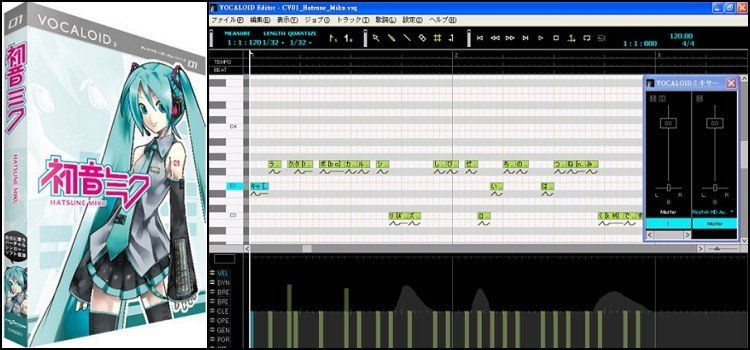
Yamaha started development in March 2000 and announced the technology in 2003. The first Vocaloids, Leon and Lola, were released by the British studio Zero-G on March 3, 2004. MEIKO followed as the first Japanese female voicebank, then KAITO as the first Japanese male. The engine is Yamaha’s; many of the famous faces belong to other companies that license it.
The line did not stop at version five. VOCALOID6 arrived on October 13, 2022 with Yamaha’s VOCALOID:AI singing engine, and the official anniversary catalog now lists more than 200 voicebanks across twenty years. New libraries still appear, so any page that pretends to own every name is already out of date.
With the editor you can also import MIDI files that lay down the rhythm as if you were sitting at a piano. From there you add lyrics and turn a known song into a version sung by a Vocaloid. That shortcut is how a lot of early covers happened: the melody was already written; the synthetic singer did the rest.
Voicebanks keep coming out, and songs follow them. Like so much else in Japan, producers pair those voices with illustrated characters. The most famous of those packs is still Hatsune Miku (初音ミク), the Crypton Future Media library released on August 31, 2007, with a 16-year-old mascot, turquoise twintails, and a voice sampled from Saki Fujita.
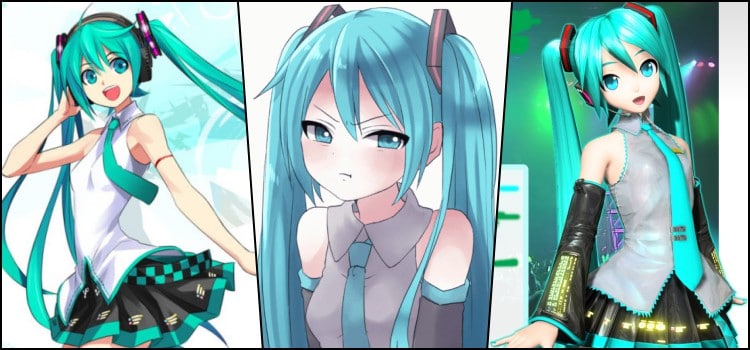
Miku plus Nico Nico is the usual origin story, and it is not hype for its own sake. Fan-made animations and synthesized tracks on that Japanese video site popularized the idea that each voicebank had a “cover” — a character you could draw, animate, and send on stage. Tracks such as World is Mine then traveled the rest of the internet as if a software product were a pop star.
Official Vocaloid characters
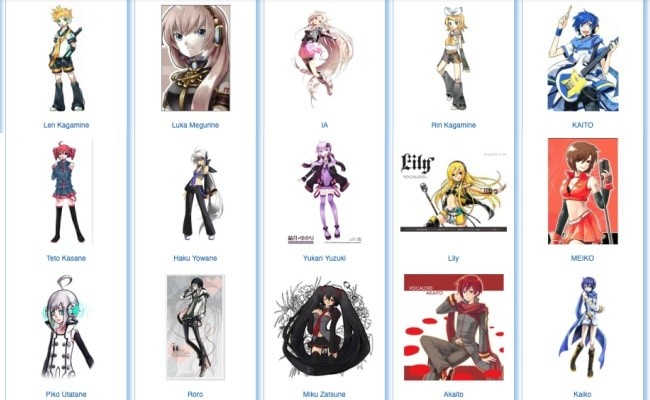
This is not a warehouse of every library Yamaha has ever licensed. It is a working map of official Vocaloid characters: products with a Yamaha-licensed voicebank, often an illustration on the box, and a name people actually search. Japanese names sit in brackets. Surname-first order shows up a lot, so if Ctrl+F fails on “Rin Kagamine,” try 鏡音リン.
Crypton Future Media — Piapro Characters
- MEIKO - [メイコ]
- KAITO - [カイト]
- Hatsune Miku - [初音ミク]
- Kagamine Rin - [鏡音リン]
- Kagamine Len - [鏡音レン]
- Megurine Luka - [巡音ルカ]
MEIKO (November 5, 2004) and KAITO (February 17, 2006) were already on the market before Miku. Crypton later grouped the six as Piapro Characters. Luka arrived on January 30, 2009 as a bilingual Japanese/English library; Rin and Len shipped together on December 27, 2007.
Other well-known official voicebanks
- GUMI / Megpoid - [グミ]
- Kamui Gakupo / Gackpoid - [神威がくぽ]
- Lily - [リリィ]
- IA - [イア]
- Yuzuki Yukari - [結月ゆかり]
- Nekomura Iroha - [猫村いろは]
- Kaai Yuki - [歌愛ユキ]
- Hiyama Kiyoteru - [氷山キヨテル]
- SF-A2 miki - [SF-A2 開発コード miki]
- Otomachi Una - [音街ウナ]
- Tohoku Zunko - [東北ずん子]
- v flower - [v flower]
- Fukase
- CUL - [カル]
- Aoki Lapis - [蒼姫ラピス]
- MAYU - [まゆ]
- galaco - [ギャラ子]
- MAIKA
- Merli - [メルリ]
- Mew
- kokone - [心響]
- Tone Rion - [兎眠りおん]
- Utatane Piko - [歌手音ピコ]
- Ryuto / Gachapoid - [リュウト]
- Chika
- Rana - [ラナ]
- ARSLOID - [神生アキラ]
- LUMi - [ルミ]
- anon - [杏音] / kanon - [鳥音]
- Macne Nana
English, Chinese, Korean, and the first Zero-G voices
- Leon and Lola
- MIRIAM
- Sweet Ann
- Prima - [プリマ]
- Tonio - [トニオ]
- Avanna
- Oliver
- SONiKA
- BIG AL
- DEX and DAINA
- CYBER DIVA
- SeeU - [시유]
- UNI - [유니]
- Luo Tianyi - [洛天依]
- YANHE - [言和]
- Yuezheng Ling - [乐正绫]
- Yuezheng Longya - [樂正龍牙]
- Xin Hua - [シンファ]
- Xingchen / Stardust - [星尘]
Yamaha’s own VOCALOID6 bundle added voices such as HARUKA, AKITO, SARAH, and ALLEN. They are official libraries. They do not have Miku-scale mascots, and treating every bundled name as a virtual idol is how these lists get noisy.
Fan characters, UTAU, and names that sneak onto every list
The old “complete” roll call mixed licensed Vocaloids with fan designs and other synthesizers. That mix is the real trap, not a missing name or two.
Kasane Teto (重音テト) is the usual example: she looks like she belongs next to Miku, and she shows up in the same illustration grids, but the original Teto voice was built for UTAU, a different singing tool. Yowane Haku (弱音ハク) and Akita Neru (亞北ネル) started as fan jokes about “weak” and “salty” takes on Miku. Akaito is a fan recolor of KAITO. Hachune Miku (はちゅねミク) is a deformed derivative that rode the leek-swinging Ievan Polkka video, not a separate Yamaha product.
Gender-swaps and extras in the same family — Mikuo, Kaiko, Gakuko, Luki, Lenka — are fan designs unless a company later ships an actual voicebank under that name. Defoko / Utane Uta comes from UTAU’s default singer, not from Vocaloid. If a list prints “UNSORTED” as if it were a character, close the tab.
So the useful test is simple. Official Vocaloid: Yamaha-licensed engine plus a released library, often with a box illustration. Fanloid: a character people drew around an existing voice. UTAU or another synth: a different program that borrowed the same internet stage. Search the Japanese name if the English spelling keeps drifting.
If you only follow one thread from here, follow Miku: she is the reason a 2004 studio utility still has a character list attached to it. The rest of the names make more sense once that split is clear.



Community
Comments
0 comments
There are no published comments in this language yet.
Send comment