
Japanese can feel unfamiliar at first because several systems work together: the writing changes within a single sentence, small marks can alter a sound, and context often carries information that English states directly. These are not random obstacles. Once you know what to notice, Japanese starts to look like a set of patterns rather than a wall of symbols.
This guide gathers 30 features that matter most to beginners. It is not a list of rules to memorize in one sitting; use it as a map for understanding what you see and hear while studying.
Contents 5
Sound and rhythm
- Japanese has five core vowel sounds. The vowels a, i, u, e, o are a useful starting point, but romaji is only a guide. Train your ear with Japanese audio instead of forcing English vowel habits onto each word.
- Rhythm is built around morae. A mora is a timing unit. A small っ, a long vowel, and ん each take time, so they can change how a word is heard.
- Long vowels matter. In words such as おばさん (obasan, aunt) and おばあさん (obāsan, grandmother), the extra vowel length is meaningful. The long-vowel mark ー is especially common in katakana.
- The small っ creates a pause before a consonant. In きって (kitte, stamp), it signals a brief closure before the next t. It is not pronounced as a separate “tsu.”
- Japanese r is its own sound. It does not match an English r or l exactly. Listening and imitation work better than searching for a perfect substitute in another language.
- Pitch can help distinguish words. Japanese pitch patterns vary by word and region. Beginners do not need to master every pattern immediately, but paying attention to native audio prevents habits from becoming fixed.
Writing: more than one script on one page
- Hiragana, katakana and kanji appear together. Everyday writing commonly mixes these scripts, sometimes with Latin letters and numerals. Learning to recognize their jobs is more useful than treating them as separate alphabets.
- Hiragana carries much of the grammar. It is used for particles, verb endings and many native words. A beginner who can read hiragana gains access to basic sentences quickly.
- Katakana often marks borrowed vocabulary. コーヒー (kōhī, coffee) and テレビ (terebi, television) are familiar examples. Katakana also appears in names, sound effects and emphasis, so it is not limited to loanwords.
- Kanji adds meaning to the page. A kanji can appear in many words and may have more than one reading. Learn readings through vocabulary, not as isolated character lists.
- Furigana gives a reading for kanji. Small hiragana placed beside or above kanji can show pronunciation. It is common in learner material, children’s books and texts where a reading may be uncertain.
- Japanese normally does not separate every word with spaces. Script changes, particles and grammar endings help readers see where one unit ends and another begins.
- Small や, ゆ and よ combine with the sound before them. They create sounds such as きゃ (kya) and しゅ (shu). Their smaller size is a real spelling distinction.
- Romaji is a bridge, not a destination. It can help at the very beginning, but it hides spelling, rhythm and script choices. Move toward kana as soon as you can.
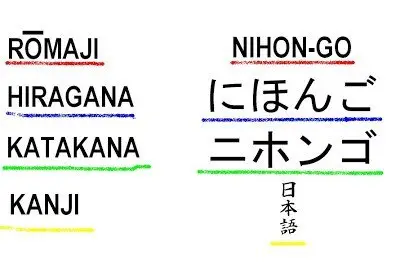
If you are still getting used to the scripts, see when hiragana and katakana can appear in the same word. The choice often tells the reader something about the word’s origin or role.
Grammar patterns that change how you read a sentence
- The verb often comes late. A common pattern places the topic first and the verb near the end: 私は本を読みます (Watashi wa hon o yomimasu) means “I read a book.”
- Particles show relationships. Short markers such as は, が, を, に and で indicate roles that English often shows through word order or prepositions. They deserve steady practice.
- Topic and subject are not always the same thing. は introduces the topic of discussion, while が can identify or emphasize a subject. Their difference becomes clearer through complete examples than through a single translation.
- Subjects are often omitted. When the speaker and situation make the subject obvious, Japanese can leave it unsaid. That is why a sentence may look incomplete in a word-for-word translation while sounding natural in conversation.
- Modifiers come before what they modify. This applies to adjectives and longer descriptive clauses. Read backward from the noun when a phrase seems dense.
- Verbs do not change for person or number. The verb form does not switch just because the subject is “I,” “she” or “they.” Context and other words identify the subject.
- The non-past form covers present and future meaning. Time words and context tell you whether 食べます (tabemasu) means “eat,” “will eat,” or describes a habit.
- Japanese has no grammatical gender for nouns. Nouns do not divide into masculine and feminine classes as they do in many European languages.
- Plural meaning is often left to context. Japanese has ways to express a group, but a noun does not need a plural ending every time English would use one.
- Counters are part of counting. Numbers change shape depending on what is counted: people, flat objects, books, animals and many other categories have their own counters.
Context and politeness are part of the message
- Plain and polite styles serve different situations. The same idea can end in a plain form or in です/ます style. Choosing between them depends on relationship and setting.
- Honorific language has more than one direction. Keigo includes forms that raise another person and forms that humble the speaker or their in-group. It is a system of social distance, not a collection of fancy words.
- Names commonly take suffixes. Endings such as さん, ちゃん, くん and さま carry tone and relationship. They are not interchangeable translations of “Mr.” or “Ms.”
- Set phrases do real social work. Expressions such as すみません, おつかれさまです and よろしくお願いします change meaning with the situation. Learn the scene along with the dictionary gloss.
- Onomatopoeia is unusually productive. Words like どきどき for a pounding heart or しとしと for a gentle rain can describe sounds, movement and feelings with precision.
- Loanwords change as they enter Japanese. A borrowed word follows Japanese sound patterns and may develop a narrower meaning. Do not assume that a katakana word means exactly what its English-looking form suggests.
How to study these features without getting lost
Start with hiragana, basic pronunciation and short sentences. Add katakana soon after, then meet kanji through the words you already want to read. When grammar feels confusing, do not translate every word in isolation: find the verb, identify the particles, then ask what the speaker is leaving to context.
For pronunciation practice, compare your reading with recorded Japanese rather than relying only on romanized spelling. Our guide to Japanese pronunciation and sound changes is a useful next step once the basic kana are familiar.
The biggest shift is to see Japanese as connected systems. Script helps you read, particles organize the sentence, verb endings set the tone, and context completes what is not spoken. Study a little of each system often, and real examples will make the patterns stick.





Community
Comments
0 comments
There are no published comments in this language yet.
Send comment