
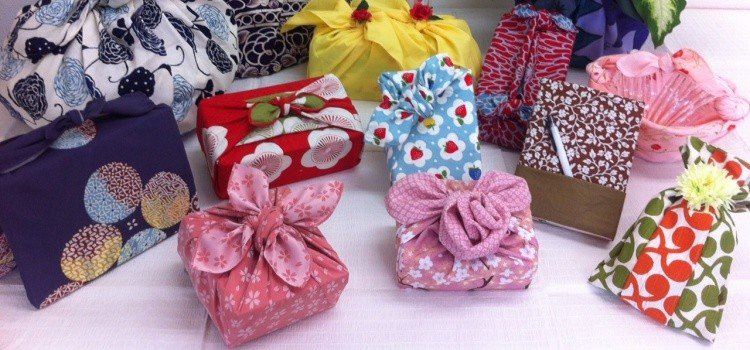
Do you know the Japanese wrapping called furoshiki? The word names both the technique and the square of cloth used to pack clothes, gifts, bottles, books, and the day's lunch.
Written Furoshiki [風呂敷], it splits into furo (bath) and shiki (to spread or lay out). The steam of the bathhouse is still in the name, even when the same square is tying a present or riding along as a bag.
There is no single official size. A furoshiki can be as small as a hand or larger than a bedsheet. The big ones reach about two meters; a traditional small cloth often sits around 36 centimeters. The same knots also work with a napkin or a spare scarf, as long as the fabric can take a tie.
Contents 8
Picnic among the flowers
Following the cherry blossom trail, in April, in a village called Shirakawago, I encountered the charming furoshiki for the first time. It is a square of cloth in which people wrap everything: gifts, boxes, bottles, books, obento lunch boxes, and more.
Besides the care that goes into the wrapping, the same cloth can become a canteen sling, a handbag, or a shoulder bag. A small, neatly rolled furoshiki can even imitate a flower on a modest gift.
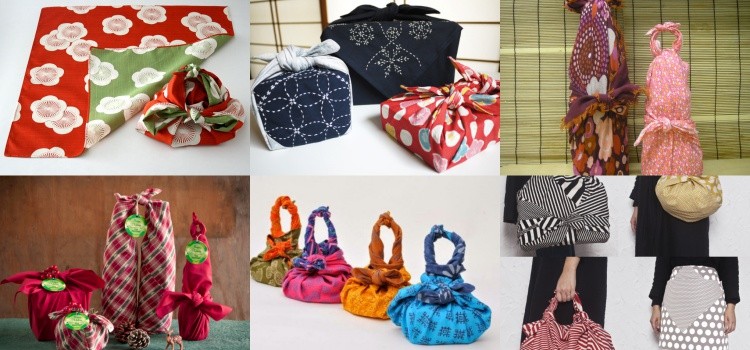
Gifts are wrapped in floral fabrics, preferably in silk. For family use, a simpler cloth will do. When you wrap a present with furoshiki, you are giving two gifts at the same time.
Japanese households still match the print to the season. In spring, flowers and young animals turn up first. Colors follow the holiday or the event on the calendar.
What size furoshiki do you need?
A practical rule: the object should occupy about one third of the cloth, and the diagonal of the square should be roughly three times the longest side of what you wrap. Too small and the knot fights you; too large and the extra fabric swallows the shape.
| Cloth size | What it usually wraps |
|---|---|
| About 36–50 cm | Small box, compact bento, handkerchief-style wrap |
| About 68–70 cm | Books, a wine bottle, picnic lunch |
| About 90–100 cm | Two bottles, a shopping bundle, a cushion |
| Larger, up to about 2 m | Bulky loads, a wall hanging, a makeshift bag |
Traditional shop names still speak of hitohaba (one width, around 36–38 cm) and doubles of that. Modern makers more often sell the 45–50, 70, and 90 cm squares. Cotton is the everyday workhorse; silk is the gift; polyester and rayon show up when you want a print that dries fast.
Things to do with a furoshiki
The wrapping culture in Japan is less a single trick than a family of knots. Cloths are often printed with traditional motifs, or patterned by shibori, the resist-dyeing that leaves rings and ripples in the fabric.
With one square you can wrap a gift, carry a lunch, make a bottle bag, gather fruit, hold a stack of books, or throw a summer tote over your shoulder. A small roll can finish a present like a flower. A large one can cover a table or hang on a wall.
A close cousin is the tenugui, a thin cotton towel rather than a wrapping square. Both live in daily Japanese cloth culture, but they are not the same tool.
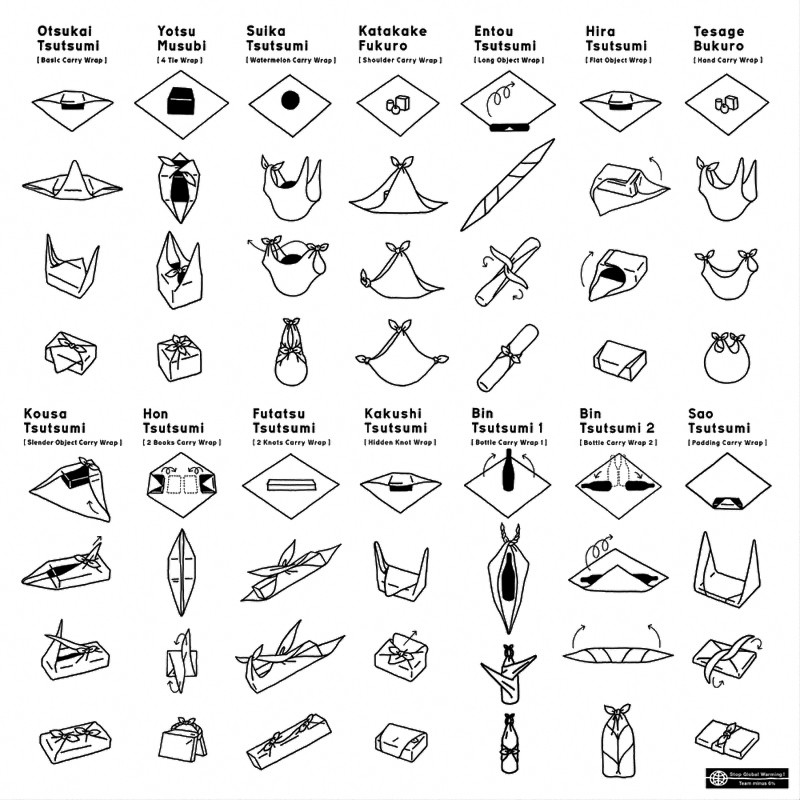
A few wraps worth learning first
You do not need fourteen techniques to start. Three already cover most errands. The basic knot under many of them is the ma-musubi, a square knot that lies flat and holds.
Otsukai tsutsumi — the errand wrap
Lay the cloth like a diamond, pattern down. Set a box or bento in the center. Fold one corner over, then the opposite corner. Tie the remaining two corners on top. This is the everyday carry for a lunch or a small gift.
Bin tsutsumi — the bottle wrap
Bin means bottle. Place the bottle on the cloth, knot the two corners that run along its length, then bring the side corners around and tie a handle or a bow at the neck. There is a two-bottle version of the same idea.
Tesage bukuro — a bag in a minute
Place the load in the center, knot two adjacent corners on each side, and you have handles. It is the fastest way to turn leftover fabric into a shopping bag.
Japan's Ministry of the Environment still publishes a leaflet with fourteen folding patterns from the 2006 campaign. The chart above maps several of the same families: yotsu musubi for a box, hon tsutsumi for books, katakake fukuro for a shoulder carry.
History and origin of furoshiki
Wrapping in cloth is older than the word. In the Nara period (710–794), squares called tsutsumi protected valuables — temple objects and goods worth carrying with ceremony. In the Heian period (794–1185), the nobility used cloth wraps to store clothing. In bathhouses and onsen, a marked cloth kept one person's garments from mixing with everyone else's.
The name furoshiki itself — “bath spread” — settled in the Muromachi period, when visitors laid the cloth down to dress after the steam. By the Edo period the same square was as much a market bag as a bath mat. Merchants printed family crests so a bundle could be claimed at a glance.
In the twentieth century, cheap paper and plastic bags pushed furoshiki out of daily shopping. In 2006, Japan's Minister of the Environment, Yuriko Koike, presented a specially designed Mottainai Furoshiki to argue that a reusable cloth was still an answer to wasted bags. Mottainai is the old reluctance to throw away something that still has use.
Any decent square — a tablecloth, a scarf, a beach sarong — can do the same work if it is strong enough to knot. The invitation is the same as it was in Shirakawa-go: wrap with care, carry without waste, and let the cloth come home to be used again.


Community
Comments
0 comments
There are no published comments in this language yet.
Send comment