
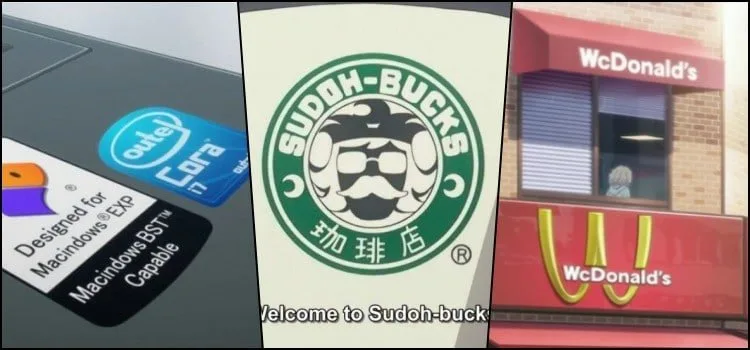
Fake brands are one of anime's most familiar background jokes. A burger chain gains a new letter, a search engine gets a crooked spelling, or a convenience store swaps its numbers around. The reference stays readable, but the fictional world keeps its own name.
These altered names are often called product displacement: a real-world reference is replaced by a look-alike inside the story. They are different from official product placement, where a real company and its branding appear openly. Both can make a setting feel recognizably modern; the difference is whether the brand is being shown as itself.
Contents 10
Why anime uses altered brand names
A familiar logo tells the viewer a lot in a second: this is a convenience store, a fast-food counter, a laptop, a soft drink or a video site. An invented name can keep that visual shorthand while giving the artists room to change the sign, package or joke to fit the scene.
The reason is not always the same. Sometimes the altered name is part of a gag; sometimes it helps a fictional city feel close to everyday Japan; sometimes a production chooses a made-up label rather than using a real logo. A changed name alone does not reveal the business arrangement behind a scene, so it is safer to read it as a storytelling choice rather than proof of a specific deal.
The reverse also happens. Code Geass is remembered for visible Pizza Hut branding, while other series use fictional versions of familiar restaurants and products. That contrast is useful: anime does not avoid real brands in every case, and a parody is not the only way a brand enters a show.
Notable fake brands in anime
The best examples are easy to recognize without turning the reference into the whole joke. Spellings vary by translation and by the exact scene, so treat this as a selection of well-known cases rather than a complete catalogue.
| Real-world reference | Anime version | Where viewers may spot it |
|---|---|---|
| McDonald's | WcDonald's | A recurring fast-food parody across anime and manga |
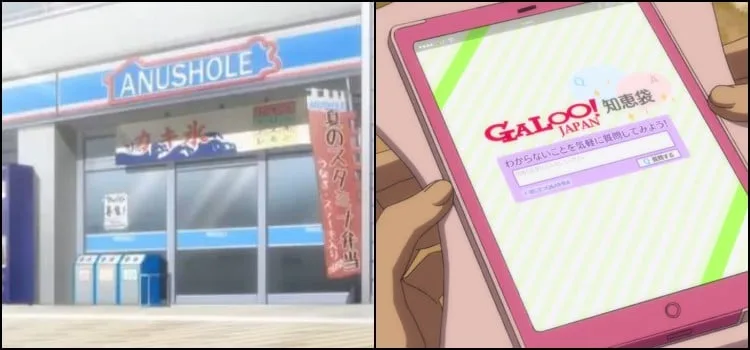
| Geegle, Goodle, Moogle | Prison School, Steins;Gate and My Hero Academia | |
| YouTube | YoTube, GodTube, MyTube | My Hero Academia, Dragon Ball Super and Inuyashiki |
| 7-Eleven | 1-One, 6/10, 8/11 | Himouto! Umaru-chan, The World God Only Knows and Haikyu!! |
| Sony | Somy, Cony, Tony | Electronics and audio gear in several series |
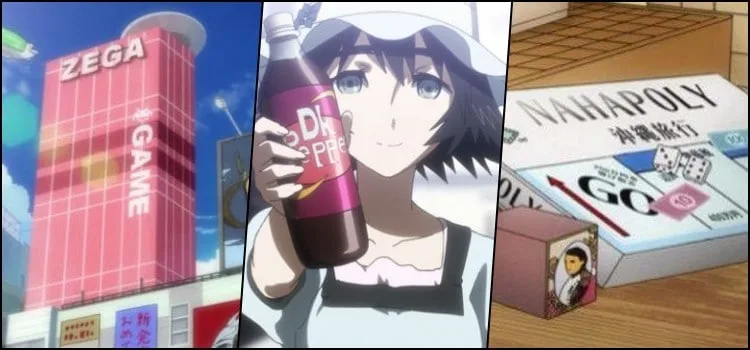
| Dr Pepper | DK Pepper, Doktor Pepper | Steins;Gate and its film |
| Nintendo | Bentendo OwEe | The game-console parody in Gintama |
WcDonald's and the long-running fast-food joke
WcDonald's became a useful shorthand because the inverted arches and altered name are understood almost immediately. It has appeared in anime and manga for decades, and The Devil Is a Part-Timer! uses the related MgRonald's name for a central workplace. In 2024, McDonald's turned the old in-joke into an official campaign with anime shorts produced by Studio Pierrot. The campaign is a neat reminder that a fictional parody and an approved collaboration can coexist in anime culture.
Small spelling changes can carry world-building
Not every altered brand is a broad joke. A search box called Goodle or a pair of Somy headphones can make a school, office or apartment feel contemporary without making the scene about the product. In science-fiction settings, the name can also become part of the invented world: A Certain Scientific Railgun uses exaggerated computer labels that blend cues from several familiar technology companies.
How to tell parody from official placement
Start with the sign or packaging. A deliberately altered word, symbol or color arrangement usually signals a fictional stand-in. An unchanged name and logo may point to ordinary depiction or an official tie-in, but the scene alone cannot explain every production decision.
Context helps too. A parody may support a punchline, a fictional corporation or a background detail. Official placement is more likely to keep the exact branding and may be accompanied by a campaign outside the show. The Pizza Hut material in Code Geass is an especially visible example of the second approach.
Why these details matter to anime fans
Brand parodies reward close watching. They turn an ordinary train station, café or bedroom into a place with its own texture, and they show how artists adapt everyday Japanese life into a fictional setting. The fun comes from recognizing the reference, then noticing what the altered name says about the series: a quick visual joke, a bit of satire, or simply a world that looks almost like ours.
For more examples of where everyday life and animation overlap, see our guide to Japanese schools and their anime versions.
Common questions
Are fake brands in anime always parodies?
No. Some are obvious spoofs, while others are original businesses that only borrow a familiar visual cue. The closer the name and design are to a real company, the easier it is for viewers to read the reference.
Why does the same brand have several fake names?
Each studio, manga artist or fictional setting can create its own version. That is why a convenience store or soft drink may have several altered names across different works.
Does an altered logo mean there was no official partnership?
Not necessarily. The altered logo only describes what appears on screen. Partnerships and licensing are separate questions, and the answer can differ from one production to another.


Community
Comments
0 comments
There are no published comments in this language yet.
Send comment