
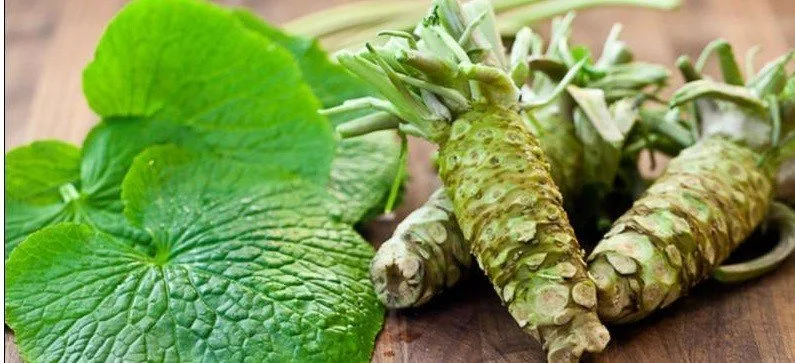
That little green mound next to sushi looks inevitable—almost a rule of Japanese cuisine. Most of the time, though, it is not the plant Japan calls wasabi (山葵). The real rhizome is rarer, greener in its own way, and much harder to grow than the horseradish paste people meet abroad.
What follows is the plant itself: where it thrives, how it entered Japanese tables, how cooks use root and leaf, and why the tube version and the freshly grated stem are not the same story.
Contents 6
What wasabi really is
Wasabi is a pungent condiment from a Japanese plant in the Brassicaceae family—the same broad family as mustard and Western horseradish. Cooks usually grind the thick stem (often called a “root”) into a paste; leaves and stems can appear in pickles and other dishes as well.
Its heat is not the slow burn of chili. Fresh wasabi hits the nose more than the tongue: sharp, green, with a short-lived punch and, when it is truly fresh, a soft sweetness afterward. That profile is why chefs treat it as a companion to raw fish rather than a random “spicy sauce.”
Why real wasabi is expensive
True wasabi likes cool, clean, running water, shade, and mountain climates. In Japan it is strongly associated with highland streams—places such as the Amagi Highlands on the Izu Peninsula, Shizuoka, and areas around Hotaka and Nagano. Traditional water fields (often layered stone and sand systems such as the Tatamiishi style in Shizuoka) keep temperature and oxygen stable without treating the plant like ordinary field crops.
Those conditions are hard to scale. Harvest takes a long time, yields stay limited, and outside Japan the living plant is still uncommon. That scarcity is the main reason restaurants and factories reach for cheaper substitutes.
A short history: medicine, dictionary, and the table
Wild Japanese horseradish seems to have been used as a medicinal plant and as a folk answer to food poisoning, which helps explain its early pairing with raw fish. Written and botanical records point to use already in the Nara period (710–794) and to later entries in botanical dictionaries of the Heian period (794–1185). Over centuries it moved from rare mountain plant to a fixed presence on sushi and sashimi plates—and into the global imagination of Japanese food.
Wasabi in the kitchen
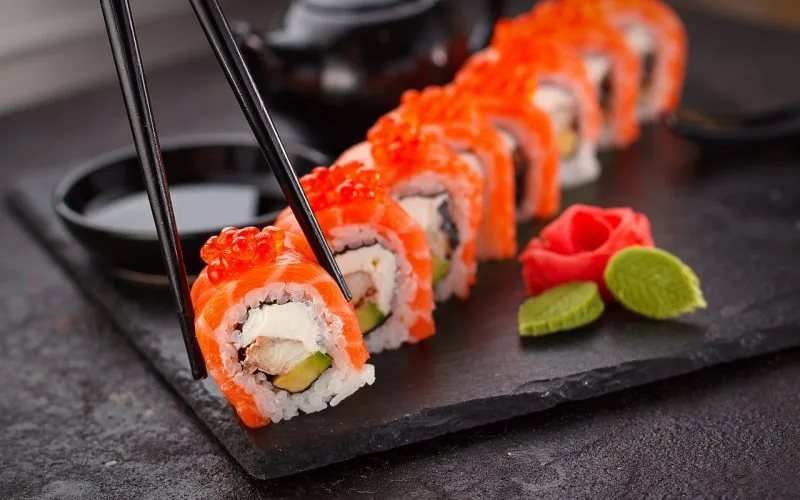
The classic role is still the best known: a thin layer with sushi and sashimi, often tucked between fish and rice so the aroma stays protected until the bite. Beyond that, wasabi turns up in ochazuke, noodle bowls, dressings, and vegetable dishes. Powdered forms season fried or roasted vegetables; leaves can be pickled (wasabizuke is a Shizuoka specialty) or eaten carefully when very fresh.
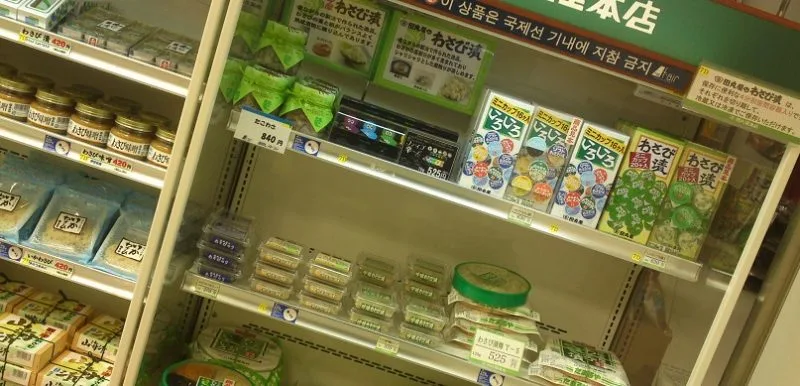
Japan also likes to invent flavors. Ice cream, soft drinks, chocolate, snacks, popcorn, peas, and peanuts “with wasabi” are easy to find—though the heat in many packaged snacks comes from horseradish-style spice rather than grated mountain rhizome.
In some restaurants, guests grate their own stem at the table so the paste is as fresh as possible. That small ceremony is less about spectacle and more about chemistry: once cells break, the volatile compounds that create the aroma begin to fade within minutes if the paste sits open.
Real wasabi or green imitation?
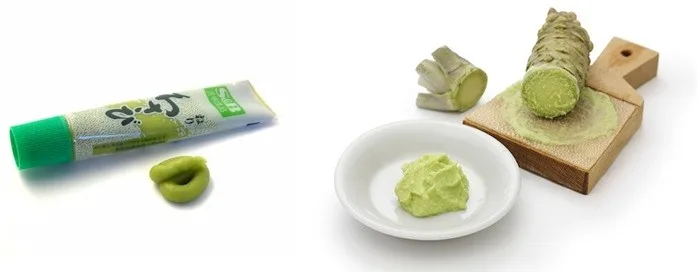
Outside high-end kitchens, the famous green paste is often a mix of Western horseradish, mustard, starch, and green color—sometimes with only a trace of real wasabi, sometimes with none. In Japan, horseradish itself is even nicknamed seiyō wasabi (西洋わさび), “Western wasabi,” which says a lot about how close the substitute feels and how different the plant still is.
Labels help when you care. Powder labeled “wasabi” may list horseradish first. Tubes and restaurant paste can be mixed for shelf life. Fresh stems stay pale green inside; the heat should lift and leave quickly, without the heavy, lingering burn many people associate with dyed horseradish.
Quick check: real wasabi is the plant Eutrema japonicum (also known as Wasabia japonica); most everyday green paste is horseradish dressed to look the part.
Fresh grating: keeping the punch
When you do get a real stem, grate only what you will eat soon—traditionally on sharkskin, today often on a fine metal grater. Keep the ungrated piece cool and covered. Mix with soy sauce only if that is how you like to eat; many sushi bars prefer wasabi under the fish so the flavor is measured, not drowned.
Wasabi will not turn every meal into a farm visit in Shizuoka. Knowing what the green mound usually is—and what the mountain plant actually tastes like—already changes how you read a sushi plate, a snack package, and a menu that quietly promises the real thing.

Community
Comments
0 comments
There are no published comments in this language yet.
Send comment