
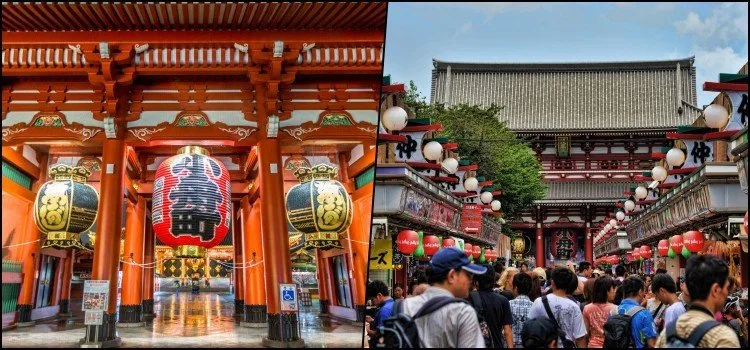
Sensō-ji (浅草寺), located in the Asakusa district of Tokyo, is the city's oldest Buddhist temple. Dedicated to the bodhisattva Kannon (Avalokiteśvara), often called Asakusa Kannon, it remains a place of devotion and, according to the temple, draws around 30 million visitors a year.
The origin of the temple goes back to a legend from 628. Two fisherman brothers, Hinokuma Hamanari and Takenari, reportedly pulled a statue of Kannon from the Sumida River. The village headman Haji no Nakatomo recognized the spiritual importance of the find and converted his home into a small temple. In 645 the priest Shōkai established Sensō-ji on the present site. The principal image has remained hidden from view ever since.
Contents 12
The history of Sensō-ji and its cultural relevance
The history of Sensō-ji stretches more than 1,300 years: from the founding through fires and war to the postwar reconstruction.
From foundation to current relevance
Sensō-ji was built to honor Kannon, the bodhisattva of compassion, one of the most widely revered figures in Japanese Buddhism. During the Edo period (1603-1868), the temple established itself as a spiritual and cultural center, attracting both devotees and travelers. Tokugawa Ieyasu designated it in 1590 as a prayer temple of the shogunate.
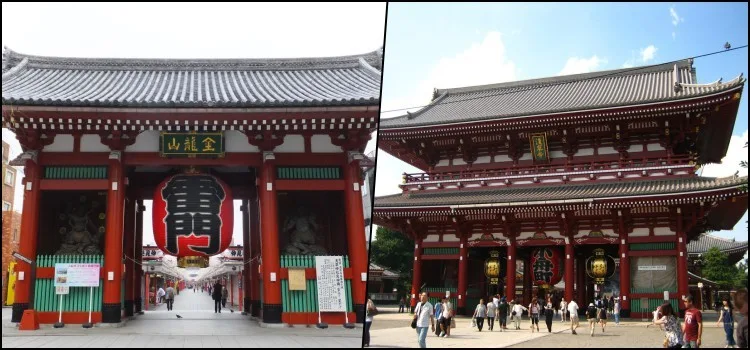
After the air raids of March 1945, the Main Hall was rebuilt in 1958 in reinforced concrete, keeping the outer form of the older buildings. Kaminarimon followed in 1960, Hōzōmon in 1964, and the five-story pagoda in 1973.
Architecture and art of the temple
The entrance to Sensō-ji is marked by the Kaminarimon (Thunder Gate), with its huge red lantern, one of the most photographed spots in Tokyo. After crossing the Hōzōmon gate, visitors reach the temple's main hall, rebuilt in traditional Japanese style. The complex also houses a five-story pagoda, several worship halls, and sacred statues.
Connection to Shintoism
Right next to the Buddhist Main Hall stands Asakusa-jinja. Tokugawa Iemitsu had the shrine built in 1649. It honors the three founding figures of Sensō-ji. This side-by-side layout is how Buddhism and Shinto are lived in Asakusa.
Experiencing Sensō-ji: rituals and traditional practices
A visit to Sensō-ji is an immersion in traditional rituals and spiritual practices that delight both devotees and tourists.
Purification ritual
Right at the entrance to the temple you will find a large incense cauldron. Waving the smoke over yourself is considered a purifying act that brings luck and health. Another ritual is temizu: at a sacred fountain, visitors wash their hands and mouth to cleanse themselves before entering the main hall.
Prayer and offering
At the main altar, visitors can perform omairi, the usual prayer at the temple. It is common to toss a coin into the offering box, bow, and place the palms together (gasshō). The temple recommends the formula Namu Kanzeon Bosatsu, "I place my trust in Bodhisattva Kannon." Clapping belongs to the gesture at Asakusa Shrine. You can also consult your fortune through omikuji, a paper oracle that can be tied at the temple if the prediction is unfavorable.
Festivals and events
The largest festival in Asakusa is Sanja Matsuri in May, on the third weekend. It is the festival of Asakusa Shrine and honors the three founders of Sensō-ji. Colorful mikoshi processions and traditional dances then fill the streets of Asakusa. Through the year the temple itself adds Hatsumōde, Setsubun, the Hōzuki Market in July and the Hagoita Market in December.
Nakamise-dōri and the surroundings of Sensō-ji
Beyond its spiritual importance, Sensō-ji is surrounded by attractions that enrich the experience of any visit.
The Nakamise-dōri shopping street
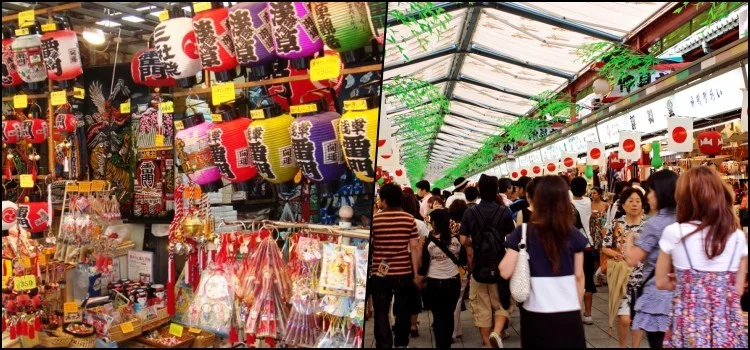
The street Nakamise-dōri, connecting the Kaminarimon gate to the temple, is lined with about 89 traditional shops selling souvenirs, typical sweets, and Japanese crafts. At 250 meters long, it is the perfect place to pick up a kimono, a folding fan, or to try delights like ningyō-yaki, small cakes filled with sweet bean paste.
Nearby attractions
Sensō-ji is strategically located in Asakusa, close to other iconic landmarks:
- Tokyo Skytree: the tallest tower in Japan, a few minutes east on the Sumida, with impressive panoramic views.
- Sumida River: ideal for boat rides or relaxing walks along the bank.
- Ueno Park: a historic site with museums, a zoo, and beautiful scenery, especially during cherry blossom season.
Gardens and smaller temples
Around Sensō-ji you will find gardens, smaller halls, and historical monuments. The garden of Dembō-in sits behind the complex and stays quieter than Nakamise-dōri.
The axis from Kaminarimon along Nakamise-dōri to the Main Hall is the same path Edo pilgrims already walked. Beside it stands Asakusa Shrine, whose festival honors the temple's founders. Anyone who visits Sensō-ji sees devotion, trade and neighborhood on a few hundred meters.

Community
Comments
0 comments
There are no published comments in this language yet.
Send comment